







Question: Chapter 5 Risk Assessment: Internal Control Evaluation 219 5.72 Authorization of Credit Tests of Controls - Using IDEA For this exercise, your cli- ent, Bright
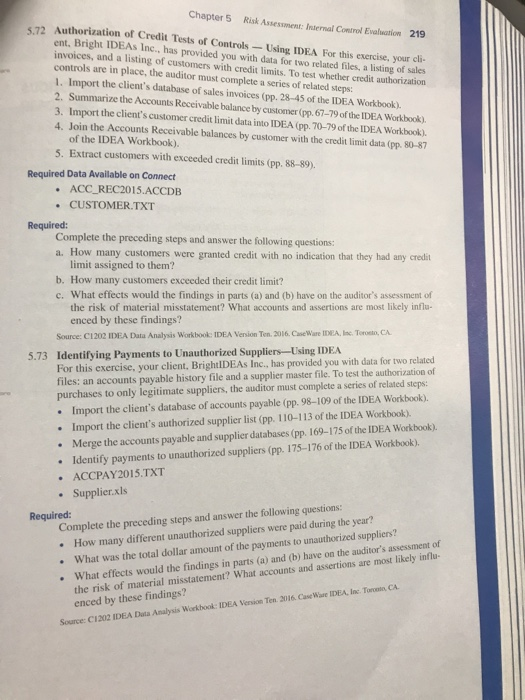
Chapter 5 Risk Assessment: Internal Control Evaluation 219 5.72 Authorization of Credit Tests of Controls - Using IDEA For this exercise, your cli- ent, Bright IDEAs Inc., has provided you with data for two related files, a listing of sales invoices, and a listing of customers with credit limits. To test whether credit authorization controls are in place, the auditor must complete a series of related steps: 1. Import the client's database of sales invoices (pp. 28-45 of the IDEA Workbook) 2. Summarize the Accounts Receivable balance by customer (pp. 67-79 of the IDEA Workbook). 3. Import the client's customer credit limit data into IDEA (pp. 70-79 of the IDEA Workbook). 4. Join the Accounts Receivable balances by customer with the credit limit data (pp. 80-87 of the IDEA Workbook). 5. Extract customers with exceeded credit limits (pp. 88-89). Required Data Available on Connect ACC_REC2015.ACCDB CUSTOMER.TXT Required: Complete the preceding steps and answer the following questions: a. How many customers were granted credit with no indication that they had any credit limit assigned to them? b. How many customers exceeded their credit limit? c. What effects would the findings in parts (a) and (b) have on the auditor's assessment of the risk of material misstatement? What accounts and assertions are most likely influ- enced by these findings? Source: CI202 IDEA Data Analysis Workbook: IDEA Version Ten.2016. Case Ware DEA, Inc. Toronto, CA 5.73 Identifying Payments to Unauthorized Suppliers-Using IDEA For this exercise, your client, BrightIDEAs Inc., has provided you with data for two related files: an accounts payable history file and a supplier master file. To test the authorization of purchases to only legitimate suppliers, the auditor must complete a series of related steps: Import the client's database of accounts payable (pp. 98-109 of the IDEA Workbook). Import the client's authorized supplier list (pp. 110-113 of the IDEA Workbook). Merge the accounts payable and supplier databases (pp. 169-175 of the IDEA Workbook). Identify payments to unauthorized suppliers (pp. 175-176 of the IDEA Workbook). ACCPAY 2015.TXT Supplier.xls Required: Complete the preceding steps and answer the following questions: How many different unauthorized suppliers were paid during the year? What was the total dollar amount of the payments to unauthorized suppliers? What effects would the findings in parts (a) and (b) have on the auditor's assessment of the risk of material misstatement? What accounts and assertions are most likely influ- enced by these findings? Source: C1202 IDEA Data Analysis Workbook: IDEA Version Ten 2016. Case IDEA, Inc. Tom. CA Chapter 5 Risk Assessment: Internal Control Evaluation 219 5.72 Authorization of Credit Tests of Controls - Using IDEA For this exercise, your cli- ent, Bright IDEAs Inc., has provided you with data for two related files, a listing of sales invoices, and a listing of customers with credit limits. To test whether credit authorization controls are in place, the auditor must complete a series of related steps: 1. Import the client's database of sales invoices (pp. 28-45 of the IDEA Workbook) 2. Summarize the Accounts Receivable balance by customer (pp. 67-79 of the IDEA Workbook). 3. Import the client's customer credit limit data into IDEA (pp. 70-79 of the IDEA Workbook). 4. Join the Accounts Receivable balances by customer with the credit limit data (pp. 80-87 of the IDEA Workbook). 5. Extract customers with exceeded credit limits (pp. 88-89). Required Data Available on Connect ACC_REC2015.ACCDB CUSTOMER.TXT Required: Complete the preceding steps and answer the following questions: a. How many customers were granted credit with no indication that they had any credit limit assigned to them? b. How many customers exceeded their credit limit? c. What effects would the findings in parts (a) and (b) have on the auditor's assessment of the risk of material misstatement? What accounts and assertions are most likely influ- enced by these findings? Source: CI202 IDEA Data Analysis Workbook: IDEA Version Ten.2016. Case Ware DEA, Inc. Toronto, CA 5.73 Identifying Payments to Unauthorized Suppliers-Using IDEA For this exercise, your client, BrightIDEAs Inc., has provided you with data for two related files: an accounts payable history file and a supplier master file. To test the authorization of purchases to only legitimate suppliers, the auditor must complete a series of related steps: Import the client's database of accounts payable (pp. 98-109 of the IDEA Workbook). Import the client's authorized supplier list (pp. 110-113 of the IDEA Workbook). Merge the accounts payable and supplier databases (pp. 169-175 of the IDEA Workbook). Identify payments to unauthorized suppliers (pp. 175-176 of the IDEA Workbook). ACCPAY 2015.TXT Supplier.xls Required: Complete the preceding steps and answer the following questions: How many different unauthorized suppliers were paid during the year? What was the total dollar amount of the payments to unauthorized suppliers? What effects would the findings in parts (a) and (b) have on the auditor's assessment of the risk of material misstatement? What accounts and assertions are most likely influ- enced by these findings? Source: C1202 IDEA Data Analysis Workbook: IDEA Version Ten 2016. Case IDEA, Inc. Tom. CA
Step by Step Solution
There are 3 Steps involved in it

Get step-by-step solutions from verified subject matter experts
 Study Help