







Question: CHAPTER 6 CASE EXERGISE Centralized Purchasing, Discounts, and the No - Tipsy Bar Stool The Simpson Production Company ( known as Simp Co for short
CHAPTER CASE EXERGISE
Centralized Purchasing, Discounts, and the NoTipsy Bar Stool
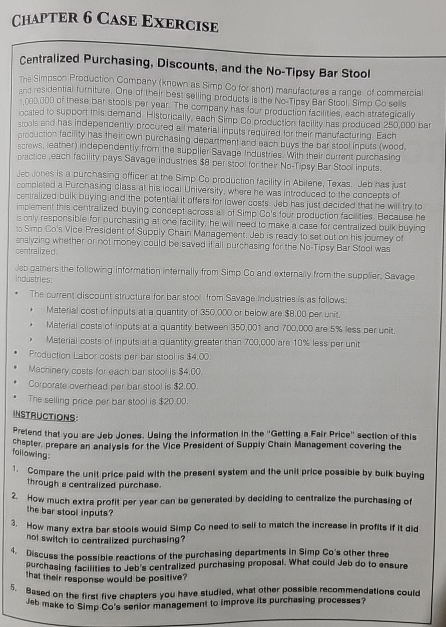
The Simpson Production Company known as Simp Co for short manufactures a range of commercial and residentia furniture. One of their best seilling products is the NoTipsy Ear Stool. Simp Co sells t of these bar stools per year. The company has four production facilities, each strategically iocated to support this demand. Historically, each Simp Co production facility has produced DD bar stoals and has indepencently procured all material inputs required for their manufacturing. Each procuction fecility has their Cwn purchasing deparment and each buys the bar stool inputs wood screws, leather independently from the supoller Sqvage Industries. With their current purchasing pracice, each facility pays Savage industries $ per $ foo for their NoTpsy Bar Stool inputs.
Jeb Jones is a purchasing officer at the Smp Co production facility in Abilene, Texas. Jeb has just completed a Furchasing class at his lecal Uriversity, where he was introduced to the concepts of centralized bulk buying and the potential it offers for lower costs. Jeb has just decided that he will try to imperment this centra lized buying concept scross a of Simp Co's lour production facilties. Because he ia only responsible for purchasing at one facility, he wil need to make a case for centralized bulk buying io Simp Co's Vice President of Supply Chain Management. Jeb is ready to set out on his joumey of anayzing whether or not money could be saved if all purchasing for the NoTipsy Bar Stool was centrailized.
Jab gathers the following information internally from Simp Co and externaly from the suppliar, Ssvage hodustries:
The current discount structure for bar stoo trom Savage industries is as follows:
Material cost of inputs at a quantity of or below are $ per unit.
Material costs of inputs at a quantity between and are less per unit.
Meterial costs of inputs at a quantity greater than are less per unit
Production Labor cosis per bar stool is $
Macninery costs for eacin bar stoo is $
Corporate overhead per bar stool is $
Tre selling price per bar stool is $
WSTRUCTIONS:
Preiend that you are Jeb Jones. Using the information in the "Getting a Fair Price" section of this chapter, prepare an analysis for the Vice President of Supply Chain Management covering the following:
Compare the unit price pald with the present system and the unit price possibie by bulk buying through a centralized purchase.
How much extra protit per year can be generated by deciding to centralize the purchasing of the bar stool inputs?
How many extra bar stools wouid simp Co need to sell to match the increase in profits if it did not switch to centralized purchasing?
Discuss the possible reactions of the purchasing departments in Simp Co's other three purchasing facilities to jeb's centralized purchasing proposal. What could Jeb do to onsure that their response would be positive?
Based on the first five chapters you have studied, what other possible recommendations could Jeb make to Simp Co's senior management to improve its purchasing processes?
Step by Step Solution
There are 3 Steps involved in it
1 Expert Approved Answer
Step: 1 Unlock

Question Has Been Solved by an Expert!
Get step-by-step solutions from verified subject matter experts
Step: 2 Unlock
Step: 3 Unlock
 Study Help