







Question: Chapter 6: FIXED BLUR Question 1 {1 point] / Saved Consider the following news headline: Canadian business leaders fear reduced world demand for commodities. 1v'v'hich
Chapter 6: FIXED BLUR
![Chapter 6: FIXED BLUR Question 1 {1 point] / Saved Consider the](https://s3.amazonaws.com/si.experts.images/answers/2024/07/6685951533bf7_48566859515123da.jpg)
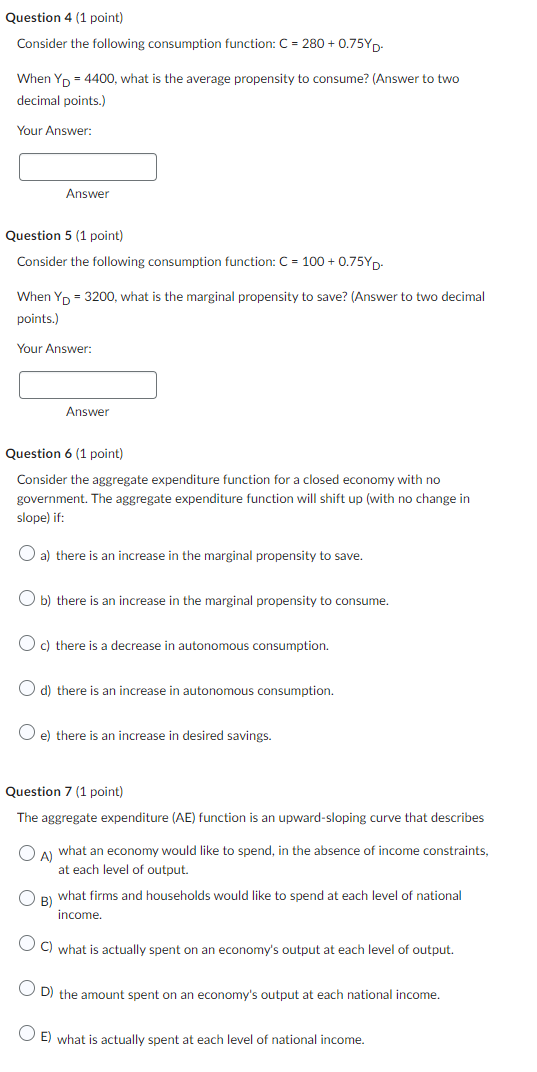
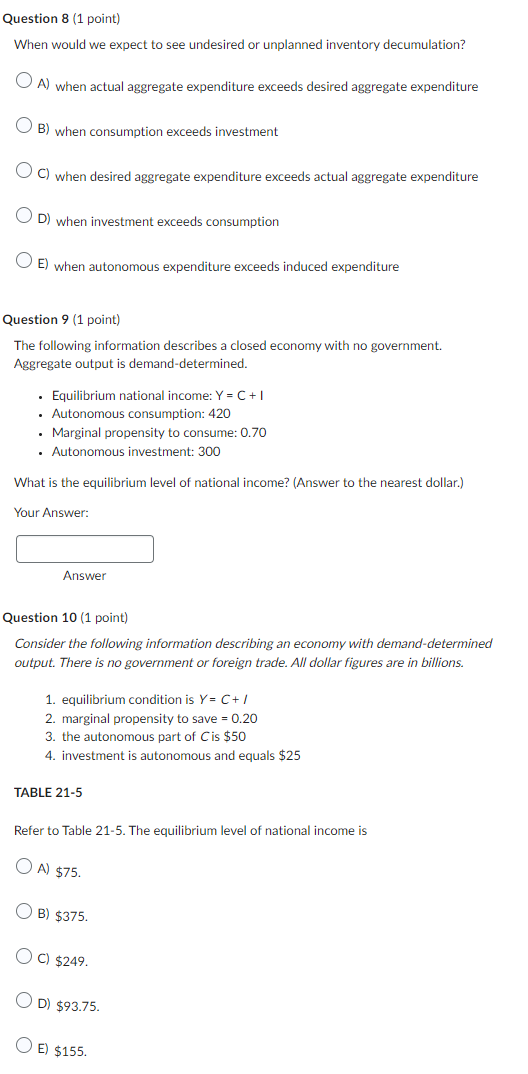
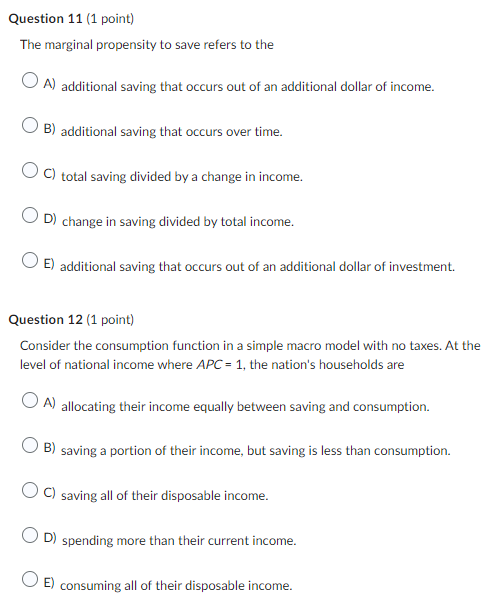
Question 1 {1 point] / Saved Consider the following news headline: "Canadian business leaders fear reduced world demand for commodities". 1v'v'hich of the following correctlv describes the likelv effect in our simple macro model? N The IKE function shifts downward. O B} The AE function shifts upward. 0 Cl The consumption function shifts upward. O D} The savings function shifts downward. O E} The investment function shifts upward. Question 2 {1 point] v\" Saved In a simple macro model with the price level assumed to be constant. a change in firms' level of desired investment is predicted to influence equilibrium national income bv 0 All shifting the saving function. 0 B} shifting the consumption function. 0 Cl shifting the 45-degree line. 0 D} causing movement along the investment function. E} shifting the aggregate expenditure function. Question 3 {1 point] In a simple macroeconomic model. with no government or foreign trade. if desired aggregate expenditure were less than actual national income, then: 0 a] inventories and national income are in equilibrium. 0 b] inventories begin to fall. leading to a fall in national income. 0 c] inventories begin to rise. leading to a rise in national income. 0 d] inventories begin to fall. leading to a rise in national income. 0 e} inventories begin to rise. leading to a fall in national income. Question 4 (1 point) Consider the following consumption function: C = 280 + 0.75Yp- When Yo = 4400, what is the average propensity to consume? (Answer to two decimal points.) Your Answer: Answer Question 5 (1 point) Consider the following consumption function: C = 100 + 0.75YD- When Yo = 3200, what is the marginal propensity to save? (Answer to two decimal points.) Your Answer: Answer Question 6 (1 point) Consider the aggregate expenditure function for a closed economy with no government. The aggregate expenditure function will shift up (with no change in slope) if: O a) there is an increase in the marginal propensity to save. O b) there is an increase in the marginal propensity to consume. O c) there is a decrease in autonomous consumption. O d) there is an increase in autonomous consumption. O e) there is an increase in desired savings. Question 7 (1 point) The aggregate expenditure (AE) function is an upward-sloping curve that describes O A) what an economy would like to spend, in the absence of income constraints, at each level of output. O B) what firms and households would like to spend at each level of national income. O C) what is actually spent on an economy's output at each level of output. O D) the amount spent on an economy's output at each national income. O E) what is actually spent at each level of national income.Question 8 (1 point) When would we expect to see undesired or unplanned inventory decumulati O A) when actual aggregate expenditure exceeds desired aggregate expenditure O B) when consumption exceeds investment O C) when desired aggregate expenditure exceeds actual aggregate expenditure O D) when investment exceeds consumption O E) when autonomous expenditure exceeds induced expenditure Question 9 (1 point) The following information describes a closed economy with no government. Aggregate output is demand-determined. . Equilibrium national income: Y = C + | . Autonomous consumption: 420 . Marginal propensity to consume: 0.70 . Autonomous investment: 300 What is the equilibrium level of national income? (Answer to the nearest dollar.) Your Answer: Answer Question 10 (1 point) Consider the following information describing an economy with demand-determined output. There is no government or foreign trade. All dollar figures are in billions. 1. equilibrium condition is Y = C+ / 2. marginal propensity to save = 0.20 3. the autonomous part of Cis $50 4. investment is autonomous and equals $25 TABLE 21-5 Refer to Table 21-5. The equilibrium level of national income is O A) $75. O B) $375. O C) $249. O D) $93.75. O E) $155.Question 11 (1 point) The marginal propensity to save refers to the O A) additional saving that occurs out of an additional dollar of income. O B) additional saving that occurs over time. O C) total saving divided by a change in income. O D) change in saving divided by total income. E) additional saving that occurs out of an additional dollar of investment. Question 12 (1 point) Consider the consumption function in a simple macro model with no taxes. At the level of national income where APC = 1, the nation's households are O A) allocating their income equally between saving and consumption. ( B) saving a portion of their income, but saving is less than consumption. O C) saving all of their disposable income. O D) spending more than their current income. O E) consuming all of their disposable income
Step by Step Solution
There are 3 Steps involved in it

Get step-by-step solutions from verified subject matter experts
 Study Help