







Question: Chapter 7: Applying Excel: Exercise (a) What is the net operating income (loss) in Year 1 under absorption costing? (b) What is the net operating
Chapter 7: Applying Excel: Exercise
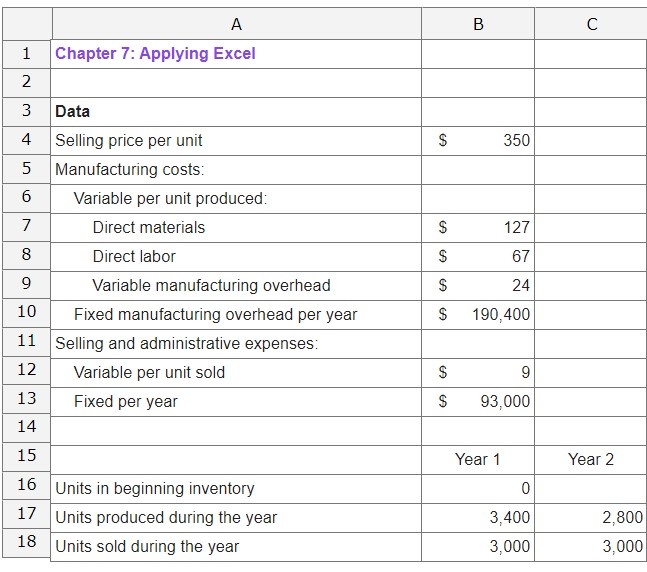
(a) What is the net operating income (loss) in Year 1 under absorption costing?
(b) What is the net operating income (loss) in Year 2 under absorption costing?
(c) What is the net operating income (loss) in Year 1 under variable costing?
(d) What is the net operating income (loss) in Year 2 under variable costing?
(e) The net operating income (loss) under absorption costing is less than the net operating income (loss) under variable costing in Year 2 because: (You may select more than one answer. Single click the box with the question mark to produce a check mark for a correct answer and double click the box with the question mark to empty the box for a wrong answer. Any boxes left with a question mark will be automatically graded as incorrect.)
check all that apply
- Units were left over from the previous year.unanswered
- The cost of goods sold is always less under variable costing than under absorption costing.unanswered
- Sales exceeded production so some of the fixed manufacturing overhead of the period was released from inventories under absorption costing.unanswered
3.
Make a note of the absorption costing net operating income (loss) in Year 2.
At the end of Year 1, the companys board of directors set a target for Year 2 of net operating income of $170,000 under absorption costing. If this target is met, a hefty bonus would be paid to the CEO of the company. Keeping everything else the same from part (2) above, change the units produced in Year 2 to 5,600 units.
(a) Would this change result in a bonus being paid to the CEO?
multiple choice 1
-
Yes
-
No
(b) What is the net operating income (loss) in Year 2 under absorption costing?
(c) Would this doubling of production in Year 2 be in the best interests of the company if sales are expected to continue to be 3,000 units per year?
multiple choice 2
-
Yes
-
No
A B 1 1 Chapter 7: Applying Excel N $ 350 4 5 $ 127 $ 67 3 Data 4 Selling price per unit Manufacturing costs: 6 Variable per unit produced: 7 Direct materials 8 Direct labor Variable manufacturing overhead 10 Fixed manufacturing overhead per year 11 Selling and administrative expenses: 12 Variable per unit sold 13 Fixed per year 14 8 9 $ 24 S 190,400 S 9 $ 93,000 15 Year 1 Year 2 0 16 Units in beginning inventory 17 Units produced during the year 18 Units sold during the year 3,400 3,000 2,800 3,000
Step by Step Solution
There are 3 Steps involved in it

Get step-by-step solutions from verified subject matter experts
 Study Help