



Question: CHAPTER 7) You are making a buying vs renting decision. You have the following information The house you like costs $200,000. You expect home values
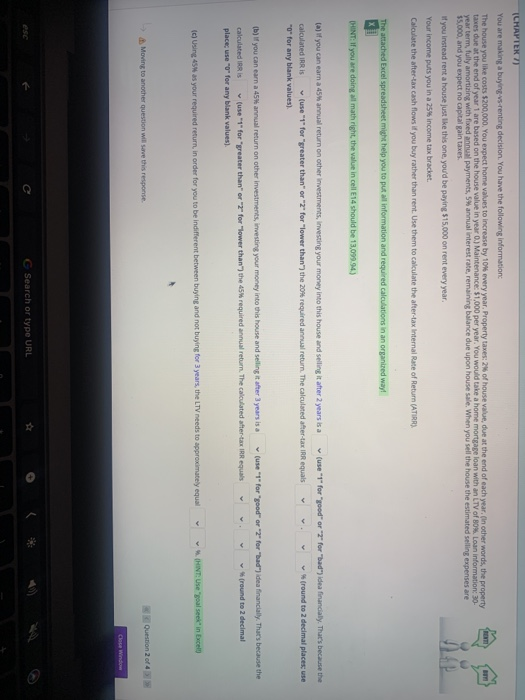
CHAPTER 7) You are making a buying vs renting decision. You have the following information The house you like costs $200,000. You expect home values to increase by 10% every year. Property taxes: 2% of house value, due at the end of each year. (In other words, the property taxes due at the end of year 1 are based on the house value in year o.) Maintenance $1,000 per year. You would take a home mortgage loan with an TV of 80% Loan Information: 30 year term, fully amortizing with fixed annual payments, 5% annual interest rate, remaining balance due upon house sale. When you sell the house the estimated selling expenses are $5,000, and you expect no capital gain taxes. if you instead rent a house just like this one, you'd be paying $15,000 on rent every year. Your income puts you in a 25% income tax bracket. Calculate the after-tax cash flows if you buy rather than rent. Use them to calculate the after-tax Internal Rate of Return (ATIRR). The attached Excel spreadsheet might help you to put all information and required calculations in an organized way! HINT: If you are doing all math right, the value in cell E14 should be 13,099.94) (a) if you can earn a 45% annual return on other investments, Investing your money into this house and selling it after 2 years is a (use "1" for "good" or "2" for "bad") idea financialy. That's because the calculated IRRIS (use "1" for "greater than" or "2" for "lower than the 20% required annual return. The calculated after-tax IRR equals (round to 2 decimal places, use "0" for any blank values) (h) if you can earn a 45 annual return on other investments, investing your money into this house and selling it after 3 years is a (use "1" for "good" or "2" for "bad") idea financially. That's because the calculated IRIS use "1" for greater than" or "" for "lower than the 45% required annual return. The calculated after tax RR equals (round to 2 decimal place, use" for any blank values). Using 45 as your required return, in order for you to be indifferent between buying and not buying for 3 years, the LTV needs to approximately equal HINT: Use goal seek'in Excel Moving to another question will save this response Question 2 of 4 Close Window G Search or type URL CHAPTER 7) You are making a buying vs renting decision. You have the following information The house you like costs $200,000. You expect home values to increase by 10% every year. Property taxes: 2% of house value, due at the end of each year. (In other words, the property taxes due at the end of year 1 are based on the house value in year o.) Maintenance $1,000 per year. You would take a home mortgage loan with an TV of 80% Loan Information: 30 year term, fully amortizing with fixed annual payments, 5% annual interest rate, remaining balance due upon house sale. When you sell the house the estimated selling expenses are $5,000, and you expect no capital gain taxes. if you instead rent a house just like this one, you'd be paying $15,000 on rent every year. Your income puts you in a 25% income tax bracket. Calculate the after-tax cash flows if you buy rather than rent. Use them to calculate the after-tax Internal Rate of Return (ATIRR). The attached Excel spreadsheet might help you to put all information and required calculations in an organized way! HINT: If you are doing all math right, the value in cell E14 should be 13,099.94) (a) if you can earn a 45% annual return on other investments, Investing your money into this house and selling it after 2 years is a (use "1" for "good" or "2" for "bad") idea financialy. That's because the calculated IRRIS (use "1" for "greater than" or "2" for "lower than the 20% required annual return. The calculated after-tax IRR equals (round to 2 decimal places, use "0" for any blank values) (h) if you can earn a 45 annual return on other investments, investing your money into this house and selling it after 3 years is a (use "1" for "good" or "2" for "bad") idea financially. That's because the calculated IRIS use "1" for greater than" or "" for "lower than the 45% required annual return. The calculated after tax RR equals (round to 2 decimal place, use" for any blank values). Using 45 as your required return, in order for you to be indifferent between buying and not buying for 3 years, the LTV needs to approximately equal HINT: Use goal seek'in Excel Moving to another question will save this response Question 2 of 4 Close Window G Search or type URL
Step by Step Solution
There are 3 Steps involved in it

Get step-by-step solutions from verified subject matter experts