Question: Chapter 8 Discussion Read the Reality Check (in Chapter 8) - Snapchat: When Is a Companys Product Responsible for Causing Injuries? on (pg. 388) in
Chapter 8 Discussion
Read the Reality Check (in Chapter 8) - Snapchat: When Is a Companys Product Responsible for Causing Injuries? on (pg. 388) in your text carefully prior to posting to this forum.
In your first post (20 points) DUE JULY 2nd at MIDNIGHT- answer the following questions:
1) What liability if any, should Snapchat have for the damages caused by this accident? No one denies that the driver bears primary responsibility, but did Snapchat also contribute to the harms caused?
2) What uses could Snapchat have reasonably foreseen for this speed filter? What could Snapchat reasonably be expected to know about the users of the product?
3) Was the advice contained in the terms of service sufficient warning to protect Snapchat from any minor misuse of its product?
4) Do you think that the speed filter is a dangerous product? Was Snapchat negligent in marketing this product?
Format: Response to each question should be 1 long paragraph each. A paragraph should have a minimum of 6+ well written sentences. On your first post you must create a new thread. You will not be able to read/view your student colleagues' posts until you have posted your own.
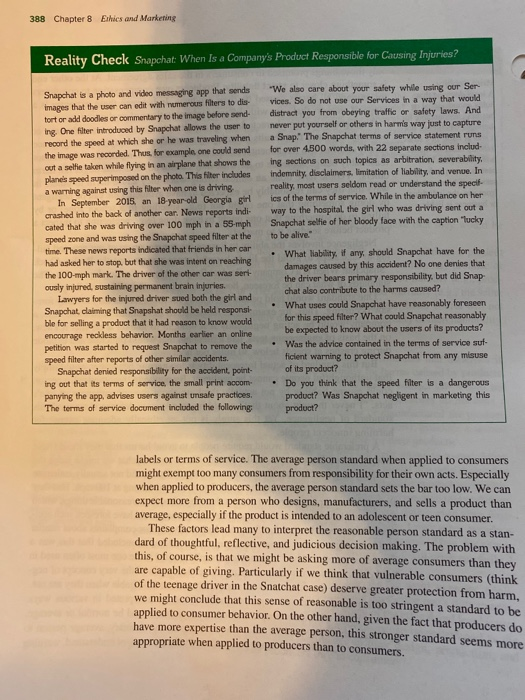
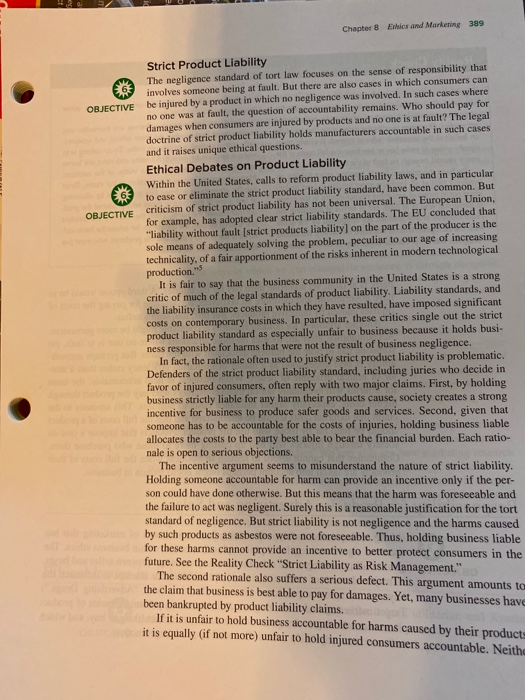
388 Chapter 8 Ethics and Marketing Reality Check Snapchat: When Is a Company's Product Responsible for Causing Injuries? Snapchat is a photo and video messaging app that sends images that the user can edit with numerous filters to dis- tort or add doodles or commentary to the image before send- ing. One filter introduced by Snapchat allows the user to record the speed at which she or he was traveling when the image was recorded. Thus, for example, one could send out a selfie taken while flying in an airplane that shows the plane's speed superimposed on the photo. This filter includes a warning against using this filter when one is driving In September 2015. an 18-year-old Georgia girl crashed into the back of another car. News reports indi- cated that she was driving over 100 mph in a 55-mph speed zone and was using the Snapchat speed filter at the time. These news reports indicated that friends in her car had asked her to stop, but that she was intent on reaching the 100 mph mark. The driver of the other car was sert ously injured, sustaining permanent brain injuries. Lawyers for the injured driver sued both the girl and Snapchat, claiming that Snapshat should be held responsi ble for selling a product that it had reason to know would encourage reckless behavior. Months earlier an online petition was started to request Snapchat to remove the speed filter after reports of other similar accidents. Snapchat denied responsibility for the accident, point- ing out that its terms of service, the small print accom panying the app, advises users against unsafe practices The terms of service document included the following "We also care about your safety while using our Ser vices. So do not use our Services in a way that would distract you from obeying traffic or safety laws. And never put yourself or others in harm's way just to capture a Snap." The Snapchat terms of service statement runs for over 4.500 words, with 22 separate sections include ing sections on such topics as arbitration, severability. indemnity, disclaimers, limitation of liability, and venue. In reality, most users seldom read or understand the specif- ics of the terms of service. While in the ambulance on her way to the hospital, the girl who was driving sent out a Snapchat selfie of her bloody face with the caption "lucky to be alive What liability, if any, should Snapchat have for the damages caused by this accident? No one denies that the driver bears primary responsibility, but did Snap chat also contribute to the harms caused? What uses could Snapchat have reasonably foreseen for this speed filter? What could Snapchat reasonably be expected to know about the users of its products? Was the advice contained in the terms of service suf- ficient warning to protect Snapchat from any misuse of its product? Do you think that the speed filter is a dangerous product? Was Snapchat negligent in marketing this product? . labels or terms of service. The average person standard when applied to consumers might exempt too many consumers from responsibility for their own acts. Especially when applied to producers, the average person standard sets the bar too low. We can expect more from a person who designs, manufacturers, and sells a product than average, especially if the product is intended to an adolescent or teen consumer. These factors lead many to interpret the reasonable person standard as a stan- dard of thoughtful, reflective, and judicious decision making. The problem with this, of course, is that we might be asking more of average consumers than they are capable of giving. Particularly if we think that vulnerable consumers (think of the teenage driver in the Snatchat case) deserve greater protection from harm, we might conclude that this sense of reasonable is too stringent a standard to be applied to consumer behavior. On the other hand, given the fact that producers do have more expertise than the average person, this stronger standard seems more appropriate when applied to producers than to consumers. Chapter 8 Ethics and Markering 389 Strict Product Liability The negligence standard of tort law focuses on the sense of responsibility that involves someone being at fault. But there are also cases in which consumers can OBJECTIVE be injured by a product in which no negligence was involved. In such cases where no one was at fault, the question of accountability remains. Who should pay for damages when consumers are injured by products and no one is at fault? The legal doctrine of strict product liability holds manufacturers accountable in such cases and it raises unique ethical questions. Ethical Debates on Product Liability Within the United States, calls to reform product liability laws, and in particular GE to ease or eliminate the strict product liability standard, have been common. But OBJECTIVE criticism of strict product liability has not been universal. The European Union, for example, has adopted clear strict liability standards. The EU concluded that "liability without fault (strict products liability on the part of the producer is the sole means of adequately solving the problem, peculiar to our age of increasing technicality, of a fair apportionment of the risks inherent in modern technological production." It is fair to say that the business community in the United States is a strong critic of much of the legal standards of product liability. Liability standards, and the liability insurance costs in which they have resulted, have imposed significant costs on contemporary business. In particular, these critics single out the strict product liability standard as especially unfair to business because it holds busi- ness responsible for harms that were not the result of business negligence. In fact, the rationale often used to justify strict product liability is problematic. Defenders of the strict product liability standard, including juries who decide in favor of injured consumers, often reply with two major claims. First, by holding business strictly liable for any harm their products cause, society creates a strong incentive for business to produce safer goods and services. Second, given that someone has to be accountable for the costs of injuries, holding business liable allocates the costs to the party best able to bear the financial burden. Each ratio nale is open to serious objections. The incentive argument seems to misunderstand the nature of strict liability. Holding someone accountable for harm can provide an incentive only if the per- son could have done otherwise. But this means that the harm was foreseeable and the failure to act was negligent. Surely this is a reasonable justification for the tort standard of negligence. But strict liability is not negligence and the harms caused by such products as asbestos were not foreseeable. Thus, holding business liable for these harms cannot provide an incentive to better protect consumers in the future. See the Reality Check "Strict Liability as Risk Management." The second rationale also suffers a serious defect. This argument amounts to been bankrupted by product liability claims. the claim that business is best able to pay for damages. Yet, many businesses have If it is unfair to hold business accountable for harms caused by their products it is equally (if not more) unfair to hold injured consumers accountable. Neithe









 Study Help