







Question: Chapter 8 Lab More Classes and Objects Lab Objectives Be able to write a copy constructor Be able to write equals and toString methods Be
Chapter 8 Lab More Classes and Objects Lab Objectives Be able to write a copy constructor Be able to write equals and toString methods Be able to use objects made up of other objects (Aggregation) Be able to write methods that pass and return objects Introduction Examine the UML diagram that follows. Notice that the instance fields in the CreditCard class are other types of objects, a Person object or a Money object. We can say that the CreditCard has a Person, and the Person object has a Address object as one of its instance fields.
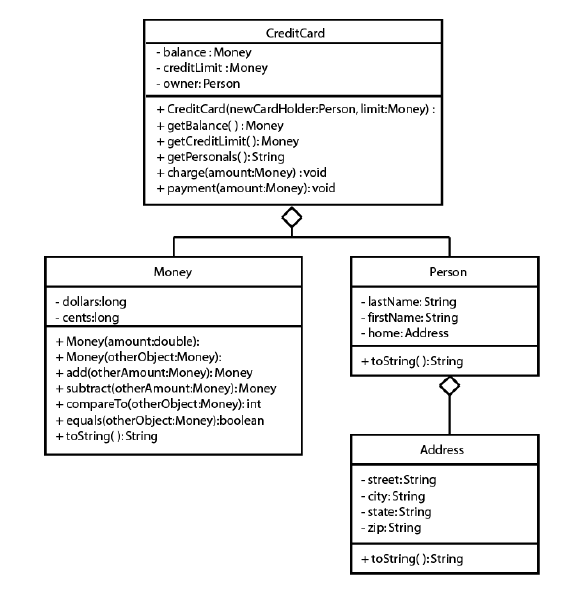 Task #1 Writing a Copy Constructor 1. Copy the files Address.java, Person.java, Money.java , MoneyDriver.java, and CreditCardDemo.java into your NetBeans or other IDE tool. Address.java, Person.java, MoneyDemo.java, and CreditCardDemo.java are complete and will not need to be modified. We will start by modifying Money.java. 2. Overload the constructor. The constructor that you will write will be a copy constructor. It should use the parameter money object to make a duplicate money object, by copying the value of each instance variable from the parameter object to the instance variable of the new object. Task #2 Writing equals and toString methods 1. Write and document an equals method. The method compares the instance variables of the calling object with instance variables of the parameter object for equality and returns true if the dollars and the cents of the calling object are the same as the dollars and the cents of the parameter object. Otherwise, it returns false. 2. Write and document a toString method. This method will return a String that looks like money, including the dollar sign. Remember that if you have less than 10 cents, you will need to put a 0 before printing the cents so that it appears correctly with 2 decimal places. 3. Compile, debug, and test by running the MoneyDriver.java driver program. You should get the output: The current amount is $500.00 Adding $10.02 gives $510.02 Subtracting $10.88 gives $499.14 $10.02 equals $10.02 $10.88 does not equal $10.02 Task #3 Passing and Returning Objects 1. Create a CreditCard class according to the UML Diagram on the back. It should have data fields that include an owner of type Person, a balance of type Money, and a creditLimit of type Money. 2. It should have a constructor that has two parameters, a Person to initialize the owner and a Money value to initialize the creditLimit. The balance can be initialized to a Money value of zero. Remember you are passing in objects (pass by reference), so you have passed in the address to an object. If you want your CreditCard to have its own creditLimit and balance, you should create a new object of each using the copy constructor in the Money class. 3. It should have accessor methods to get the balance and the available credit. Since these are objects (pass by reference), we dont want to create an insecure credit card by passing out addresses to components in our credit card, so we must return a new object with the same values. Again, use the copy constructor to create a new object of type money that can be returned. 4. It should have an accessor method to get the information about the owner, but in the form of a String that can be printed out. This can be done by calling the toString method for the owner (who is a Person). 5. It should have a method that will charge to the credit card by adding the amount of Money in the parameter to the balance if it will not exceed the credit limit. If the credit limit will be exceeded, the amount should not be added, and an error message can be printed to the console. 6. It should have a method that will make a payment on the credit card by subtracting the amount of Money in the parameter from the balance. 7. Compile, debug, and test it out completely by running CreditCardDemo.java. You should get the output: Diane Christie, 237J Harvey Hall, Menomonie, WI 54751 Balance: $0.00 Credit Limit: $1000.00 Attempt to charge $200.00 Charge: $200.00 Balance: $200.00 Attempt to charge $10.02 Charge: $10.02 Balance: $210.02 Attempt to pay $25.00 Payment: $25.00 Balance: $185.02 Attempt to charge $990.00 Exceeds credit limit Balance: $185.02
Address.java
/**Defines an address using a street, city, state, and zipcode*/ public class Address { /**The street number and street name*/ private String street; /**The city in which the address is located*/ private String city; /**The state in which the address is located*/ private String state; /**The zip code associated with that city and street*/ private String zip;
/**Constructor creates an address using four parameters @param road describes the street number and name @param town describes the city @param st describes the state @param zipCode describes the zip code*/ public Address(String road, String town, String st, String zipCode) { street = road; city = town; state = st; zip = zipCode; }
/**toString method returns information about the address @return all imformation about the address*/ public String toString() { return (street + ", " + city + ", " + state + " " + zip); } }
CreditCard.java:
// To represent the a credit card
public class CreditCard { private Money balance; //the current balance // To do - finish Task #3 step 1 //Constructor creates a credit card for the Person parameter //with an approved credit limit of the Money parameter //and sets the balance to a Money amount of zero public CreditCard(Person newCardholder, Money limit) { balance = new Money(0); owner = newCardholder; // pass by reference // To do - finish Task #3 step 2 }
//Accessor method returns the balance public Money getBalance() { return new Money(balance); }
//Accessor method returns the credit limit // To do - finish Task #3 step 3
//Accessor method returns information about the owner // To do - finish Task #3 step 4 //Method to make a charge to the credit card, if //the credit limit will not be exceded public void charge(Money amount) { // To do - finish Task #3 step 5 }
//Method to make a payment to the credit card // To do - finish Task #3 step 6 }
CreditCardDemo.java:
//Demonstrates the CreditCard class
public class CreditCardDemo { public static void main(String[] args) { final Money LIMIT = new Money(1000); final Money FIRST_AMOUNT = new Money(200); final Money SECOND_AMOUNT = new Money(10.02); final Money THIRD_AMOUNT = new Money(25); final Money FOURTH_AMOUNT = new Money(990); Person owner = new Person("Christie", "Diane", new Address("237J Harvey Hall", "Menomonie", "WI", "54751")); CreditCard visa = new CreditCard(owner, LIMIT); System.out.println(visa.getPersonals()); System.out.println("Balance: " + visa.getBalance()); System.out.println("Credit Limit: " + visa.getCreditLimit()); System.out.println(); System.out.println("Attempt to charge " + FIRST_AMOUNT); visa.charge(FIRST_AMOUNT); System.out.println("Balance: " + visa.getBalance()); System.out.println("Attempt to charge " + SECOND_AMOUNT); visa.charge(SECOND_AMOUNT); System.out.println("Balance: " + visa.getBalance()); System.out.println("Attempt to pay " + THIRD_AMOUNT); visa.payment(THIRD_AMOUNT); System.out.println("Balance: " + visa.getBalance()); System.out.println("Attempt to charge " + FOURTH_AMOUNT); visa.charge(FOURTH_AMOUNT); System.out.println("Balance: " + visa.getBalance()); } }
Money.java:
//Objects represent nonnegative amounts of money public class Money { private long dollars; //A number of dollars private long cents; //A number of cents //Constructor creates a Money object using the amount of money in //dollars and cents represented with a decimal number public Money(double amount) { if (amount
//Task 1 step 2 - Copy constructor, uses one Money object //to make duplicate Money object public Money(Money otherObject) { this.dollars = otherObject.dollars; // To do - copy other instance variable from the given otherObject }
//Adds the calling Money object to the parameter Money object. public Money add(Money otherAmount) { Money sum = new Money(0); sum.cents = this.cents + otherAmount.cents; long carryDollars = sum.cents/100; sum.cents = sum.cents%100; sum.dollars = this.dollars + otherAmount.dollars + carryDollars; return sum; } //Subtracts the parameter Money object from the calling Money //object and returns the difference. public Money subtract (Money amount) { Money difference = new Money(0); if (this.cents amount.dollars) { value = 1; } else if (this.cents amount.cents) { value = 1; } else { value = 0; } return value; }
//Compares instance variables of the calling object with the //instance variables of the parameter object for equality //and returns true if the dollars and the cents of the //calling object are the same as the dollars and the cents //of the parameter object. Otherwise, it returns false. public boolean equals(Money amount) { // To do - Task 2 step 1 }
//Describes the Money object public String toString() { // To do - Task 2 step 2 } }
MoneyDriver.java:
//This program tests the money class.
public class MoneyDriver { //This is a driver for testing the class public static void main(String[] args) { final int BEGINNING = 500; final Money FIRST_AMOUNT = new Money(10.02); final Money SECOND_AMOUNT = new Money(10.02); final Money THIRD_AMOUNT = new Money(10.88); Money balance = new Money(BEGINNING); System.out.println("The current amount is " + balance.toString()); balance = balance.add(SECOND_AMOUNT); System.out.println("Adding " + SECOND_AMOUNT + " gives " + balance.toString()); balance = balance.subtract(THIRD_AMOUNT); System.out.println("Subtracting " + THIRD_AMOUNT + " gives " + balance.toString()); boolean equal = SECOND_AMOUNT.equals(FIRST_AMOUNT); if(equal) System.out.println(SECOND_AMOUNT + " equals " + FIRST_AMOUNT); else System.out.println(SECOND_AMOUNT + " does not equal " + FIRST_AMOUNT);
equal = THIRD_AMOUNT.equals(FIRST_AMOUNT); if(equal) System.out.println(THIRD_AMOUNT + " equals " + FIRST_AMOUNT); else System.out.println(THIRD_AMOUNT + " does not equal " + FIRST_AMOUNT); } }
Person.java:
/**Defines a person by name and address*/ public class Person { /**The person's last name*/ private String lastName; /**The person's first name*/ private String firstName; /**The person's address*/ private Address home;
/**Constructor creates a person from a last name, first name, and address @param last the person's last name @param first the person's first name @param residence the person's address*/ public Person(String last, String first, Address residence) { lastName = last; firstName = first; home = residence; }
/**toString method returns information about the person @return information about the person*/ public String toString() { return(firstName + " " + lastName + ", " + home.toString()); }
}
Credit Card balance :Money creditLimit Money owner Person CreditCard(newCardHolder:Person, limit: Money) getBalance(): Money get CreditLimit(): Money getPersonals(): String charge amount:Money) :void payment amount Money):void Money Person dollars long lastName: String firstName String cents:long home: Address Money(amount:double): Money (otherObject:Money): +toString(): String add (other Amount: Money): Money subtract(otherA mount:Money):Money compareTo(otherObject:Money): int equals (otherObject: Money):boolean +toString(): String Address Street: String city: String state: String zip: String toString() String
Step by Step Solution
There are 3 Steps involved in it

Get step-by-step solutions from verified subject matter experts
 Study Help