







Question: Chapter 9: Hypothesis Tests for a Single Population Proportion Score: 0/14 0/14 answered Question 5 Many investors and financial analysts believe the Dow Jones Industrial
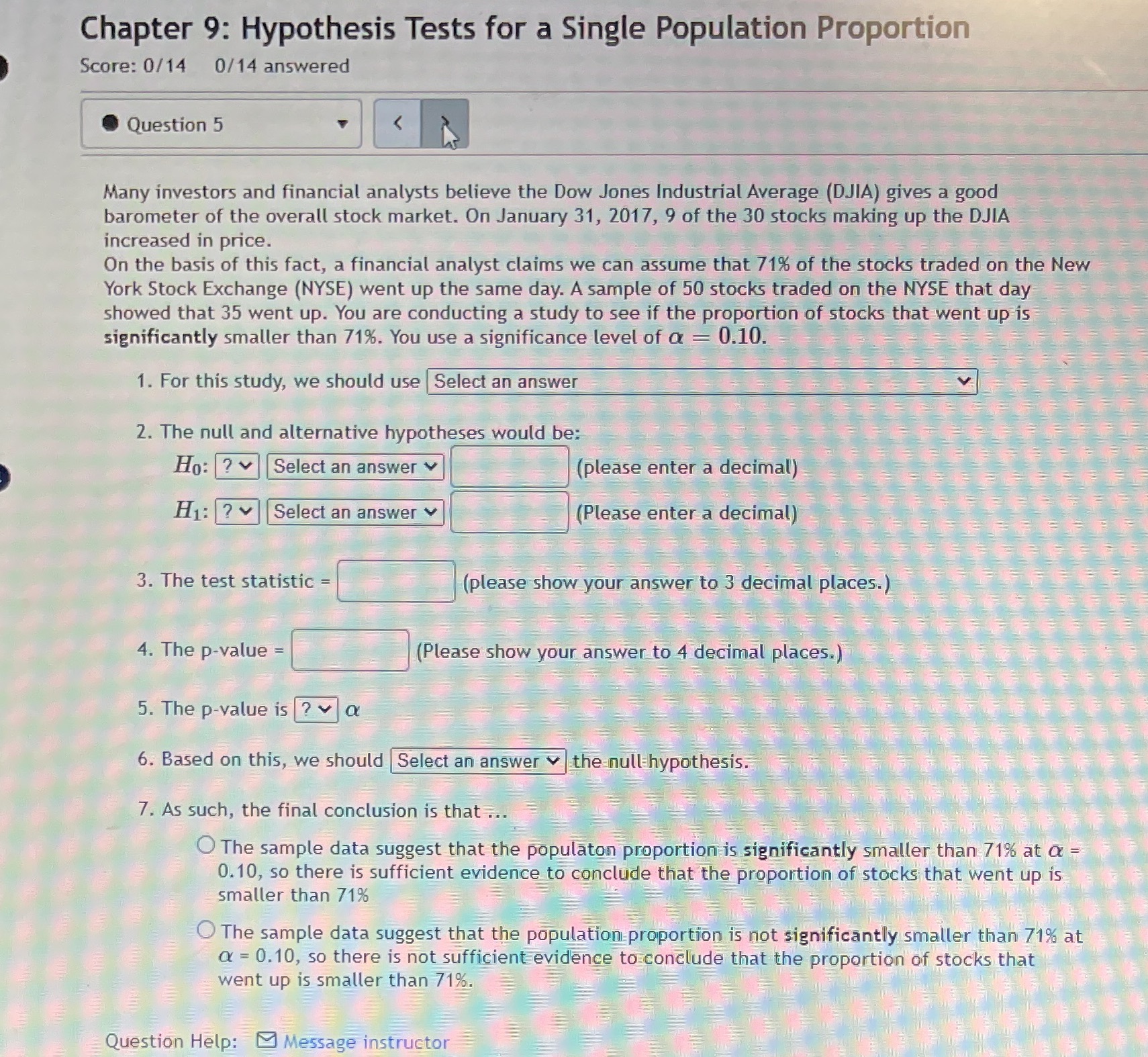
Chapter 9: Hypothesis Tests for a Single Population Proportion Score: 0/14 0/14 answered Question 5 Many investors and financial analysts believe the Dow Jones Industrial Average (DJIA) gives a good barometer of the overall stock market. On January 31, 2017, 9 of the 30 stocks making up the DJIA increased in price. On the basis of this fact, a financial analyst claims we can assume that 71% of the stocks traded on the New York Stock Exchange (NYSE) went up the same day. A sample of 50 stocks traded on the NYSE that day showed that 35 went up. You are conducting a study to see if the proportion of stocks that went up is significantly smaller than 71%. You use a significance level of a = 0.10. 1. For this study, we should use |Select an answer 2. The null and alternative hypotheses would be: Ho: ? v Select an answer v (please enter a decimal) H1: ? Select an answer Please enter a decimal) 3. The test statistic = (please show your answer to 3 decimal places.) 4. The p-value = (Please show your answer to 4 decimal places.) 5. The p-value is |? v o 6. Based on this, we should Select an answer v| the null hypothesis. 7. As such, the final conclusion is that ... The sample data suggest that the populaton proportion is significantly smaller than 71% at a = 0.10, so there is sufficient evidence to conclude that the proportion of stocks that went up is smaller than 71% O The sample data suggest that the population proportion is not significantly smaller than 71% at o = 0.10, so there is not sufficient evidence to conclude that the proportion of stocks that went up is smaller than 71%. Question Help: Message instructor
Step by Step Solution
There are 3 Steps involved in it

Get step-by-step solutions from verified subject matter experts
 Study Help