



Question: Chapter 9 Question 4 federal tax liability. How much will federal tax liability change for Mr. Blue and Ms. Jones as a result of their
Chapter 9 Question 4
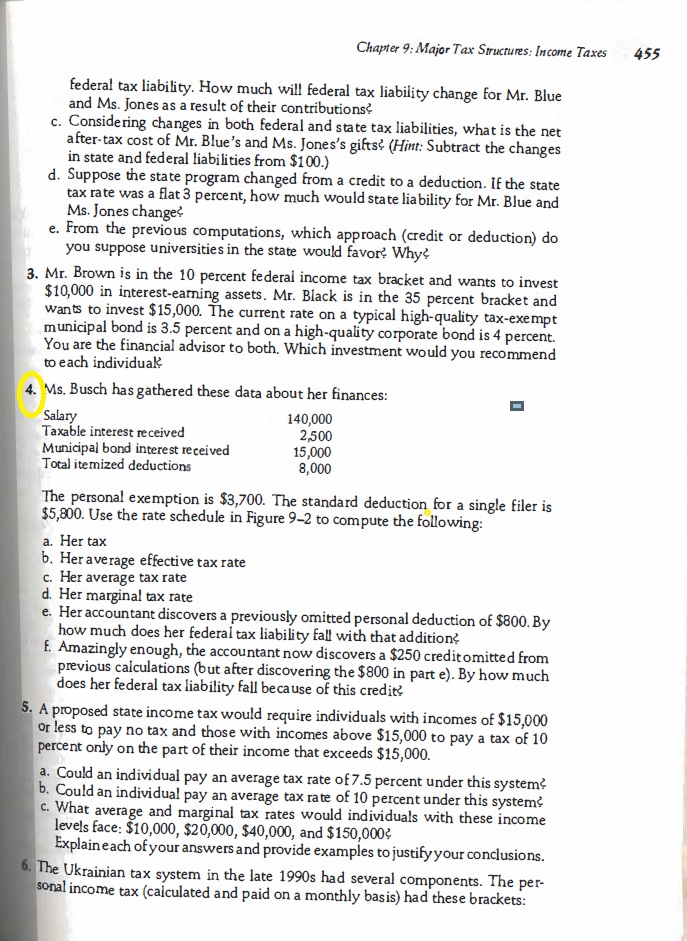
federal tax liability. How much will federal tax liability change for Mr. Blue and Ms. Jones as a result of their contributions? c. Considering changes in both federal and state tax liabilities, what is the net after-tax cost of Mr. Blue's and Ms. Jones's gifts? (Hint: Subtract the changes in state and federal liabilities from $100.) d. Suppose the state program changed from a credit to a deduction. If the state tax rate was a flat 3 percent, how much would state liability for Mr. Blue and Ms. Jones change? e. From the previous computations, which approach (credit or deduction) do you suppose universities in the state would favor? Why? 3. Mr. Brown is in the 10 percent federal income tax bracket and wants to invest $10,000 in interest-earning assets. Mr. Black is in the 35 percent bracket and wants to invest $15,000. The current rate on a typical high-quality tax-exempt municipal bond is 3.5 percent and on a high-quality corporate bond is 4 percent. You are the financial advisor to both. Which investment would you recommend to each individual 4. Ms. Busch has gathered these data about her finances: The personal exemption is $3,700. The standard deduction for a single filer is $5,800. Use the rate schedule in Figure 9-2 to compute the following: a. Her tax b. Her average effective tax rate c. Her average tax rate d. Her marginal tax rate e. Her accountant discovers a previously omitted personal deduction of $800. By how much does her federal tax liability fall with that addition? f. Amazingly enough, the accountant now discovers a $250 credit omitted from previous calculations (but after discovering the $800 in part e). By how much does her federal tax liability fall because of this credit? 5. A proposed state income tax would require individuals with incomes of $15,000 or less to pay no tax and those with incomes above $15,000 to pay a tax of 10 percent only on the part of their income that exceeds $15,000. a. Could an individual pay an average tax rate of 7.5 percent under this system? b. Could an individual pay an average tax rate of 10 percent under this system? c. What average and marginal tax rates would individuals with these income levels face: $10,000,$20,000,$40,000, and $150,000 ? Explain each of your answers and provide examples to justify your conclusions. 6. The Ukrainian tax system in the late 1990 s had several components. The personal income tax (caiculated and paid on a monthly basis) had these brackets
Step by Step Solution
There are 3 Steps involved in it

Get step-by-step solutions from verified subject matter experts