







Question: Chapter 9 Uniprocessor Scheduling. Five batch jobs, A through E, arrive at a computer center at essentially the same time. They have an estimated running
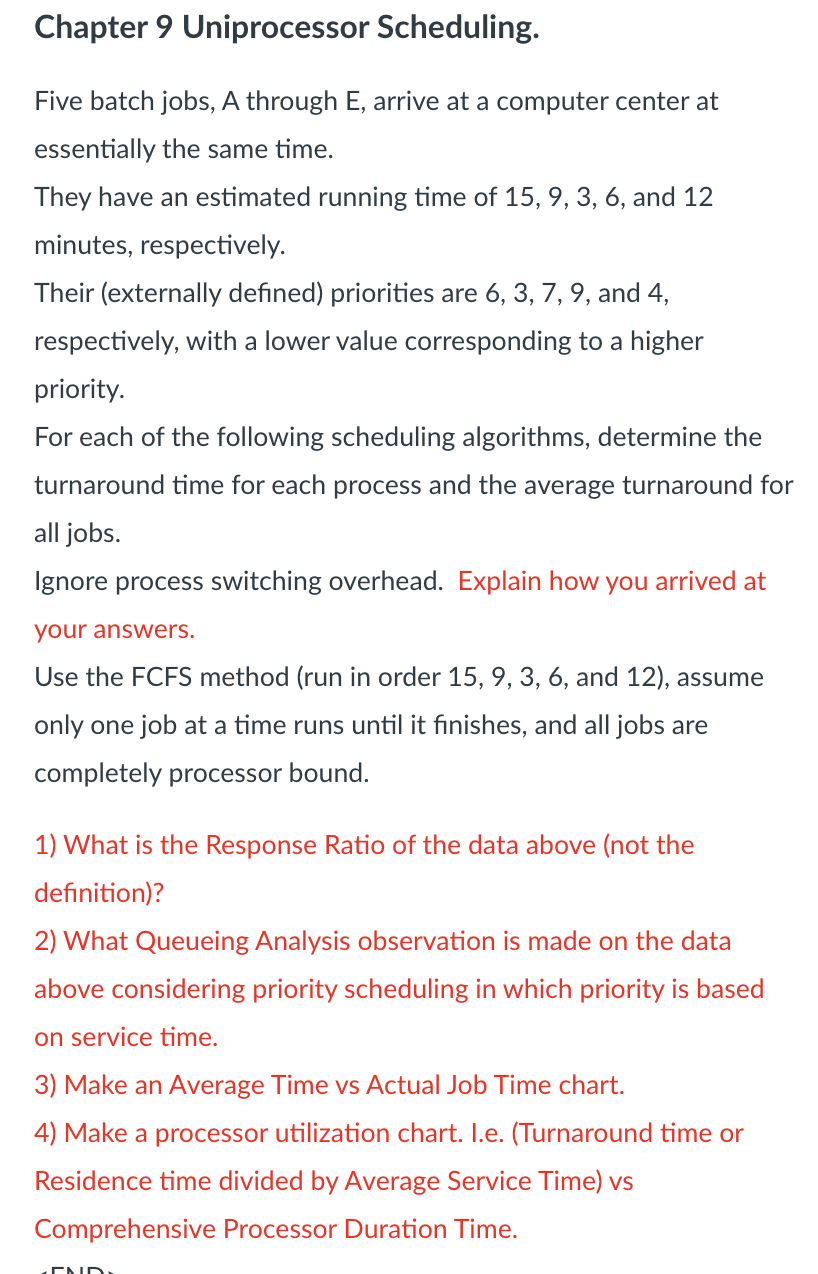
Chapter 9 Uniprocessor Scheduling. Five batch jobs, A through E, arrive at a computer center at essentially the same time. They have an estimated running time of 15, 9, 3, 6, and 12 minutes, respectively. Their (externally defined) priorities are 6, 3, 7, 9, and 4, respectively, with a lower value corresponding to a higher priority. For each of the following scheduling algorithms, determine the turnaround time for each process and the average turnaround for all jobs. Ignore process switching overhead. Explain how you arrived at your answers. Use the FCFS method (run in order 15, 9, 3, 6, and 12), assume only one job at a time runs until it finishes, and all jobs are completely processor bound. 1) What is the Response Ratio of the data above (not the definition)? 2) What Queueing Analysis observation is made on the data above considering priority scheduling in which priority is based on service time. 3) Make an Average Time vs Actual Job Time chart. 4) Make a processor utilization chart. I.e. (Turnaround time or Residence time divided by Average Service Time) vs Comprehensive Processor Duration Time
Step by Step Solution
There are 3 Steps involved in it

Get step-by-step solutions from verified subject matter experts
 Study Help