Question: Chapter (attachments) discusses many methods individuals can use to communicate financial statement information to stakeholders in a fraudulent manner. Choose one method and explain how
Chapter (attachments) discusses many methods individuals can use to communicate financial statement information to stakeholders in a fraudulent manner.
Choose one method and explain how perpetrators use it.
Which of the three "M's of financial reporting fraud does this method fall under?
Cite a case related to the method.
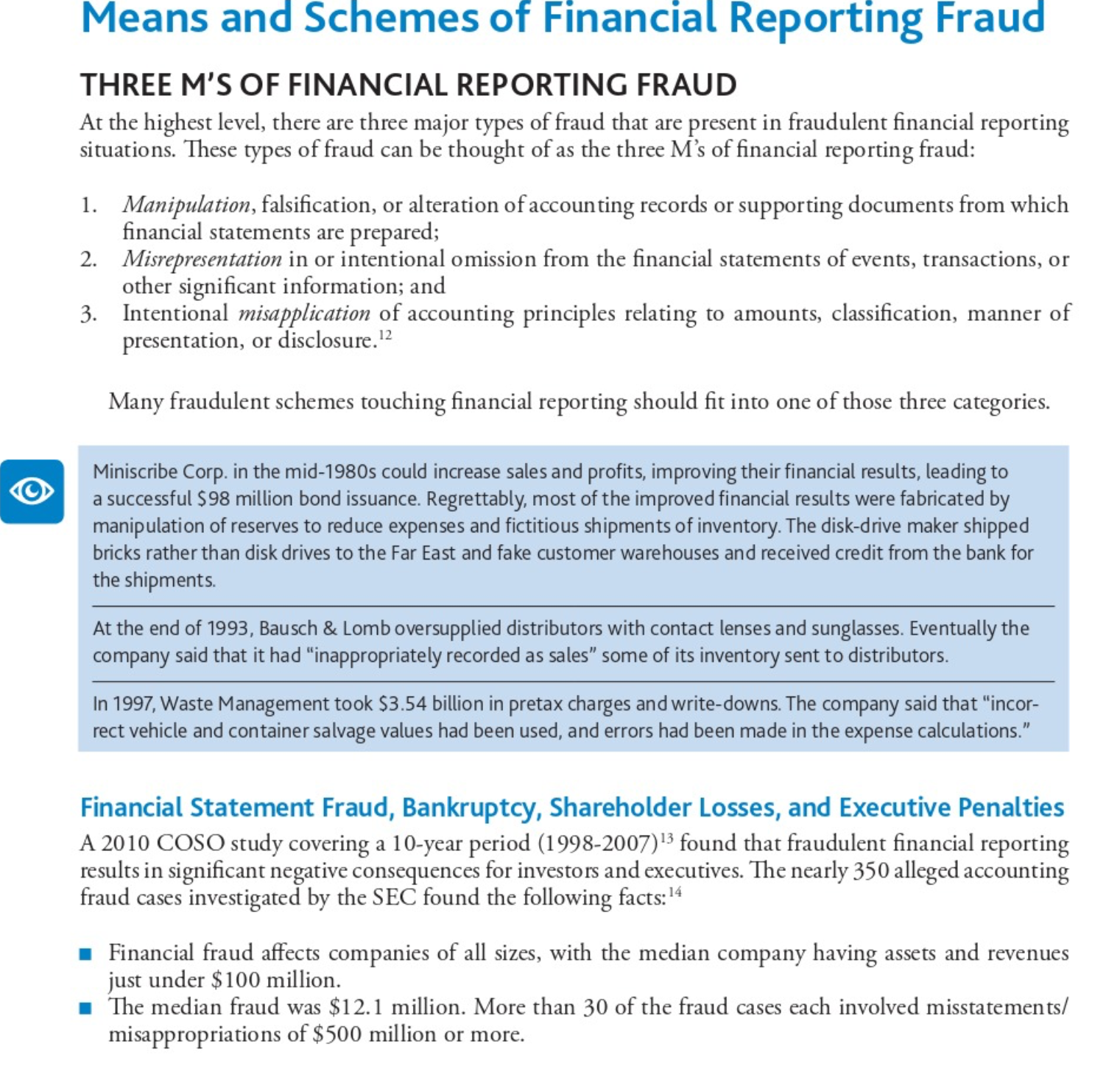
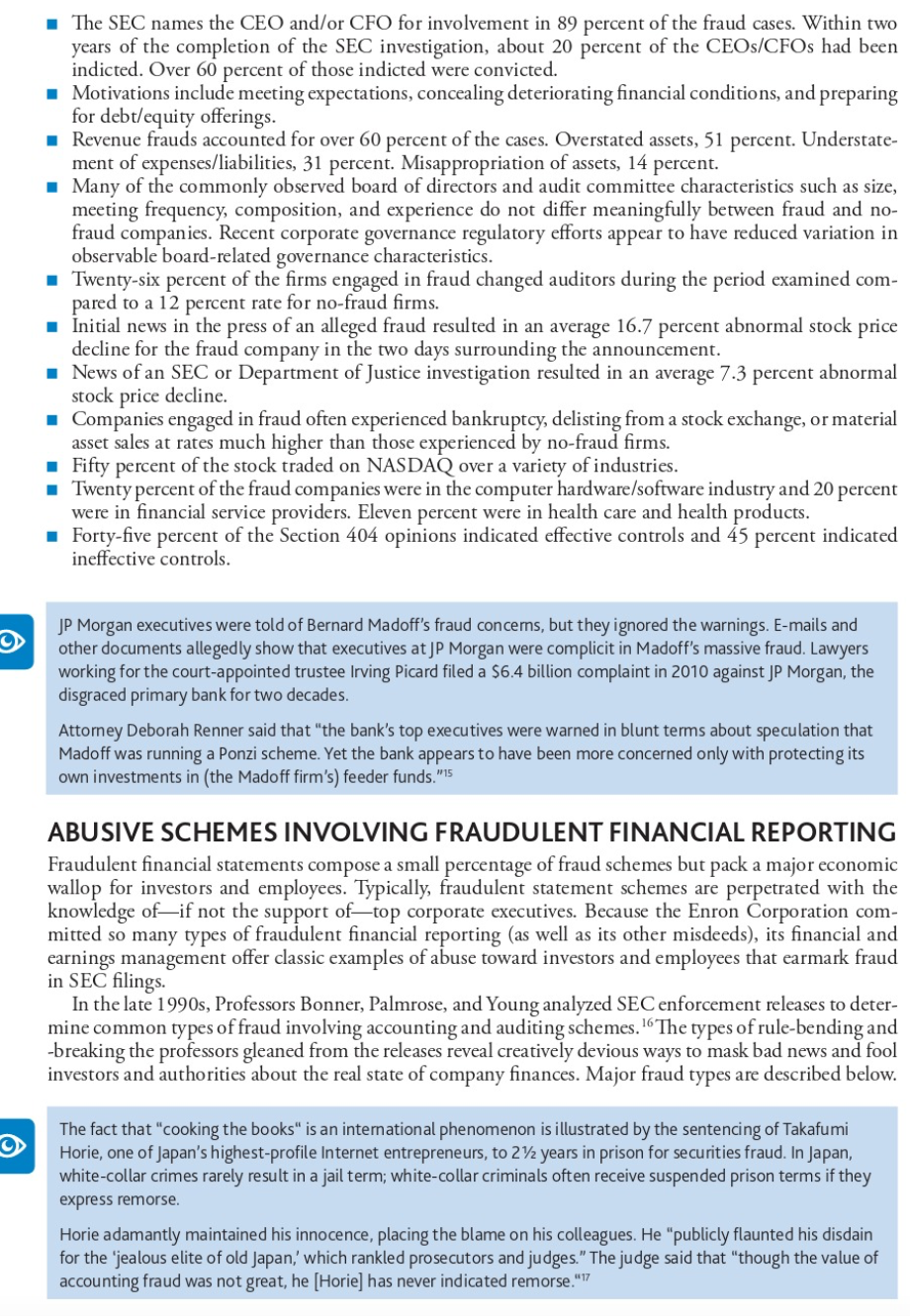
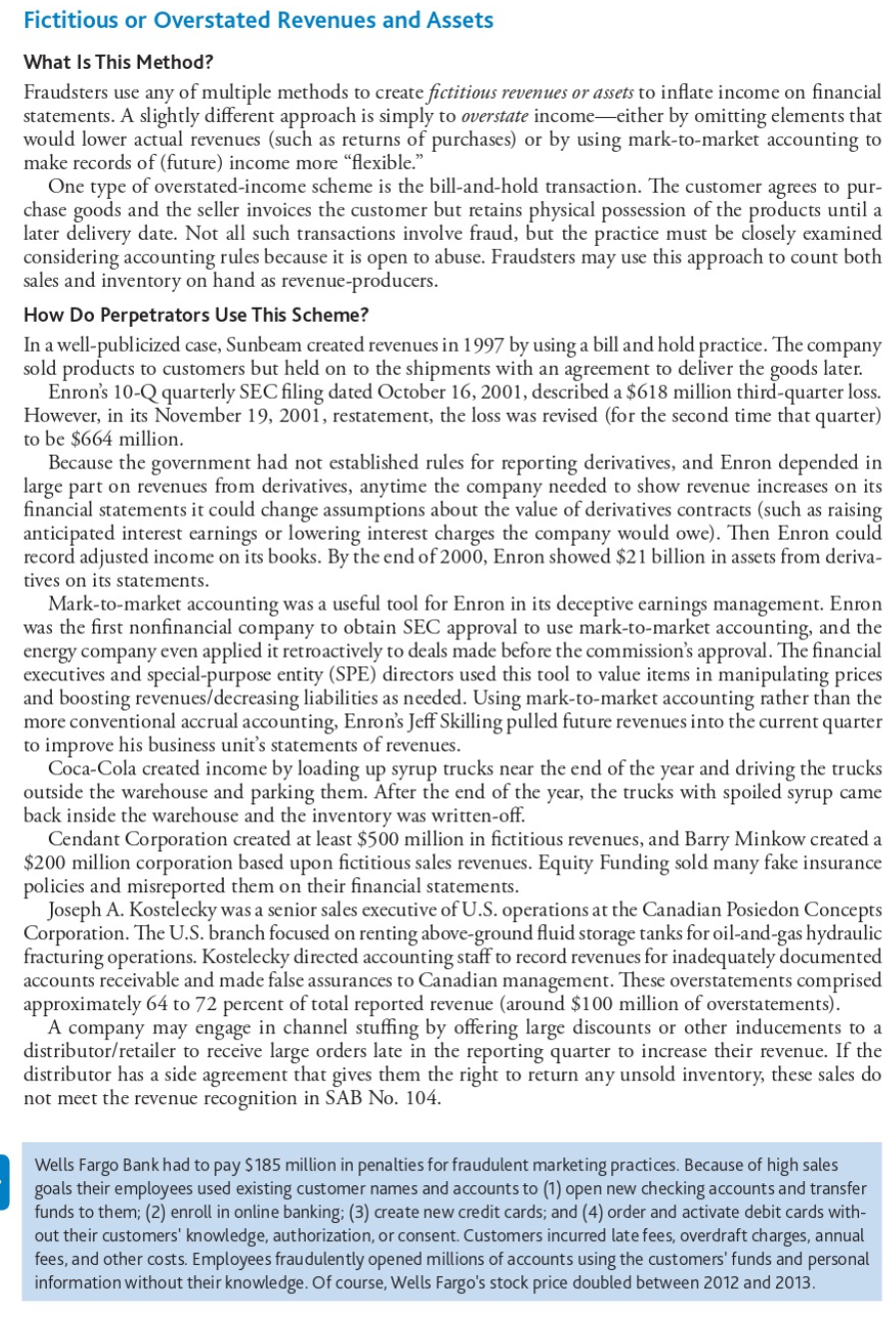
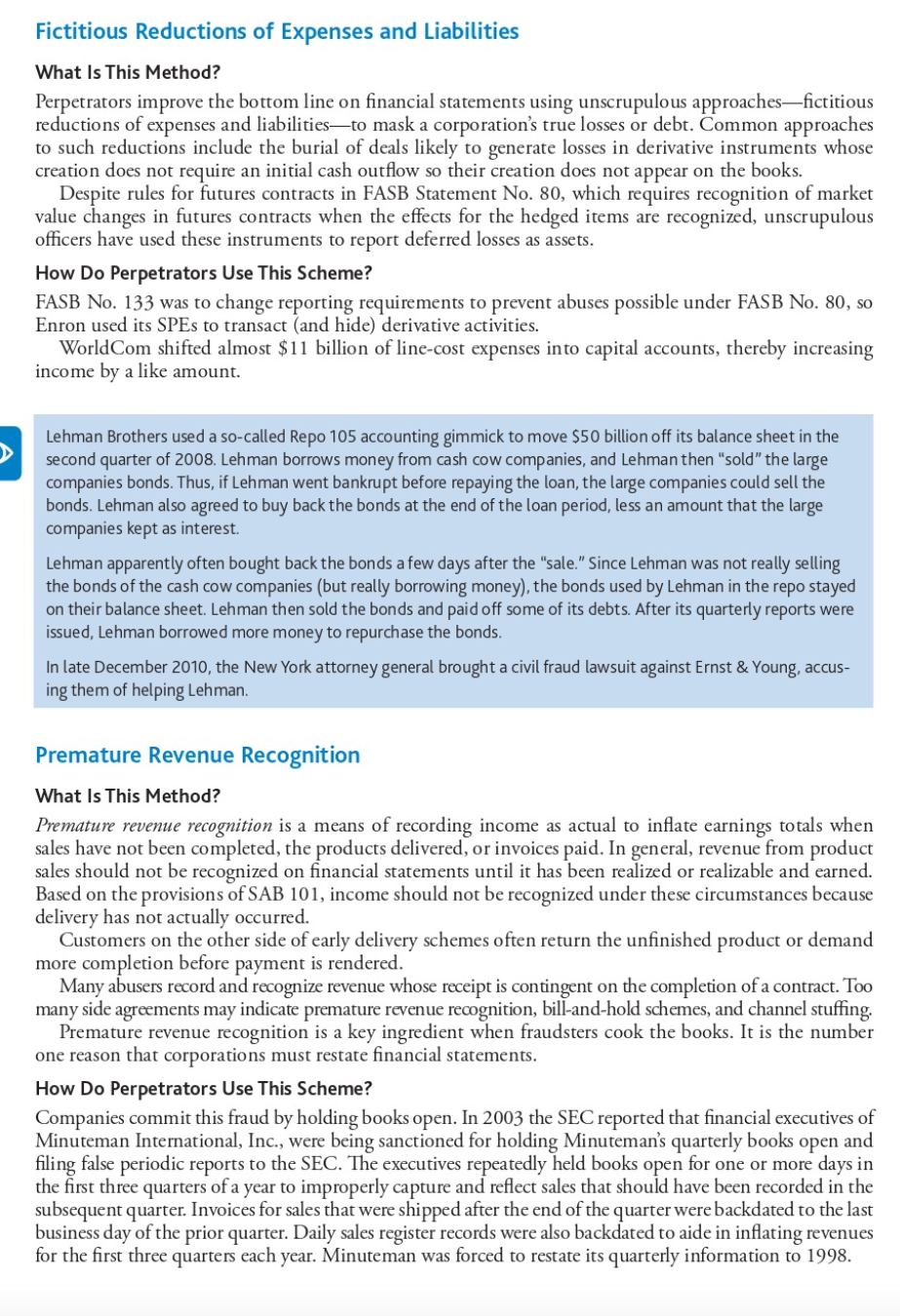
Means and Schemes of Financial Reporting Fraud THREE M'S OF FINANCIAL REPORTING FRAUD At the highest level, there are three major types of fraud that are present in fraudulent financial reporting situations. These types of fraud can be thought of as the three M's of financial reporting fraud: 1. Manipulation, falsification, or alteration of accounting records or supporting documents from which financial statements are prepared; 2. Misrepresentation in or intentional omission from the financial statements of events, transactions, or other significant information; and 3. Intentional misapplication of accounting principles relating to amounts, classification, manner of presentation, or disclosure.12 Many fraudulent schemes touching financial reporting should fit into one of those three categories. Miniscribe Corp. in the mid-1980s could increase sales and profits, improving their financial results, leading to a successful $98 million bond issuance. Regrettably, most of the improved financial results were fabricated by manipulation of reserves to reduce expenses and fictitious shipments of inventory. The disk-drive maker shipped bricks rather than disk drives to the Far East and fake customer warehouses and received credit from the bank for the shipments. At the end of 1993, Bausch & Lomb oversupplied distributors with contact lenses and sunglasses. Eventually the company said that it had "inappropriately recorded as sales" some of its inventory sent to distributors. In 1997, Waste Management took $3.54 billion in pretax charges and write-downs. The company said that "incor- rect vehicle and container salvage values had been used, and errors had been made in the expense calculations." Financial Statement Fraud, Bankruptcy, Shareholder Losses, and Executive Penalties A 2010 COSO study covering a 10-year period (1998-2007)" found that fraudulent financial reporting results in significant negative consequences for investors and executives. The nearly 350 alleged accounting fraud cases investigated by the SEC found the following facts: 14 Financial fraud affects companies of all sizes, with the median company having assets and revenues just under $100 million. The median fraud was $12.1 million. More than 30 of the fraud cases each involved misstatements/ misappropriations of $500 million or more.The SEC names the CEO and/or CFO for involvement in 89 percent of the fraud cases. Within two years of the completion of the SEC investigation, about 20 percent of the CEOs/CFOs had been indicted. Over 60 percent of those indicted were convicted. Motivations include meeting expectations, concealing deteriorating financial conditions, and preparing for debt/equity offerings. Revenue frauds accounted for over 60 percent of the cases. Overstated assets, 51 percent. Understate- ment of expenses/liabilities, 31 percent. Misappropriation of assets, 14 percent. Many of the commonly observed board of directors and audit committee characteristics such as size, meeting frequency, composition, and experience do not differ meaningfully between fraud and no- fraud companies. Recent corporate governance regulatory efforts appear to have reduced variation in observable board-related governance characteristics. Twenty-six percent of the firms engaged in fraud changed auditors during the period examined com- pared to a 12 percent rate for no-fraud firms. Initial news in the press of an alleged fraud resulted in an average 16.7 percent abnormal stock price decline for the fraud company in the two days surrounding the announcement. News of an SEC or Department of Justice investigation resulted in an average 7.3 percent abnormal stock price decline. Companies engaged in fraud often experienced bankruptcy, delisting from a stock exchange, or material asset sales at rates much higher than those experienced by no-fraud firms. Fifty percent of the stock traded on NASDAQ over a variety of industries. Twenty percent of the fraud companies were in the computer hardware/software industry and 20 percent were in financial service providers. Eleven percent were in health care and health products. Forty-five percent of the Section 404 opinions indicated effective controls and 45 percent indicated ineffective controls. JP Morgan executives were told of Bernard Madoff's fraud concerns, but they ignored the warnings. E-mails and other documents allegedly show that executives at JP Morgan were complicit in Madoff's massive fraud. Lawyers working for the court-appointed trustee Irving Picard filed a $6.4 billion complaint in 2010 against JP Morgan, the disgraced primary bank for two decades. Attorney Deborah Renner said that "the bank's top executives were warned in blunt terms about speculation that Madoff was running a Ponzi scheme. Yet the bank appears to have been more concerned only with protecting its own investments in (the Madoff firm's) feeder funds."15 ABUSIVE SCHEMES INVOLVING FRAUDULENT FINANCIAL REPORTING Fraudulent financial statements compose a small percentage of fraud schemes but pack a major economic wallop for investors and employees. Typically, fraudulent statement schemes are perpetrated with the knowledge of-if not the support of-top corporate executives. Because the Enron Corporation com- mitted so many types of fraudulent financial reporting (as well as its other misdeeds), its financial and earnings management offer classic examples of abuse toward investors and employees that earmark fraud in SEC filings. In the late 1990s, Professors Bonner, Palmrose, and Young analyzed SEC enforcement releases to deter- mine common types of fraud involving accounting and auditing schemes. "The types of rule-bending and -breaking the professors gleaned from the releases reveal creatively devious ways to mask bad news and fool investors and authorities about the real state of company finances. Major fraud types are described below. The fact that "cooking the books" is an international phenomenon is illustrated by the sentencing of Takafumi Horie, one of Japan's highest-profile Internet entrepreneurs, to 21/2 years in prison for securities fraud. In Japan, white-collar crimes rarely result in a jail term; white-collar criminals often receive suspended prison terms if they express remorse. Horie adamantly maintained his innocence, placing the blame on his colleagues. He "publicly flaunted his disdain for the 'jealous elite of old Japan,' which rankled prosecutors and judges." The judge said that "though the value of accounting fraud was not great, he [Horie] has never indicated remorse."17Fictitious or Overstated Revenues and Assets What Is This Method? Fraudsters use any of multiple methods to createm'n'am revenue: or assets to inate income on nancial statements. A slightly different approach is simply to overstate incomeeither by omitting elements that would lower actual revenues (such as returns of purchases] or by using marlotomarket accounting to make records of (future) income more \"flexible." One type of overstatedincome scheme is the billandhold transaction. The customer agrees to pur chase goods and the seller invoices the customer but retains physical possession of the products until a later delivery date. Not all such transactions involve fraud, but the practice must be closely examined considering accounting rules because it is open to abuse. Fraudsters may use this approach to count both sales and inventory on hand as revenue-producers. How Do Perpetrators Use This Scheme? In a well-publicized case. Sunbeam created revenues in 1997 by usinga bill and hold practice. The company sold products to customers but held on to the shipments with an agreement to deliver the goods later. Enron's lOQ quarterly SEC ling dated October 16. 2001. described a $618 million thirdquarter loss. However, in its November 19, 2001, restatement. the loss was revised (for the second time that quarter) to be $664 million. Because the government had not established rules for reporting derivatives. and Enron depended in large part on revenues from derivatives, anytime the company needed to show revenue increases on its nancial statements it could change assumptions about the value ofderivatives contracts (such as raising anticipated interest earnings or lowering interest charges the company would owe). Then Enron could record adjusted income on its books. By the end of2000. Enron showed 321 billion in assets from deriva- tives on 1ts statements. Mark-to-market accounting was a useful tool for Enron in its deceptive earnings management. Enron was the first nonnancial company to obtain SEC approval to use mark-to-market accounting. and the energy company even applied it retroacrively to deals made before the commission's approval. The nancial executives and special-purpose entity (SPE) directors used this tool to value items in manipulating prices and boosting revenuesfdecreasing liabilities as needed. Using mark-to-marltet accounting rather than the more conventional accrual accounting. Enron's jeff Skilling pulled future revenues into the current quarter to improve his business units statements of revenues. Coca-Cola created income by loading up syrup trucks near the end of the year and driving the trucks outside the warehouse and parking them. After the end of the year, the trucks widi spoiled syrup came back inside the warehouse and the inventory was written-off. Cendant Corporation created at least $500 million in ctitious revenues, and Barry Minkow created a $200 million corporation based upon ctitious sales revenues. Equity Funding sold many fake insurance policies and misreported them on their nancial statements. joseph A. Kostelecky was a senior sales executive of U.S. operations at the Canadian Posiedon Concepts Corporation. The US. branch focused on renting above-ground fluid storage tanks for oi l-a nd-gas hydraulic fracturing operations. Kostelecky directed accounting staff to record revenues for inadequately documented accounts receivable and made false assurances to Canadian management. These overstatements comprised approximateiy 64 to 72 percent of total reported revenue (around $100 million of overstatements}. A company may engage in channel stufng by offering large discounts or other inducements to a distributor! retailer to receive large orders late in the reporting quarter to increase their revenue. If the distributor has a side agreement that gives them the right to return any unsold inventory. these sales do not meet the revenue recognition in SAB No. 104. Wells Fargo Bank had to pay $185 million in penalties for fraudulent marketing practices. Because of high sales goals their employees used existing customer names and accounts to (1] open new checking accounts and transfer funds to them; (2) enroll in online banking; (3) create new credit cards; and (4] order and activate debit cards with- out their customers' knowledge. authorization, or consent. Customers incurred late fees, overdraft charges. annual fee 5, and other costs Employees fraudulentlyr opened millions of accounts using the customers' funds and personal information without their knowledge. Of course. Wells Fargo's stock price doubled between 2012 and 2013. Fictitious Reductions of Expenses and Liabilities What Is This Method? Perpetrators improve the bottom line on financial statements using unscrupulous approaches-fictitious reductions of expenses and liabilities-to mask a corporation's true losses or debt. Common approaches to such reductions include the burial of deals likely to generate losses in derivative instruments whose creation does not require an initial cash outflow so their creation does not appear on the books. Despite rules for futures contracts in FASB Statement No. 80, which requires recognition of market value changes in futures contracts when the effects for the hedged items are recognized, unscrupulous officers have used these instruments to report deferred losses as assets. How Do Perpetrators Use This Scheme? FASB No. 133 was to change reporting requirements to prevent abuses possible under FASB No. 80, so Enron used its SPEs to transact (and hide) derivative activities. WorldCom shifted almost $11 billion of line-cost expenses into capital accounts, thereby increasing income by a like amount. Lehman Brothers used a so-called Repo 105 accounting gimmick to move $50 billion off its balance sheet in the second quarter of 2008. Lehman borrows money from cash cow companies, and Lehman then "sold" the large companies bonds. Thus, if Lehman went bankrupt before repaying the loan, the large companies could sell the bonds. Lehman also agreed to buy back the bonds at the end of the loan period, less an amount that the large companies kept as interest. Lehman apparently often bought back the bonds a few days after the "sale." Since Lehman was not really selling the bonds of the cash cow companies (but really borrowing money), the bonds used by Lehman in the repo stayed on their balance sheet. Lehman then sold the bonds and paid off some of its debts. After its quarterly reports were issued, Lehman borrowed more money to repurchase the bonds. In late December 2010, the New York attorney general brought a civil fraud lawsuit against Ernst & Young, accus- ing them of helping Lehman. Premature Revenue Recognition What Is This Method? Premature revenue recognition is a means of recording income as actual to inflate earnings totals when sales have not been completed, the products delivered, or invoices paid. In general, revenue from product sales should not be recognized on financial statements until it has been realized or realizable and earned Based on the provisions of SAB 101, income should not be recognized under these circumstances because delivery has not actually occurred. Customers on the other side of early delivery schemes often return the unfinished product or demand more completion before payment is rendered. Many abusers record and recognize revenue whose receipt is contingent on the completion of a contract. Too many side agreements may indicate premature revenue recognition, bill-and-hold schemes, and channel stuffing Premature revenue recognition is a key ingredient when fraudsters cook the books. It is the number one reason that corporations must restate financial statements. How Do Perpetrators Use This Scheme? Companies commit this fraud by holding books open. In 2003 the SEC reported that financial executives of Minuteman International, Inc., were being sanctioned for holding Minuteman's quarterly books open and filing false periodic reports to the SEC. The executives repeatedly held books open for one or more days in the first three quarters of a year to improperly capture and reflect sales that should have been recorded in the subsequent quarter. Invoices for sales that were shipped after the end of the quarter were backdated to the last business day of the prior quarter. Daily sales register records were also backdated to aide in inflating revenues for the first three quarters each year. Minuteman was forced to restate its quarterly information to 1998
Step by Step Solution
There are 3 Steps involved in it
1 Expert Approved Answer
Step: 1 Unlock
Question Has Been Solved by an Expert!
Get step-by-step solutions from verified subject matter experts
Step: 2 Unlock
Step: 3 Unlock
Students Have Also Explored These Related Finance Questions!









 Study Help