







Question: Chapter Discussion Questions 1. How would you interpret the data? Where is the hotel chain doing a good job? 2. How could you tease out
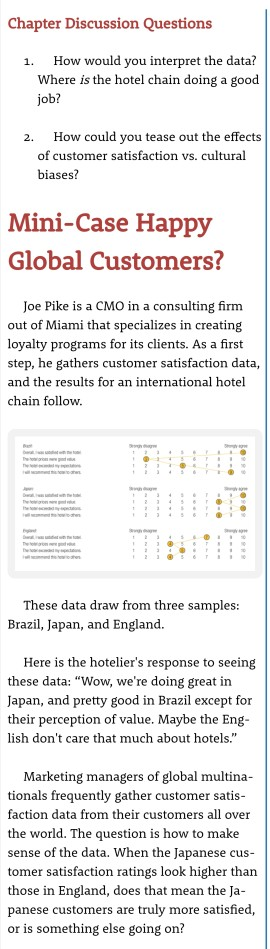
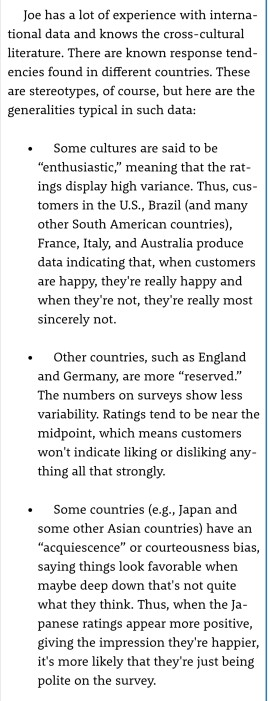
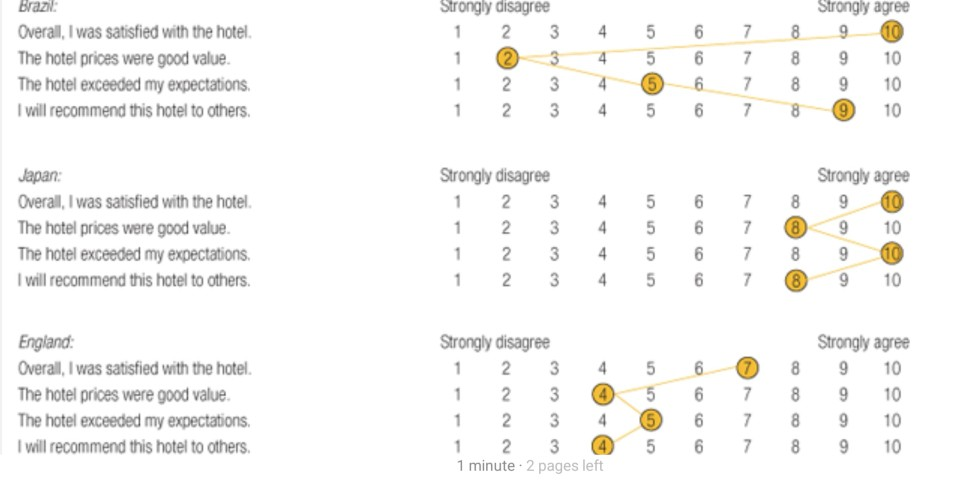
Chapter Discussion Questions 1. How would you interpret the data? Where is the hotel chain doing a good job? 2. How could you tease out the effects of customer satisfaction vs. cultural biases? Mini-Case Happy Global Customers? Joe Pike is a CMO in a consulting firm out of Miami that specializes in creating loyalty programs for its clients. As a first step, he gathers customer satisfaction data, and the results for an international hotel chain follow. These data draw from three samples: Brazil, Japan, and England. Here is the hotelier's response to seeing these data: "Wow, we're doing great in Japan, and pretty good in Brazil except for their perception of value. Maybe the Eng- lish don't care that much about hotels." Marketing managers of global multina- tionals frequently gather customer satis- faction data from their customers all over the world. The question is how to make sense of the data. When the Japanese cus- tomer satisfaction ratings look higher than those in England, does that mean the Ja- panese customers are truly more satisfied, or is something else going on? Joe has a lot of experience with interna- tional data and knows the cross-cultural literature. There are known response tend- encies found in different countries. These are stereotypes, of course, but here are the generalities typical in such data: Some cultures are said to be "enthusiastic," meaning that the rat- ings display high variance. Thus, cus- tomers in the U.S., Brazil (and many other South American countries), France, Italy, and Australia produce data indicating that, when customers are happy, they're really happy and when they're not, they're really most sincerely not. Other countries, such as England and Germany, are more "reserved." The numbers on surveys show less variability. Ratings tend to be near the midpoint, which means customers won't indicate liking or disliking any- thing all that strongly. Some countries (e.g., Japan and some other Asian countries) have an "acquiescence" or courteousness bias, saying things look favorable when maybe deep down that's not quite what they think. Thus, when the Ja- panese ratings appear more positive, giving the impression they're happier, it's more likely that they're just being polite on the survey. Brazil: Overall, I was satisfied with the hotel The hotel prices were good value. The hotel exceeded my expectations I will recommend this hotel to others. Strongly disagree 1 2 3 1 2 3 1 2 3 1 2 3 4 4 4 4 5 5 5 5 6 6 6 6 7 7 7 7 8 8 8 8 Strongly agree 9 0 9 10 9 10 9 10 8 Japan: Overall, I was satisfied with the hotel. The hotel prices were good value. The hotel exceeded my expectations, I will recommend this hotel to others. Strongly disagree 1 2 3 1 2 3 1 2 3 1 2 3 4 4 4 4 5 5 5 5 6 6 6 6 7 7 7 7 Strongly agree 9 9 10 9 10 9 10 8 England: Overall, I was satisfied with the hotel The hotel prices were good value. The hotel exceeded my expectations, I will recommend this hotel to others. Strongly disagree 1 2 3 4 1 2 3 4 1 2 3 4 1 2 3 4 1 minute - 2 pages left 5 5 5 5 6 6 6 6 7 7 7 8 8 8 8 Strongly agree 9 10 9 10 9 10 9 10
Step by Step Solution
There are 3 Steps involved in it
1 Expert Approved Answer
Step: 1 Unlock

Question Has Been Solved by an Expert!
Get step-by-step solutions from verified subject matter experts
Step: 2 Unlock
Step: 3 Unlock
 Study Help