Question: Chapter Summary: Preparing for and Evaluating the Challenges of Growth goo KE WUL & prouca Cansusiy ale marked was ready to move to the early
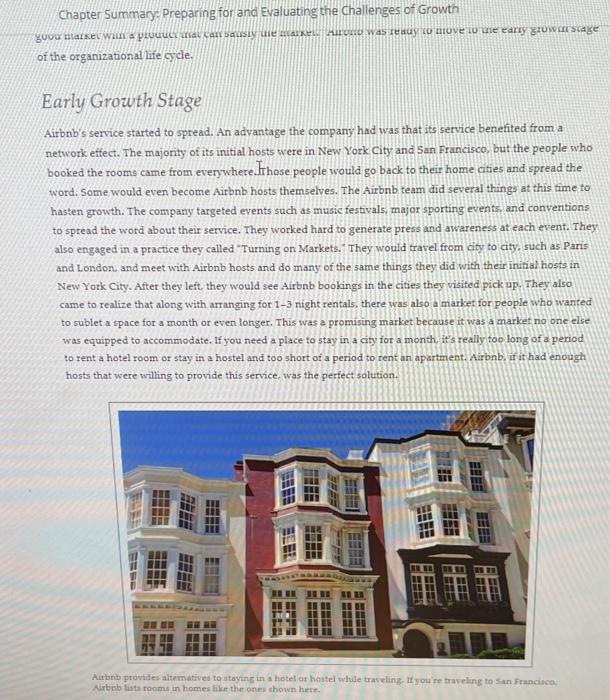
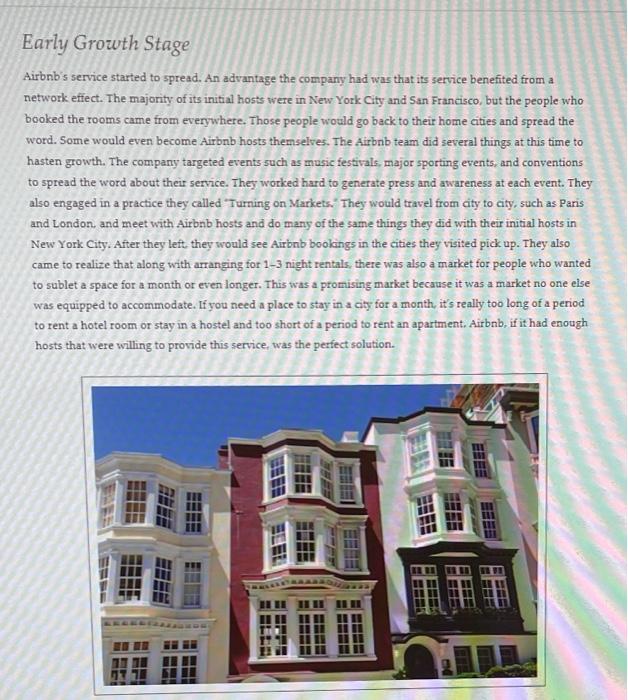
Chapter Summary: Preparing for and Evaluating the Challenges of Growth goo KE WUL & prouca Cansusiy ale marked was ready to move to the early XIU W Le stage of the organizational life cycle. Early Growth Stage Airbnb's service started to spread. An advantage the company had was that its service benefited from a network effect. The majority of its initial hosts were in New York City and San Francisco, but the people who booked the rooms came from everywhere.Ithose people would go back to their home cities and spread the word. Some would even become Airbnb hosts themselves. The Airbnb team did several things at this time to hasten growth. The company targeted events such as music festivals, major sporting events, and conventions to spread the word about their service. They worked hard to generate press and awareness at each event. They also engaged in a practice they called "Turning on Markets. They would travel from city to aty, such as Paris and London, and meet with Airbnb hosts and do many of the same things they did with their initial hosts in New York City. After they left they would see Airbnb bookings in the cities they visited pick up. They also came to realize that along with arranging for 1-3 night rentals, there was also a market for people who wanted to subiet a space for a month or even longer. This was a promising market because it was a market no one else was equipped to accommodate. If you need a place to stay in a city for a month, it's really too long of a period to rent a hotel room or stay in a hostel and too short of a period to rent an apartment. Airbnb, if it had enough hosts that were willing to provide this service was the perfect solution. FREE FA HERE FEED FEBER BEHA EL FH Airbnb provides alteratives to staying in a hotel or hostel while traveling. If you're traveling to San Francisco Airbnb lists rooms in homes like the ones shown here At the same time these activities were taking place. Chesky and Gebbia shifted their priorities. They transitioned from building a product to building a company. Prior to entering the early growth stage, Chesky and Gebbia were involved in almost every decision that was made and every initiative that the firm pursued. Now their main function was setting the vision, hinng, maintaining and strengthening the culture of the company, and increasing formalization. A good example of increased formalization is how Airbnb evolved in regard to new employee orientation. Early on. Chesky personally conducted the new employee orientation for each of the firm's new hires. As the company grew, he started doing it once a week in groups. As it continued to grow, he taped it and as part of a formal onboarding process the new hires watched the tape. Another change that took place in the early growth phase is Airbnb started relying more on data than intuition for decision making. The early growth stage also exposed Airbnb to new challenges. The company started attracting competitors as a result of its success. It also started experiencing government and regulatory challenges. Some cities have restrictions for subletting for a short period of time. In many cities, hosts must register with local authorities and obtain a license or permit. In addition, in some jurisdictions, collection of a transient occupancy tax by Airbnb is required. Airbnb's approach regarding legal challenges was to listen to all sides and try to reach an accommodation with which all parties were comfortable. The legal challenges the company would face only intensified when it reached the continuous growth stage. Another challenge has been safety issues. In June of 2011, an Airbnb renter virtually destroyed the home of an Airbnb host. This was a wake-up call for the company. At that time, Airbnb didn't have a trust and safety team. It didn't remove many users. The incident changed the way the company thought about safety, and it has put safeguards in place and became much more hands-on in managing its marketplace. Continuous Growth Stage Airbnb is now in the continuous growth stage of the organizational life cycle. In the continuous growth stage the need for structure and more formal relationships increases. In addition, businesses typically develop new products and enter new markets. This is what Airbnb is currently experiencing. Formalization has increased. The company now has a formal onboarding process with employees across the globe. It remains protective of its core values and culture. The company has a formal Core Values Council. If an employee or work group is unsure whether an idea or initiative fits or doesn't fit with Airbnb's core values, it can reach out to the committee for advice. In terms of growth, the company remains on an aggressive growth path. It currently has four markets. First, people renting out a room in their home for a 1-3 night stay. This is the market Airbnb started with and still represents more than 50 percent of its rentals. The second is people renting out their entire home or apartment for a short-term stay. Most of Airbnb's bookings occur in these two markets. The third market. which Airbnb didn't pursue but happened organically, is the vacation rental market. This market involves second homes" that people own in vacation destinations, like Lake Tahoe, Orlando, or Cape Cod, and are willing to rent when they're not present. The fourth market, which Airbnb broke into in the early growth stage, is the sublet market. This is the market for rentals that people need for a month of more. Airbnb Moving Forward Airbnb is now a large company. Its growth and size have surprised many, including its founders. The company currently has 3-plus million listings worldwide is present in 65.000 cities and towns, and is in 191 countries. In a 2017 interview with Fortune. Chesky was asked. "Did you ever think (Airbnb) would be this big7 He responded by saying "I remember when Joe Gebbia) and I were having conversations, we'd said. This thing is going to be huge. One day hundreds of people will stay on airbeds across the world. On New Year's Eve 2016, two million people from 191 countries stayed in Airbnb properties. The company is now valued at 531 billion. Airbnb continues to grow. Its total number of rentals increases every year. The company's listed nights booked hit. 52 million in 2016 versus 25 million in 2015. In terms of market penetration, according to a Morgan Stanley study, in 2015. 15 percent of leisure travelers surveyed had used Airbnb in the past 12 months. In 2016, that number rose to 19 percent and Morgan Stanley predicts the number will reach 25 percent in 2017. The buggest threat to Airbnb's growth remains government regulation. Many cities around the world have enacted laws to regulate shared accommodation. For example, in Barcelona, Spain a special license a required to other short-term rentals. The city stopped issuing licenses in 2016 to the only way to start a new Airbnb would be to buy an casting property with a license. Similarly, in early 2017, New York City introduced legislation allowing the state to fine Airbnb fur listing properties for terma less than 30 days it a permanent resident will not be present Despite these challenges, Airbnb remains in the continuous growth stage of the organizational life cycle. The next stage is the maturity stage, which a business enters when its growth slows. Perhaps to hedge against regulation slowing its growth, in late 2016 Airbnb announced a new service offering its first departure from rentals. The new product is Experiences, which offers travelers excursions and experiences host a by local residents. The service launched in 12 cities, including London, San Francisco, Paris, and Tokyo, and will offer experiences such as stargazing, surfing mountain biking, food tasting, and murder-mystery tours. So far, thousands of people have submitted experiences to be considered. Airbnb will charge Experiences hosts a 20 percent commission for bookings. There is also speculation that Airbnb is working on a concept called end-to-end" which will involve services that accommodate all of a travelers needs. The services may involve airport transfers, air travel. restaurant bookings, city guides, and more. Discussion Questions 13-38 13-39. Make a list of the things that you think Airbnb did "right in growing its business. Comment on the propensity of Airbnb's founders to solicit customer feedback. Based on the information in the case, do you think they did it too often not often enough, or just right? Is there anything in their approach to obtaining feedback that you think you'll emulate if you starta business? 13-40. To what degree did Airbnb pass through the introduction stage and the early growth stage of the organizational life cycle in a manner consistent with the recommended handling of each stage provided in the chapter? To what degree do you think government regulations threaten Airbnb's continual growth? Do you think the company will be able to generate sufficient profits from new initiatives, like Experiences to offset profits lost to stricter regulations? 13-41. Introduction It all started because two aspiring designers needed money to pay their rent. It was October 2007, and Brian Chesky and Joe Gebbia were sharing an apartment in San Francisco. There was an international design conference coming to town. The two noticed that on the conference's website, all the hotels that were listed were sold out. The thought occurred to them that they could make money by renting out space in their apartment to people attending the conference. They proceeded to pull out a couple of air beds they had in a closet and said to each other. This is it. Were going to be AirBed & Breakfast at least for the weekend." They quickly designed a website (www.airbedandbrealdast.com), put it up, and filled the three spots they had available in their apartment. They figured they'd get a couple of guys in their twenties who decided to attend the conference at the last minute. They ended up with three people who broke all their assumptions about the business, the market everything. The first person was a guy from India who just couldn't believe they put up a website offering space in their apartment. The second was a 35-year-old woman from Boston and the third vras a 45-year-old father of five from Utah. This initial experience got Chesky and Gebbia thinking there might be a bigger opportunity here. They made good money, about 51.000. renting their space for the conference. They also got to meet three amazing designers in the exact same field they aspired to enter. They also started thinking about the feedback their guests had provided regarding staying in their apartment. They had liked the social clement at the experience. Instead of being in a sterile hotel they got to stay with other designers who knew San Francisco and were eager to show them around. And they saved a little money to boot. Pre-Launch and Launch Rather than running with the AirBed & Breakfast concept Chesky and Gebbia spent the next four months working on another idea-a roommate matching site. They eventually realized that others were already pursuing that ide so they returned to the AirBed & Breakfast notion. They knew they'd need programming help, so they approached a good friend and expert programmer. Nate Biecharczyk who agree to sign on. They targeted South by Southwest (SXSW) in Austin, slated for February 2008. for the launch date. SXSW is an annual film, music and emerging technologies conference. At this point the business, still called Air Bed & Breakfast, was straightforward. It provided a way for people to find housing at a private residence rather than a hotel when attending a conference. AirBed & Breakfast didn't own any lodging. Instead, it acted as a broker and received a service fee from both the host and the guest for every booking. The cost of lodging was set by the host rather than AirBed & Breakdast. Air Bed & Breakdast's reception at SXSW was encouraging enough to continue. Chesky, Gebbra, and now Blecharczyk decided to putsue their firm and see what they could make of it. Stages of Growth While growing, most businesses go through a discernable set of stages referred to as the organizational life cycle. The stages, pictured in the chart nearby, include introduction, early growth. continuous growth, maturity, and decline. Each stage has its own set of characteristics and must be managed differently. At the time this case was written-April 2017 - AirBed & Breakfast, now called Airbnb, was in the continuous growth stage of the organizational life cycle. Although Airbnb is now a strong, successful firm, the path to get there wasn't an easy one. The following is a description of how Airbnb navigated the introduction, early growth, and early portion of the continuous growth stage of the organizational life cyde. Introduction After the SXSW conference in Austin, Chesky. Gebbia, and Blecharczyk picked another conference and advertised their service. At this conference, they started hearing something they hadn't heard before. People started saying things like they'd love to use the site next month when they visited London, but they weren't attending a conference or event. So Chesky and Gebbia started thinking that may be their business was bigger than conferences or events. They also decided it was bigger than air beds. So the site's content expanded from air beds to apartments, private rooms, boats, and virtually anyplace someone could comfortably spend a night. Sales Decline Maturity Introduction Early growth Continuous growth Time The next few months were slow. The business wasn't talong of the way the founding team had hoped it would. They were funding the business primarily via personal credit cards. In the summer of 2008, to raise money, Chesky. Gebbia, and Blecharczyk came up with a novel idea. The U.S. presidential election between Barack Obama and John McCain was in full swing. The two designed limited edition boxes of cereal one called Obama O's and the other named Cap 'n McCains. The boxes were sold at election parties for $40 each They sold about 500 boxes of the cereal which helped them raise $30.000 for their business. In early 2009. some friends encouraged Chesky, Gebbis, and Blecharczyk to apply for Y Combinator, a start up accelerator in the Silicon Valley. Y Combinator provides its participants a small amount of funding in exchange for a modest amount of equity and three months of intense mentorshup. They met with Peal Graham. the head of Y Combinator, who initially hated their idea. The meeting was almost over when the issue of the cereal boxes came up. Graham was impressed and said if they could convince people to pay $40 tor 54 boxes of cereal, he'd give them a chance. Chesky later said that getting into Y Combinator was a turning point for the business in that it provided the founders a structure through which they could work on the company full time and had access to high-quality mentors and advice. At this time, the majority of business AirBed & Breakfast was getting was from New York City. Graham told the AirBed & Breakfast team something that Chesky later said was the single best piece of advice they received. Graham told them that it was better to have 100 people who loved their service than 1 million people who sort of liked it. The idea was that people who love an idea tell others, and they then tell others. allowing the idea to spread organically. This knowledge resulted in Chesky and Gebbia deciding to thuttle back and forth from California, to attend Y Combinator events, to New York City to meet their customers They set out to meet every one of their customers in New York City. They took pictures of their customers places. They houted parties for their customers to talk about the service. Two things started to happen. Fint bookings in New York City started increasing. Apparently, their customers appreciated being asked for their feedback and started talking up the service. Second, every time they went to New York they used their own service. They started realizing that there were things about their service that were not as good as they thought They'd try to book a room on their webute and think that is annoying. They also realized that the pictures of the room for rent needed to be bigger. They'd look at the small picture of an apartment listed on their site and then actually go to the place and think. "Wow, this place is beautiful-I would have never known from the small photos. As a result of their experiences as customers of their own business. they put a lot of effort into redesigning the site and the business. Looking back. Chesky and Cebbia now believe that meeting users in New York City in the spring of 2009 was the fundamental thing that changed the company for the better. Not only did they talk to their wers, they booked rooms with them. slept in their homes, hung out with them, and picked their brains for hours on end for advice. It shaped their business, shaped the design of their website and shaped the company policies that were being developed. It goes back to a basic Paul Graham quote "Make something people want By April 2009, business was picking up. AirBed & Breakfast, which had been renamed Airbnb, raised 5535.000 from Sequoia Capital, which was a huge legitimization event. Based on what the company leared in New York City, the Sequoia investment, and the changes that were made the Airbnb team felt that they had achieved product/market fit. According to investor Marc Andreessen Product/market it means being in a good market with a prodect that can satisfy the market. Airbnb was ready to move to the early growth state of the organizational life cycle. Early Growth Stage Airbnb's service started to spread. An advantage the company had was that its service benefited from a network effect. The majority of its initial hosts were in New York City and San Francisco, but the people who booked the rooms came from everywhere. Those people would go back to their home cities and spread the word. Some would even become Airbnb hosts themselves. The Airbnb team did several things at this time to hasten growth. The company targeted events such as music festivals, major sporting events, and conventions to spread the word about their service. They worked hard to generate press and awareness at each event. They also engaged in a practice they called "Turning on Markets. They would travel from city to city, such as Paris and London, and meet with Airbnb hosts and do many of the same things they did with their initial hosts in New York City. After they left they would see Airbnb bookangs in the cities they visited pick up. They also came to realize that along with arranging for 1-3 night rentals, there was also a market for people who wanted to sublet a space for a month or even longer. This was a promising market because it was a market no one else was equipped to accommodate. If you need a place to stay in a city for a month, it's really too long of a period to rent a hotel room or stay in a hostel and too short of a period to rent an apartment. Airbnb, if it had enough hosts that were willing to provide this service, was the perfect solution. BAREL DIE # robert dechets/Shutterstock At the same time these activities were taking place. Chesky and Gebbia shifted their priorities. They transitioned from building a product to building a company. Prior to entering the early growth stage, Chesky and Gebbia were involved in almost every decision that was made and every initiative that the firm pursued. Now their main function was setting the vision, hiring maintaining and strengthening the culture of the company, and increasing formalization. A good example of increased formalization is how Airbnb evolved in regard to new employee orientation. Early on, Chesky personally conducted the new employee orientation for each of the firm's new hires. As the company grew, he started doing it once a week in groups. As it continued to grow, he taped it and as part of a formal onboarding process the new hires watched the tape. Another change that took place in the early growth phase is Airbnb started relying more on data than intuition for decision making. The early growth stage also exposed Airbnb to new challenges. The company started attracting competitors as a result of its success. It also started experiencing government and regulatory challenges. Some cities have restrictions for subletting for a short period of time. In many cities, hosts must register with local authorities and obtain a license or permit. In addition, in some jurisdictions, collection of a transient occupancy tax by Airbnb is required. Airbnb's approach regarding legal challenges was to listen to all sides and try to reach an accommodation with which all parties were comfortable. The legal challenges the company would face only intensified when it reached the continuous growth stage. Another challenge has been safety issues. In June of 2011, an Airbnb renter virtually destroyed the home of an Airbnb host. This was a wake-up call for the company. At that time, Airbnb didn't have a trust and safety team. It didn't remove many users. The incident changed the way the company thought about safety, and it has put safeguards in place and became much more hands-on in managing its marketplace. Continuous Growth Stagk Airbnb is now in the continuous growth stage of the organizational life cycle. In the continuous growth stage. the need for structure and more formal relationships increases. In addition, businesses typically develop new products and enter new markets. This is what Airbnb is currently experiencing. Formalization has increased. The company now has a formal onboarding process with employees across the globe. It remains protective of its core values and culture. The company has a formal Core Values Council. If an employee or work group is unsure whether an idea or initiative fits or doesn't fit with Airbnb's core values, it can reach out to the committee for advice. In terms of growth the company remains on an aggressive growth path.17 currently has four markets. Fast people renting out a room in their home for a 1-3 night stay. This is the market Airbnb started with and represents more than 50 percent of its rentals. The second is people renting out the entire home or apartment for a short-term stay. Most of Airbnb's bookings occur in these two markets. The third market which Airbnb didn't pursue but happened organically, is the vacation rental market. This market involves "second homes that people own in vacation destinations like Lake Tahoe Orlando, or Cape Cod, and are willing to rent when they're not present. The fourth market which Airbnb broke into an the early growth stage, is the sublet market. This is the market for rentals that people need for a month or more. Airbnb Moving Forward Airbnb is now a large company. Its growth and size have surprised many, including its founders. The company currently has 3-plus million listings worldwide, is present in 65.000 cities and towns, and is in 191 countries In a 2017 interview with Fortune, Chesky was asked. "Did you ever think (Airbnb) would be this big?" He responded by saying "I remember when Joe (Gebbia) and I were having conversations, we'd said. This thing is going to be huge. One day hundreds of people will stay on airbeds across the world. On New Year's Eve 2016 two million people from 191 countries stayed in Airbnb properties. The company is now valued at 531 billion Airbnb continues to grow. Its total number of rentals increases every year. The company's listed nights booked hit 52 million in 2016 versus 25 million in 2015. In terms of market penetration according to a Morgan Stanley study, in 2015, 15 percent of leisure travelers surveyed had used Airbnb in the past 12 months. In 2016, that number rose to 19 percent and Morgan Stanley predicts the number will reach 25 percent in 2017. The biggest threat to Airbnb's growth remains government regulation. Many abes around the world have enacted laws to regulate shared accommodation. For cumple in Barcelona. Spain. a special license is required to other short-term rentals. The city stopped issuing licenses in 2014. so the only way to start a new Airbnb would be to buy an casting property with a license. Similarly, in early 2017. New York City introduced legislation allowing the state to fine Airbnb for listing properties for terms less than 30 days in a permanent resident will not be present Despite these challenges, Airbnb remains in the commous growth stage of the organizational te cycle. The next stage in the maunty stage, which a business enters when its growth slows. Perhaps to hedge against regulation slowing is growth in late 2016 Airbnb announced a new service cering its first departure from rentals. The new product is Experiences, which ers travelers excurons and experience hosted by local dents. The service lunched in 12 cities, including London San France Pansand Tokyo and will be expenences such as targeting, surfing, mountain biking food testing and murder mystery tours. 50 far thousands of people have submitted esperences to be considered. Arbeid charge Expenses host a 20 percent commission for bookings. There is also speculation that bebis working on a concept called end-to-end which will involve services that accomodate all of a travelers needs. The services may involve airport transfers a travel mesturant boost send more spite these challenges, Airbnb remains in the continuous growth stage of the organizational life cycle. The