



Question: chapter-Opening case: uber's Foreien Narket Entry strateay You are about to read a short case exploring Uber's foreign market entry strategy. Uber, aware of the
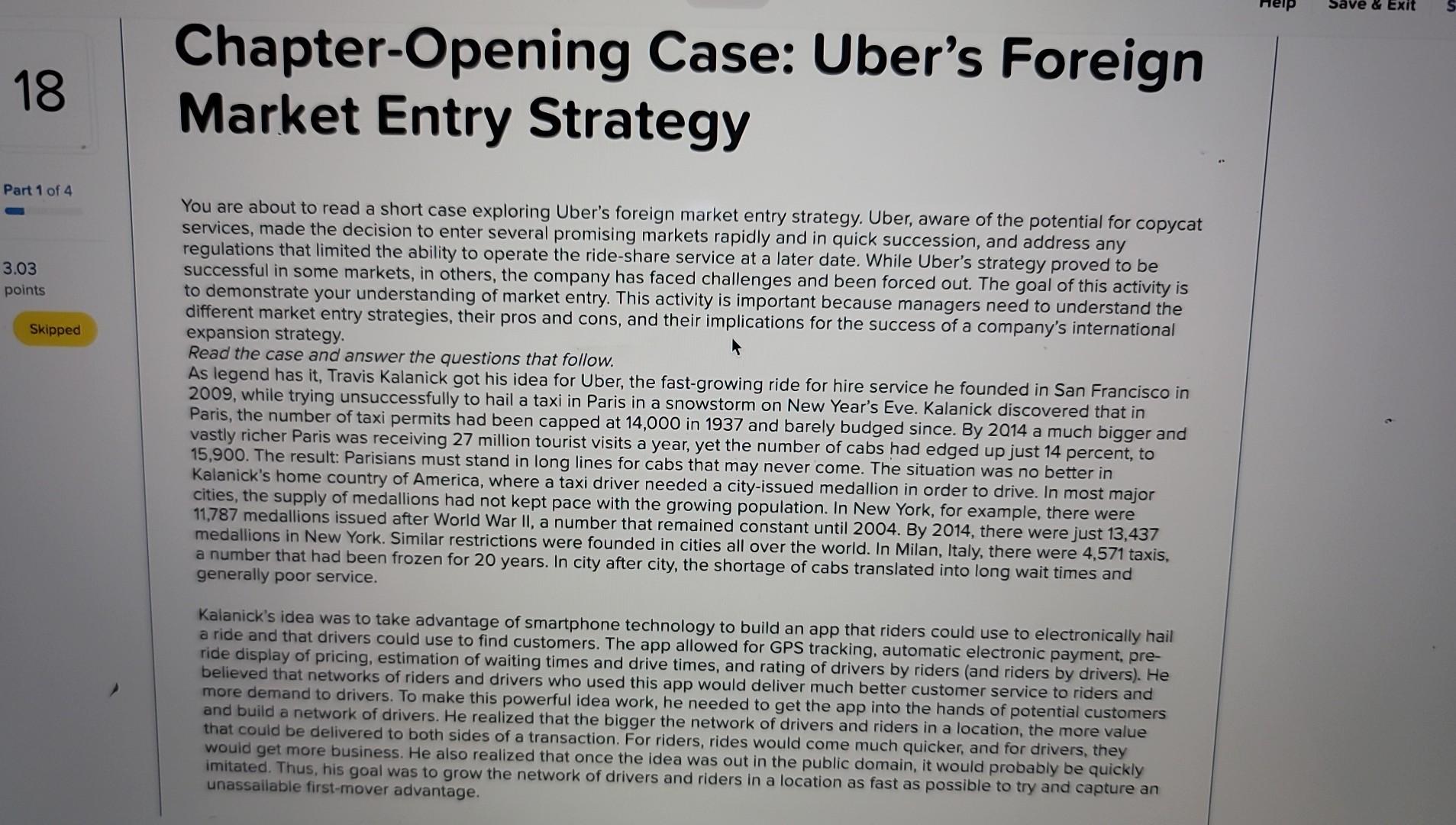
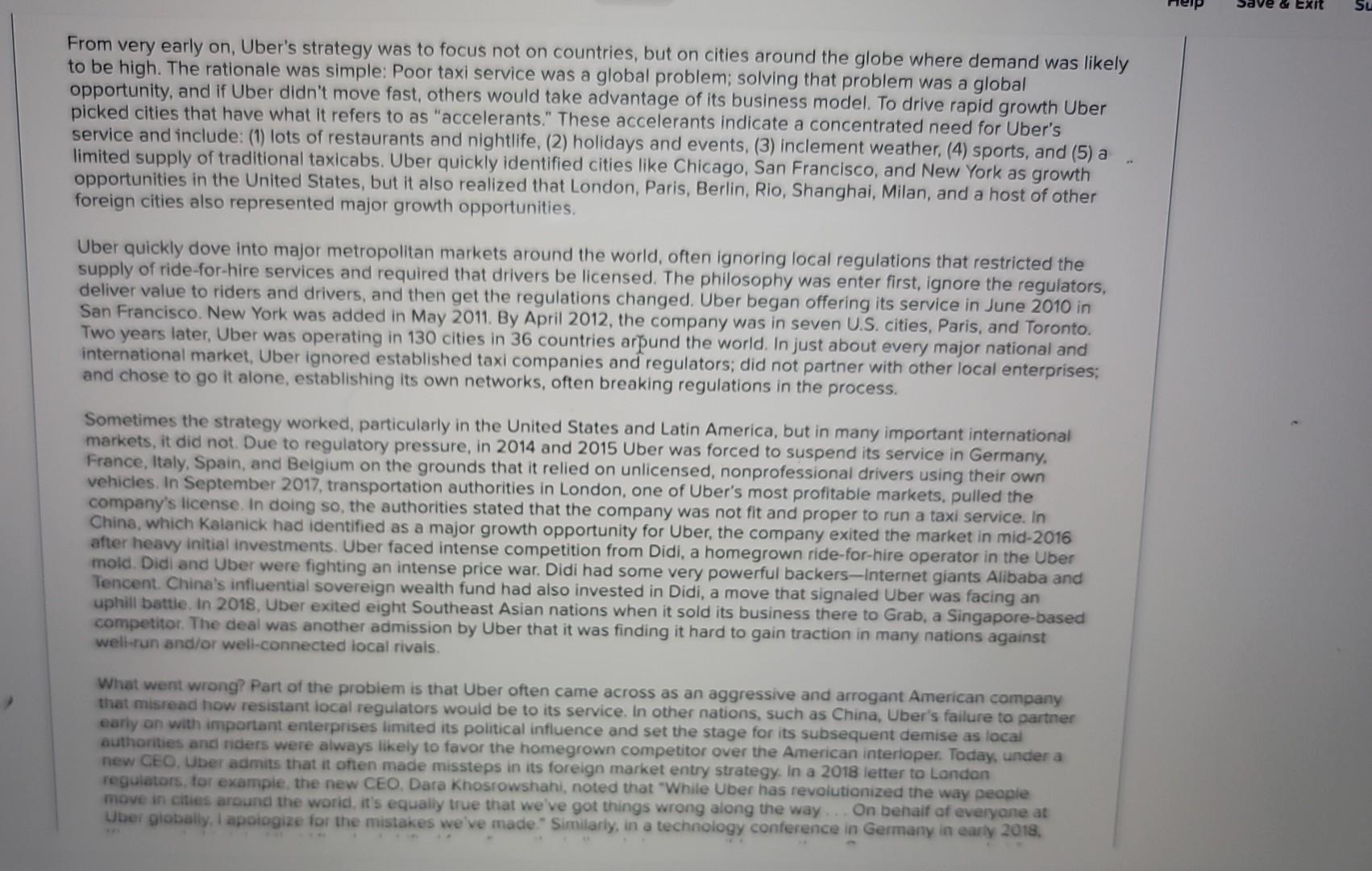
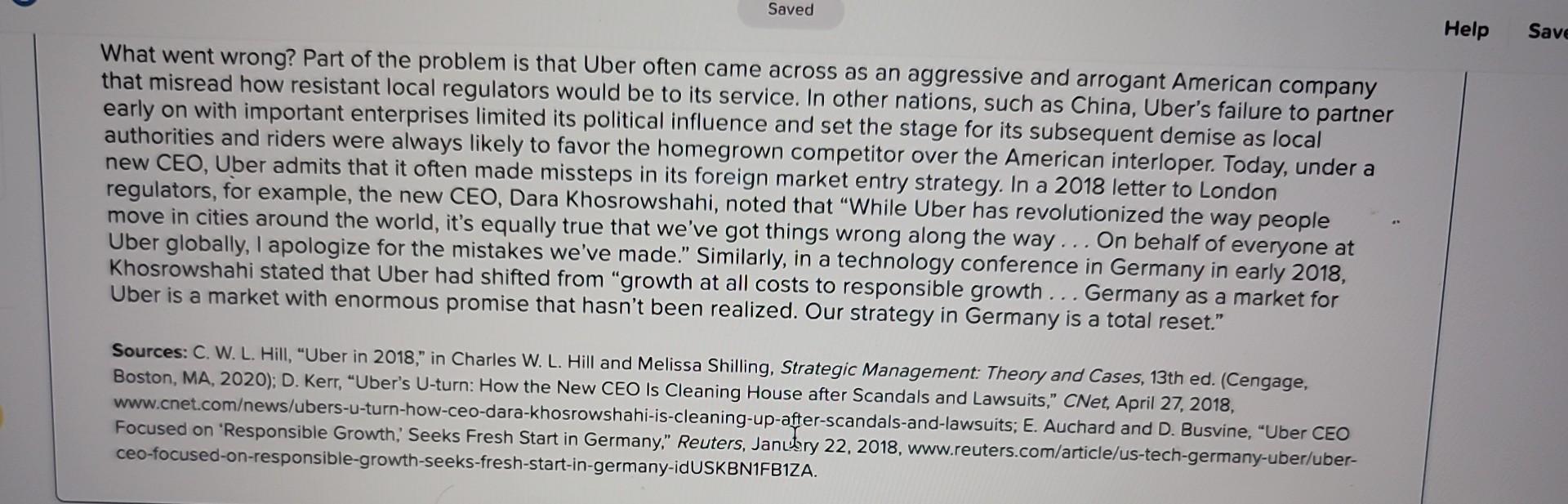
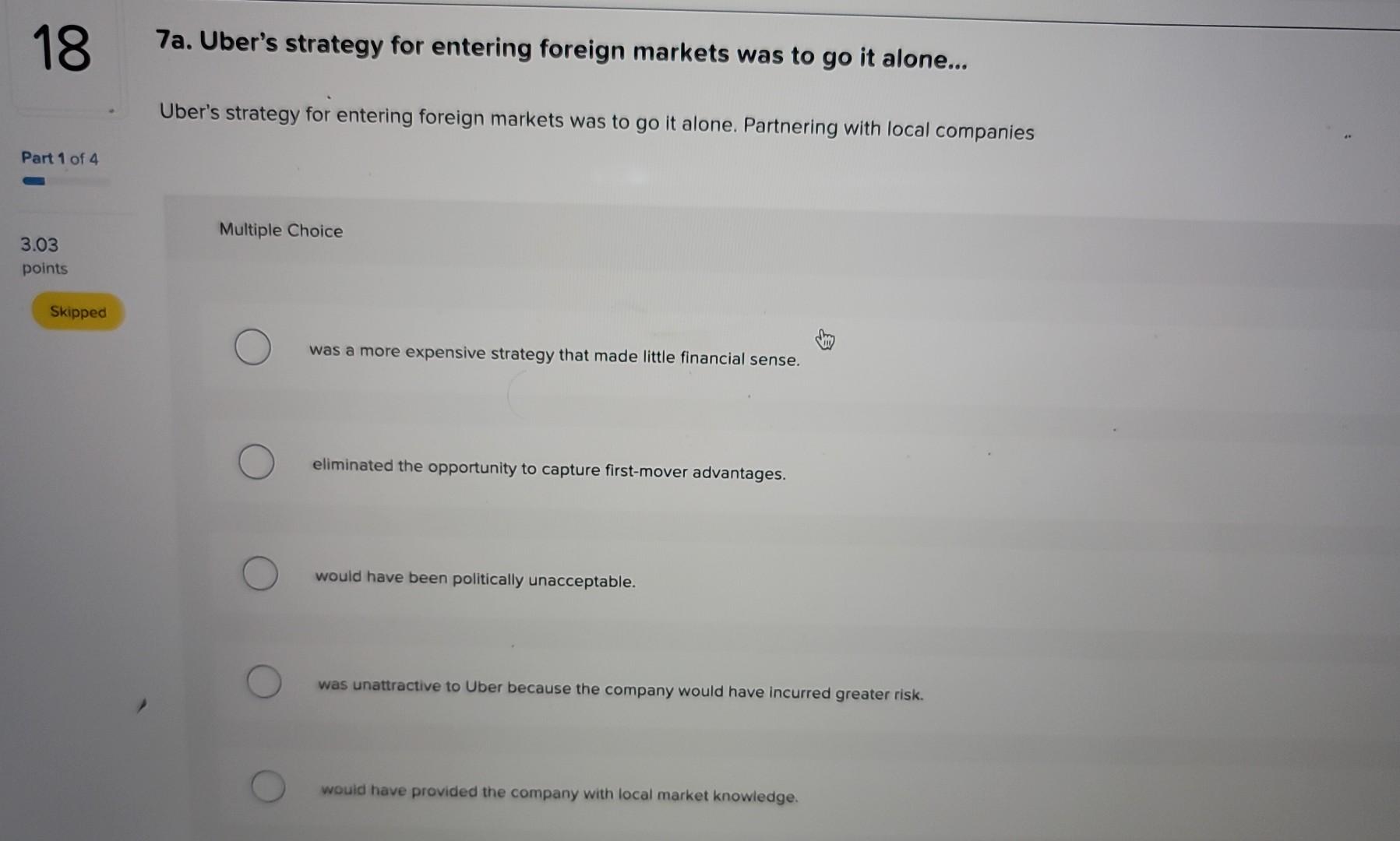
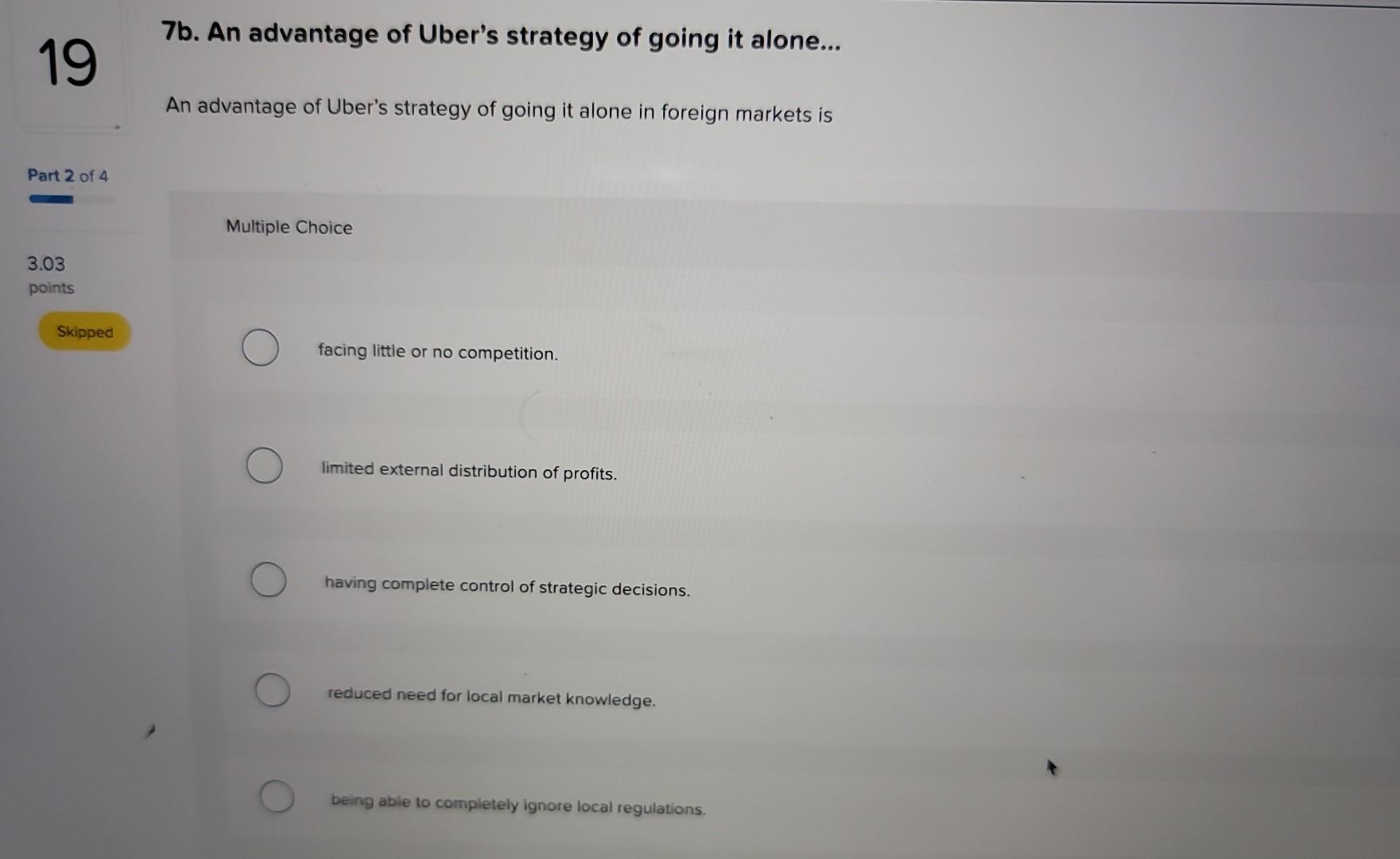
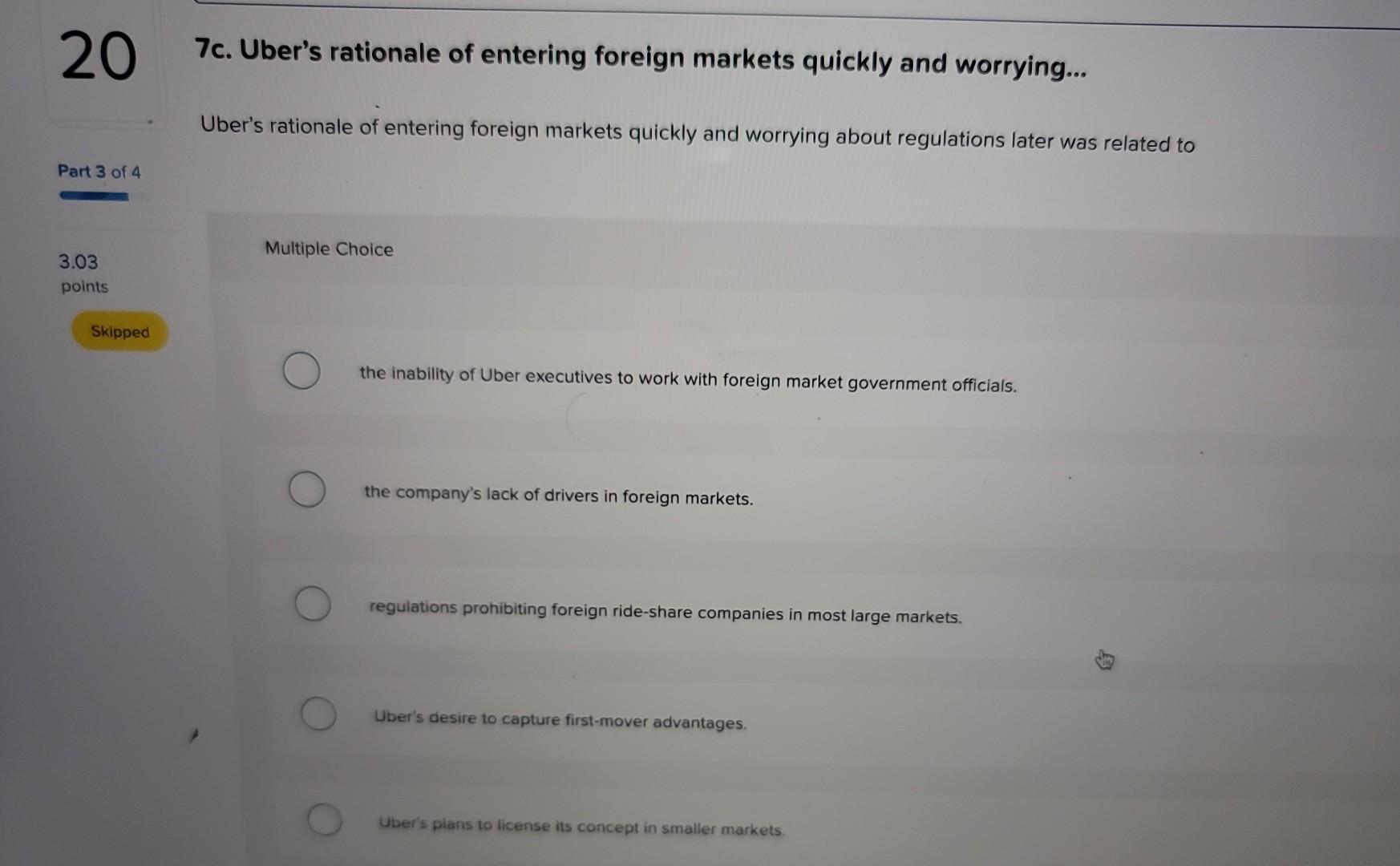
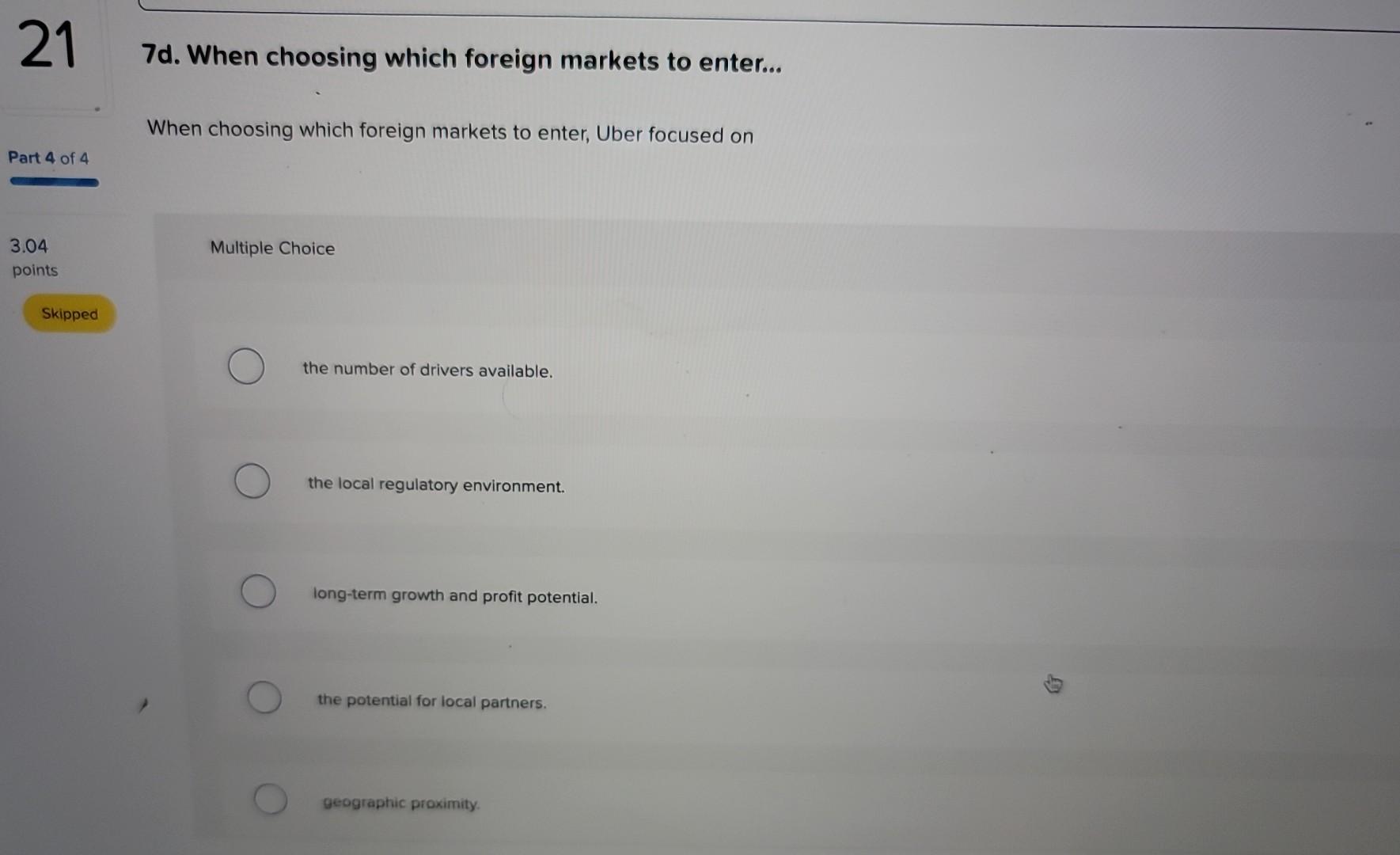
chapter-Opening case: uber's Foreien Narket Entry strateay You are about to read a short case exploring Uber's foreign market entry strategy. Uber, aware of the potential for copycat services, made the decision to enter several promising markets rapidly and in quick succession, and address any regulations that limited the ability to operate the ride-share service at a later date. While Uber's strategy proved to be successful in some markets, in others, the company has faced challenges and been forced out. The goal of this activity is to demonstrate your understanding of market entry. This activity is important because managers need to understand the different market entry strategies, their pros and cons, and their implications for the success of a company's international Read the case and answer the questions that follow. As legend has it, Travis Kalanick got his idea for Uber, the fast-growing ride for hire service he founded in San Francisco in 2009, while trying unsuccessfully to hail a taxi in Paris in a snowstorm on New Year's Eve. Kalanick discovered that in Paris, the number of taxi permits had been capped at 14,000 in 1937 and barely budged since. By 2014 a much bigger and vastly richer Paris was receiving 27 million tourist visits a year, yet the number of cabs had edged up just 14 percent, to 15,900. The result: Parisians must stand in long lines for cabs that may never come. The situation was no better in Kalanick's home country of America, where a taxi driver needed a city-issued medallion in order to drive. In most major cities, the supply of medallions had not kept pace with the growing population. In New York, for example, there were 11,787 medallions issued after World War II, a number that remained constant until 2004. By 2014 , there were just 13,437 medallions in New York. Similar restrictions were founded in cities all over the world. In Milan, Italy, there were 4,571 taxis, generally poor service. Kalanick's idea was to take advantage of smartphone technology to build an app that riders could use to electronically hail a ride and that drivers could use to find customers. The app allowed for GPS tracking, automatic electronic payment, preride display of pricing, estimation of waiting times and drive times, and rating of drivers by riders (and riders by drivers). He believed that networks of riders and drivers who used this app would deliver much better customer service to riders and more demand to drivers. To make this powerful idea work, he needed to get the app into the hands of potential customers and build a network of drivers. He realized that the bigger the network of drivers and riders in a location, the more value that could be delivered to both sides of a transaction. For riders, rides would come much quicker, and for drivers, they would get more business. He also realized that once the idea was out in the public domain, it would probably be quickly imitated. Thus, his goal was to grow the network of drivers and riders in a location as fast as possible to try and capture an unassailable first-mover advantage. From very early on, Uber's strategy was to focus not on countries, but on cities around the globe where demand was likely to be high. The rationale was simple: Poor taxi service was a global problem; solving that problem was a global opportunity, and if Uber didn't move fast, others would take advantage of its business model. To drive rapid growth Uber picked cities that have what it refers to as "accelerants." These accelerants indicate a concentrated need for Uber's service and include: (1) lots of restaurants and nightlife, (2) holidays and events, (3) inclement weather, (4) sports, and (5) a limited supply of traditional taxicabs. Uber quickly identified cities like Chicago, San Francisco, and New York as growth opportunities in the United States, but it also realized that London, Paris, Berlin, Rio, Shanghai, Milan, and a host of other foreign cities also represented major growth opportunities. Uber quickly dove into major metropolitan markets around the world, often ignoring local regulations that restricted the supply of ride-for-hire services and required that drivers be licensed. The philosophy was enter first, ignore the regulators, deliver value to riders and drivers, and then get the regulations changed. Uber began offering its service in June 2010 in San Francisco. New York was added in May 2011. By April 2012, the company was in seven U.S. cities, Paris, and Toronto. Two years later, Uber was operating in 130 cities in 36 countries arpund the world. In just about every major national and international market, Uber ignored established taxi companies and regulators; did not partner with other local enterprises; and chose to go it alone, establishing its own networks, often breaking regulations in the process. Sometimes the strategy worked, particularly in the United States and Latin America, but in many important international markets, it did not. Due to regulatory pressure, in 2014 and 2015 Uber was forced to suspend its service in Germany. France, Italy, Spain, and Belgium on the grounds that it relied on unlicensed, nonprofessional drivers using their own vehicles. In September 2017, transportation authorities in London, one of Uber's most profitable markets, pulled the company's license. In doing so, the authorities stated that the company was not fit and proper to run a taxi service. In China, which Kalanick had identified as a major growth opportunity for Uber, the company exited the market in mid-2016 after heavy initial investments. Uber faced intense competition from Didi, a homegrown ride-for-hire operator in the Uber mold. Didi and Uber were fighting an intense price war. Didi had some very powerful backers-Internet giants Alibaba and Tencent. China's influential sovereign wealth fund had also invested in Didi, a move that signaled Uber was facing an uphill battle. In 2018, Uber exited eight Southeast Asian nations when it sold its business there to Grab, a Singapore-based competitor. The deal was another admission by Uber that it was finding it hard to gain traction in many nations against well-run and/or well-connected iocal rivals. What went wrong? Part of the probiem is that Uber often came across as an aggressive and arrogant American company that misread how resistant iocal regulators would be to its service. In other nations, such as China, Uber's failure to partner early on with important enterprises limited its political influence and set the stage for its subsequent demise as local authorities and riders were always likely to favor the homegrown competitor over the American interloper. Today, under a new CEO, Uber admits that it often made missteps in its foreign market entry strategy. In a 2018 letter to London regulators, for example, the new CEO. Dara Khosrowshahi, noted that "While Uber has revolutionized the way people move in cities around the woric, it's equally true that we 've got things wrong aiong the way... On behaif af everyone at Uber giobally, I apoiogize for the mistakes we 've made." Similarly, in a technology conference in Germany in eary 2018. What went wrong? Part of the problem is that Uber often came across as an aggressive and arrogant American company that misread how resistant local regulators would be to its service. In other nations, such as China, Uber's failure to partner early on with important enterprises limited its political influence and set the stage for its subsequent demise as local authorities and riders were always likely to favor the homegrown competitor over the American interloper. Today, under a new CEO, Uber admits that it often made missteps in its foreign market entry strategy. In a 2018 letter to London regulators, for example, the new CEO, Dara Khosrowshahi, noted that "While Uber has revolutionized the way people move in cities around the world, it's equally true that we've got things wrong along the way... On behalf of everyone at Uber globally, I apologize for the mistakes we've made." Similarly, in a technology conference in Germany in early 2018 , Khosrowshahi stated that Uber had shifted from "growth at all costs to responsible growth... Germany as a market for Uber is a market with enormous promise that hasn't been realized. Our strategy in Germany is a total reset." Sources: C. W. L. Hill, "Uber in 2018," in Charles W. L. Hill and Melissa Shilling, Strategic Management: Theory and Cases, 13th ed. (Cengage, Boston, MA, 2020); D. Kerr, "Uber's U-turn: How the New CEO Is Cleaning House after Scandals and Lawsuits," CNet, April 27, 2018, www.cnet.comews/ubers-u-turn-how-ceo-dara-khosrowshahi-is-cleaning-up-affer-scandals-and-lawsuits; E. Auchard and D. Busvine, "Uber CEO Focused on 'Responsible Growth,' Seeks Fresh Start in Germany," Reuters, Janusyry 22, 2018, www.reuters.com/article/us-tech-germany-uber/uberceo-focused-on-responsible-growth-seeks-fresh-start-in-germany-idUSKBN1FB1ZA. 7a. Uber's strategy for entering foreign markets was to go it alone... Uber's strategy for entering foreign markets was to go it alone. Partnering with local companies Multiple Choice was a more expensive strategy that made little financial sense. eliminated the opportunity to capture first-mover advantages. would have been politically unacceptable. was unattractive to Uber because the company would have incurred greater risk. would have provided the company with local market knowledge. 7b. An advantage of Uber's strategy of going it alone... An advantage of Uber's strategy of going it alone in foreign markets is Multiple Choice facing little or no competition. limited external distribution of profits. having complete control of strategic decisions. reduced need for local market knowledge. being able to completely ignore local regulations. 7c. Uber's rationale of entering foreign markets quickly and worrying... Uber's rationale of entering foreign markets quickly and worrying about regulations later was related Multiple Choice the inability of Uber executives to work with foreign market government officials. the company's lack of drivers in foreign markets. regulations prohibiting foreign ride-share companies in most large markets. Uber's desire to capture first-mover advantages. Uber's plans to license its concept in smaller markets. 7d. When choosing which foreign markets to enter... When choosing which foreign markets to enter, Uber focused on Multiple Choice the number of drivers available. the local regulatory environment. long-term growth and profit potential. the potential for local partners. geographic proximity
Step by Step Solution
There are 3 Steps involved in it
1 Expert Approved Answer
Step: 1 Unlock

Question Has Been Solved by an Expert!
Get step-by-step solutions from verified subject matter experts
Step: 2 Unlock
Step: 3 Unlock