







Question: Chasing Pirates Pirated software is a major challenge to Microsoft which loses hundreds of million of dollars a year to the practice. Piracy rates vary
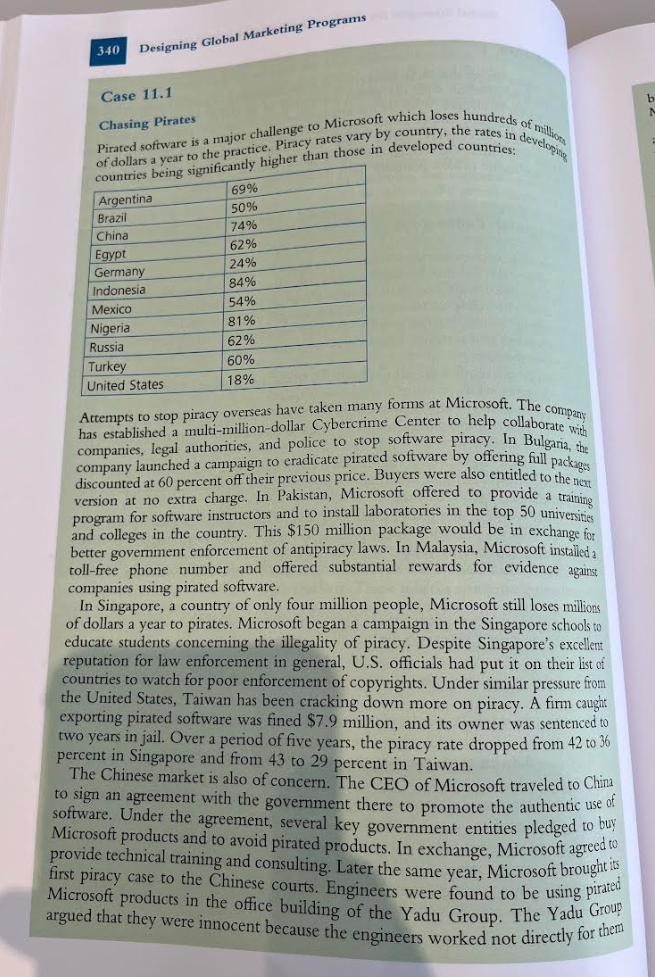
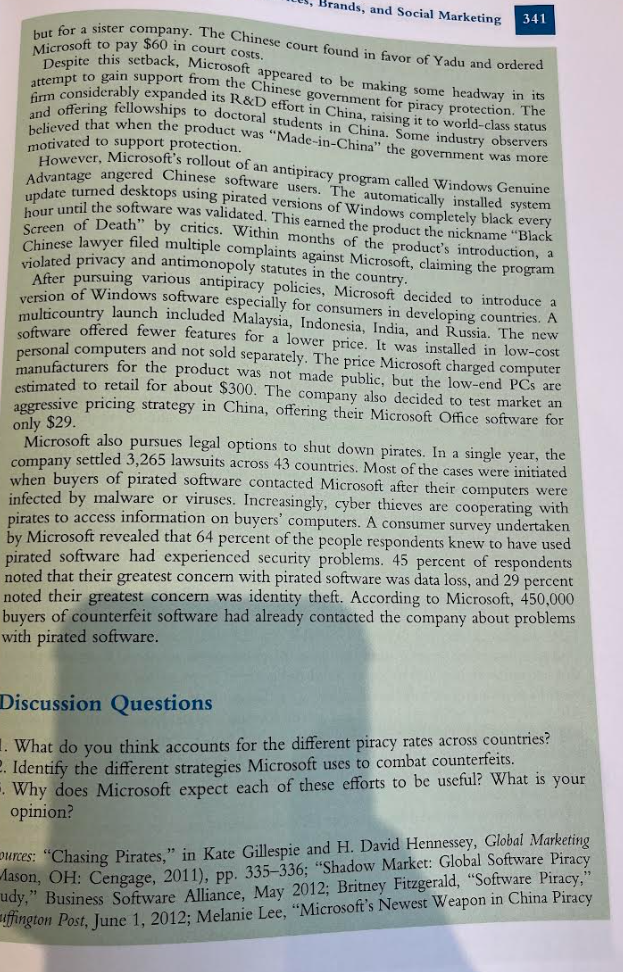
Chasing Pirates Pirated software is a major challenge to Microsoft which loses hundreds of million of dollars a year to the practice. Piracy rates vary by country, the rates in develope Attempts to stop piracy overseas have taken many forms at Microsoft. The company has established a multi-million-dollar Cybercrime Center to help collaborate with companies, legal authorities, and police to stop software piracy. In Bulgaria, the company launched a campaign to eradicate pirated software by offering full packages discounted at 60 percent off their previous price. Buyers were also entitled to the nent version at no extra charge. In Pakistan, Microsoft offered to provide a training program for software instructors and to install laboratories in the top 50 universities and colleges in the country. This $150 million package would be in exchange for better govemment enforcement of antipiracy laws. In Malaysia, Microsoft installed a toll-free phone number and offered substantial rewards for evidence against companies using pirated software. In Singapore, a country of only four million people, Microsoft still loses millions of dollars a year to pirates. Microsoft began a campaign in the Singapore schools to educate students concerning the illegality of piracy. Despite Singapore's excellent reputation for law enforcement in general, U.S. officials had put it on their list of countries to watch for poor enforcement of copyrights. Under similar pressure from the United States, Taiwan has been cracking down more on piracy. A firm caught exporting pirated software was fined $7.9 million, and its owner was sentenced to two years in jail. Over a period of five years, the piracy rate dropped from 42 to 36 percent in Singapore and from 43 to 29 percent in Taiwan. The Chinese market is also of concern. The CEO of Microsoft traveled to Chin to sign an agreement with the government there to promote the authentic use of software. Under the agreement, several key government entities pledged to buy Microsoft products and to avoid pirated products. In exchange, Microsoft agreed to provide technical training and consulting. Later the same year, Microsoft brought its first piracy case to the Chinese courts. Engineers were found to be using pirated Microsoft products in the office building of the Yadu Group. The Yadu Grout argued that they were innocent because the engineers worked not directly for ther but for a sister company. The Chinese court found in favor of Yadu and ordered Microsoft to pay $60 in court costs. Despite this setback, Microsoft appeared to be making some headway in its firm considerably expanded its R\&D effese government for piracy protection. The and offering fellowships to doctoral students in Cha, raising it to world-class status believed that when the product was "Made-in-Chin"" Some industry observers motivated to support protection. However, Microsoft's rollout of Advantage angered Chinese software antipiracy program called Windows Genuine update turned desktops using pirated versers. The automatically installed system hour until the software was validated. This ears of Windows completely black every Screen of Death" by critics. Within months the product the nickname "Black Chinese lawyer filed multiple complaints against Microsoft, claiming the program violated privacy and antimonopoly statutes in the country, claiming the program After pursuing various antipiracy policies, the country. version of Windows software especially for consumeroft decided to introduce a multicountry launch included Malaysia, Indonesia Indiateving countries. A software offered fewer features for a lower price, India, and Russia. The new personal computers and not sold separately. The price. It was installed in low-cost manufacturers for the product was not made price Microsoft charged computer estimated to retail for about $300. The compe public, but the low-end PCs are aggressive pricing strategy in China, offering thy also decided to test market an only $29. Microsoft also pursues legal options to shut down pirates. In a single year, the company settled 3,265 lawsuits across 43 countries. Most of the cases were initiated when buyers of pirated software contacted Microsoft after their computers were infected by malware or viruses. Increasingly, cyber thieves are cooperating with pirates to access information on buyers' computers. A consumer survey undertaken by Microsoft revealed that 64 percent of the people respondents knew to have used pirated software had experienced security problems. 45 percent of respondents noted that their greatest concern with pirated software was data loss, and 29 percent noted their greatest concern was identity theft. According to Microsoft, 450,000 buyers of counterfeit software had already contacted the company about problems with pirated software. Discussion Questions What do you think accounts for the different piracy rates across countries? Identify the different strategies Microsoft uses to combat counterfeits. Why does Microsoft expect each of these efforts to be useful? What is your opinion? ources: "Chasing Pirates," in Kate Gillespie and H. David Hennessey, Global Marketing Aason, OH: Cengage, 2011), pp. 335-336; "Shadow Market: Global Software Piracy udy," Business Software Alliance, May 2012; Britney Fitzgerald, "Software Piracy," uffington Post, June 1, 2012; Melanie Lee, "Microsoft's Newest Weapon in China Piracy
Step by Step Solution
There are 3 Steps involved in it

Get step-by-step solutions from verified subject matter experts
 Study Help