



Question: Check my work please. i Data Table - X Net Sales Revenue Operating Income Average Total Assets Paint Stores 482,000 $ $ 4,010,000 $ 1,300,000
Check my work please.
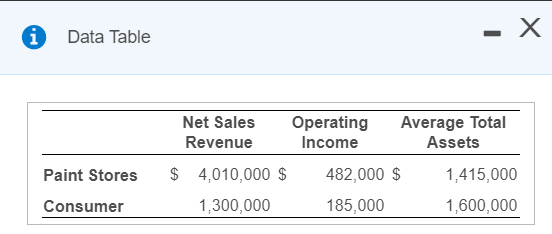
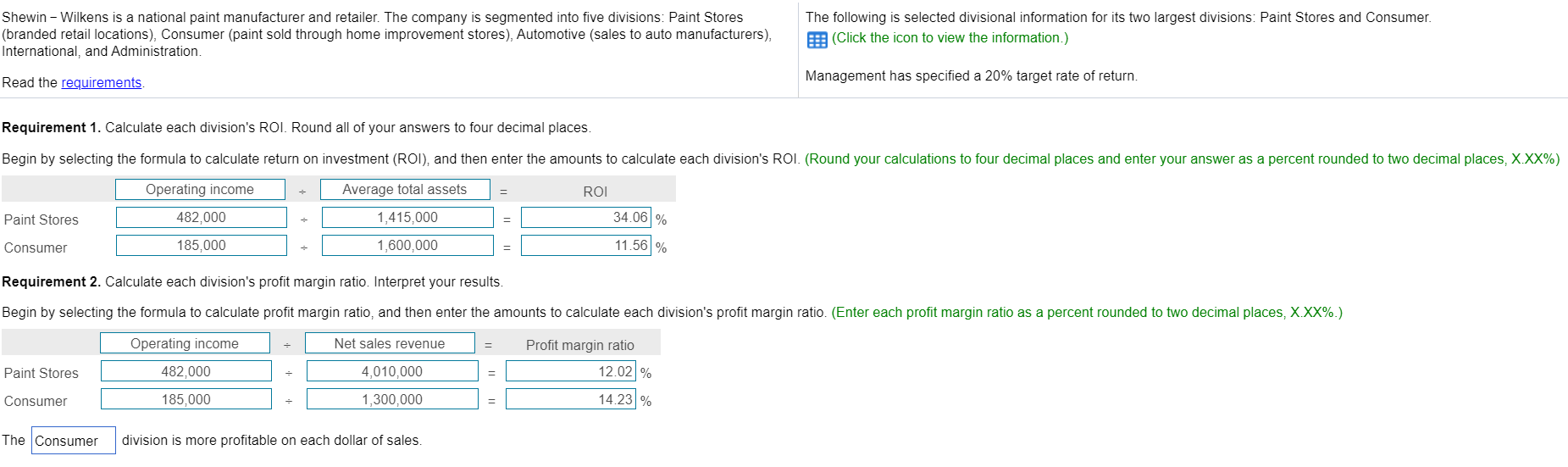
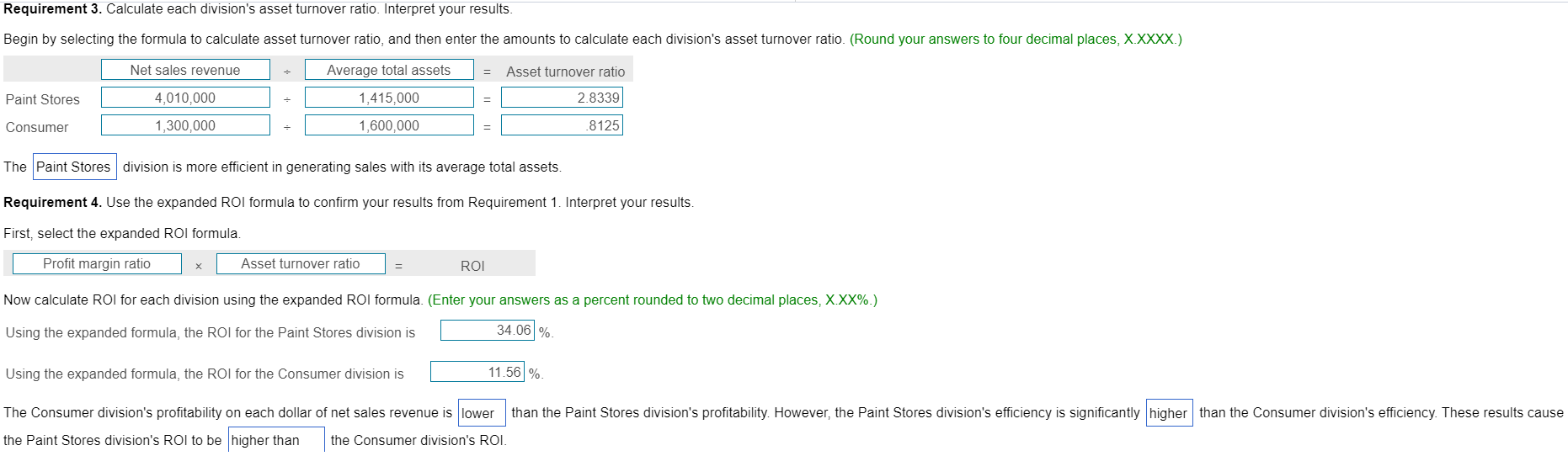
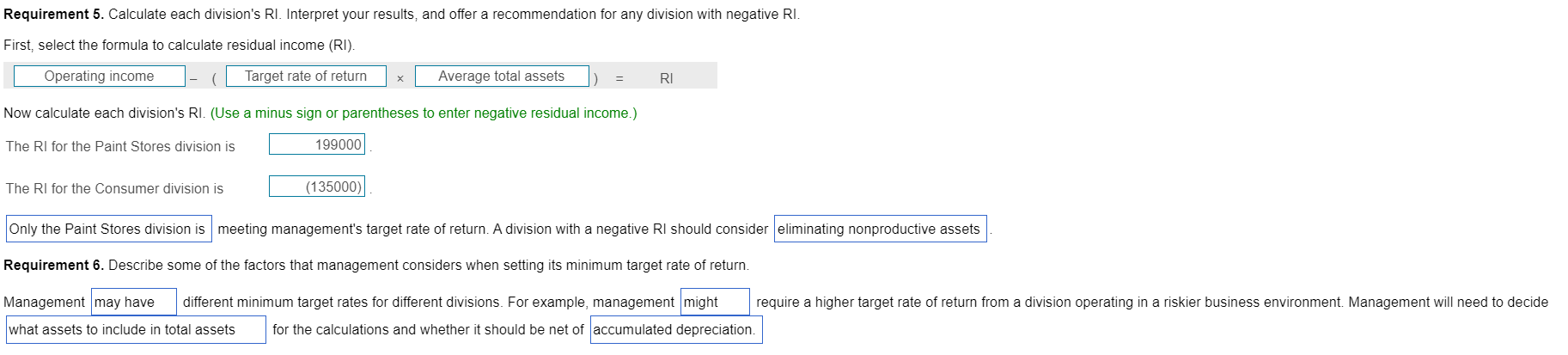
i Data Table - X Net Sales Revenue Operating Income Average Total Assets Paint Stores 482,000 $ $ 4,010,000 $ 1,300,000 1,415,000 1,600,000 Consumer 185,000 Shewin - Wilkens is a national paint manufacturer and retailer. The company is segmented into five divisions: Paint Stores (branded retail locations), Consumer (paint sold through home improvement stores), Automotive (sales to auto manufacturers), International, and Administration. The following is selected divisional information for its two largest divisions: Paint Stores and Consumer. BE: (Click the icon to view the information.) Read the requirements Management has specified a 20% target rate of return Requirement 1. Calculate each division's ROI. Round all of your answers to four decimal places. Begin by selecting the formula to calculate return on investment (ROI), and then enter the amounts to calculate each division's ROI. (Round your calculations to four decimal places and enter your answer as a percent rounded to two decimal places, X.XX%) - Average total assets ROI Operating income 482,000 Paint Stores 1,415,000 34.06% Consumer 185,000 1,600,000 11.56% Requirement 2. Calculate each division's profit margin ratio. Interpret your results. Begin by selecting the formula to calculate profit margin ratio, and then enter the amounts to calculate each division's profit margin ratio. (Enter each profit margin ratio as a percent rounded to two decimal places, X.XX%.) Operating income - Net sales revenue Profit margin ratio Paint Stores 482,000 4,010,000 12.02 % Consumer 185,000 1,300,000 14.23% The Consumer division is more profitable on each dollar of sales. Requirement 3. Calculate each division's asset turnover ratio. Interpret your results. Begin by selecting the formula to calculate asset turnover ratio, and then enter the amounts to calculate each division's asset turnover ratio. (Round your answers to four decimal places, X.XXXX.) Net sales revenue . Average total assets Asset turnover ratio Paint Stores 4,010,000 1,415,000 2.8339 Consumer 1,300,000 1,600,000 .8125 The Paint Stores division is more efficient in generating sales with its average total assets. Requirement 4. Use the expanded ROI formula to confirm your results from Requirement 1. Interpret your results. First, select the expanded ROI formula Profit margin ratio Asset turnover ratio ROI Now calculate ROI for each division using the expanded ROI formula. (Enter your answers as a percent rounded to two decimal places, X.XX%.) Using the expanded formula, the ROI for the Paint Stores division is 34.06% Using the expanded formula, the ROI for the Consumer division is 11.56% The Consumer division's profitability on each dollar of net sales revenue is lower than the Paint Stores division's profitability. However, the Paint Stores division's efficiency is significantly higher than the Consumer division's efficiency. These results cause the Paint Stores division's ROI to be higher than the Consumer division's ROI. Requirement 5. Calculate each division's RI. Interpret your results, and offer a recommendation for any division with negative RI. First, select the formula to calculate residual income (RI). Operating income Target rate of return X Average total assets RI Now calculate each division's RI. (Use a minus sign or parentheses to enter negative residual income.) The Rl for the Paint Stores division is 199000 The RI for the Consumer division is (135000) Only the Paint Stores division is meeting management's target rate of return. A division with a negative RI should consider eliminating nonproductive assets Requirement 6. Describe some of the factors that management considers when setting its minimum target rate of return. Management may have different minimum target rates for different divisions. For example, management might require a higher target rate of return from a division operating in a riskier business environment. Management will need to decide what assets to include in total assets for the calculations and whether it should be net of accumulated depreciation
Step by Step Solution
There are 3 Steps involved in it

Get step-by-step solutions from verified subject matter experts