



Question: Chem 3 0 5 PLEASE HELP WITH THE LAST 3 QUESTIONS Lab Exercise # 6 - Precipitation of C a C O 3 Data Mass
Chem
PLEASE HELP WITH THE LAST QUESTIONS
Lab Exercise # Precipitation of
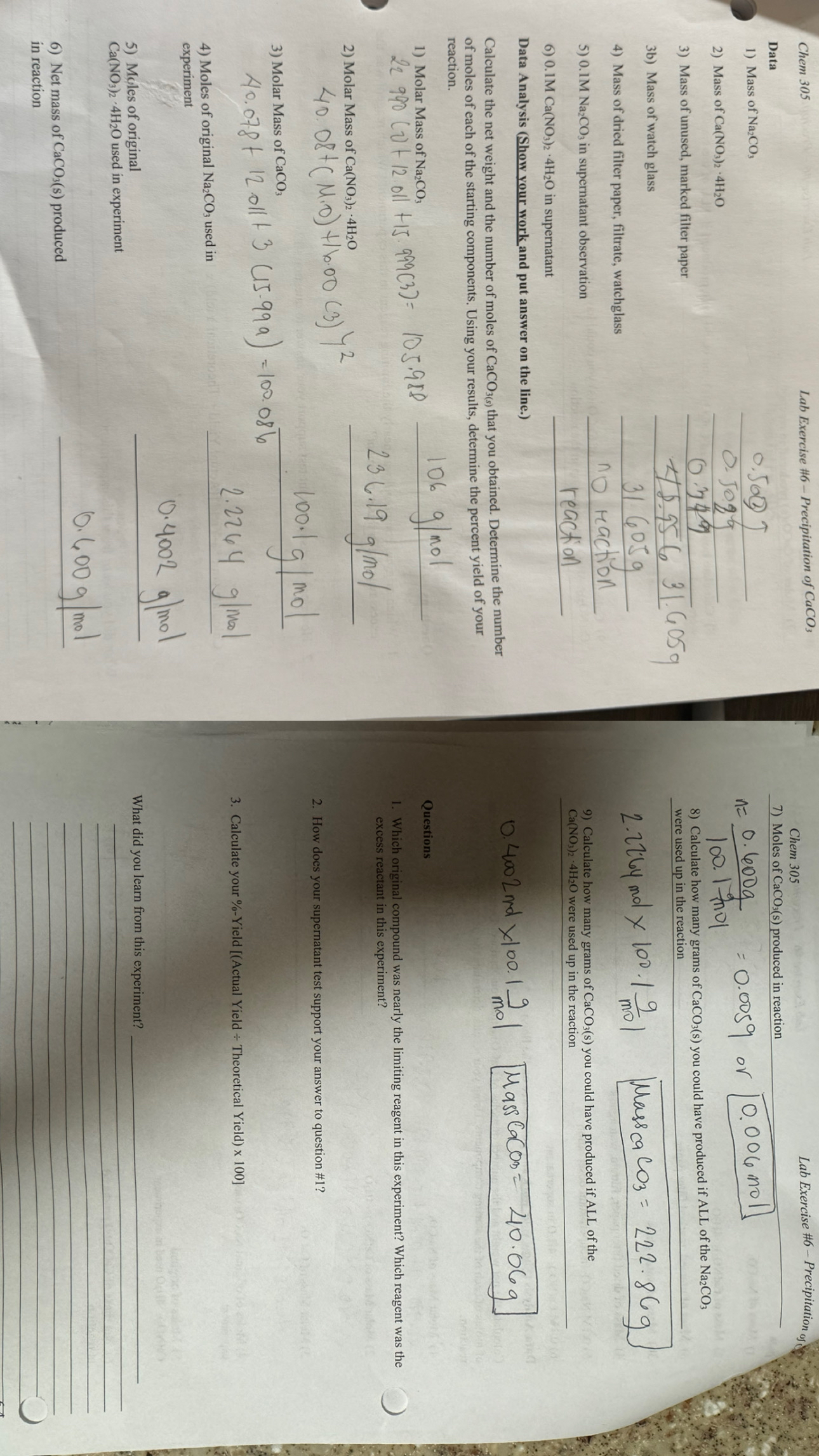
Data
Mass of
Mass of
Mass of unused, marked filter paper
b Mass of watch glass
Mass of dried filter paper, filtrate, watchglass
in supernatant observation
MCa in supernatant
Data Analysis Show your work and put answer on the line.
Calculate the net weight and the number of moles of that you obtained. Determine the number of moles of each of the starting components. Using your results, determine the percent yield of your reaction.
Molar Mass of
Molar Mass
gol
Molar Mass of
Molar Mass of
Moles of original used in experiment
Mules of original used in experiment
Net mass of produced in reaction
Chem
Lab Exercise # Precipitation of
Moles of produced in reaction
or mol
Calculate how many grams of you could have produced if ALL of the were used up in the reaction
mol Massca
Calculate how many grams of you could have produced if ALL of the were used up in the reaction
Mass acon
Questions
Which original compound was nearly the limiting reagent in this experiment? Which reagent was the excess reactant in this experiment?
How does your supernatant test support your answer to question #
Calculate your Yield Actual Yield Theoretical Yield
Step by Step Solution
There are 3 Steps involved in it
1 Expert Approved Answer
Step: 1 Unlock

Question Has Been Solved by an Expert!
Get step-by-step solutions from verified subject matter experts
Step: 2 Unlock
Step: 3 Unlock