







Question: Chess Pieces using JAVA Each chess piece can move in a specific way. In addition to moving, each chess piece can also kill a chess
Chess Pieces using JAVA
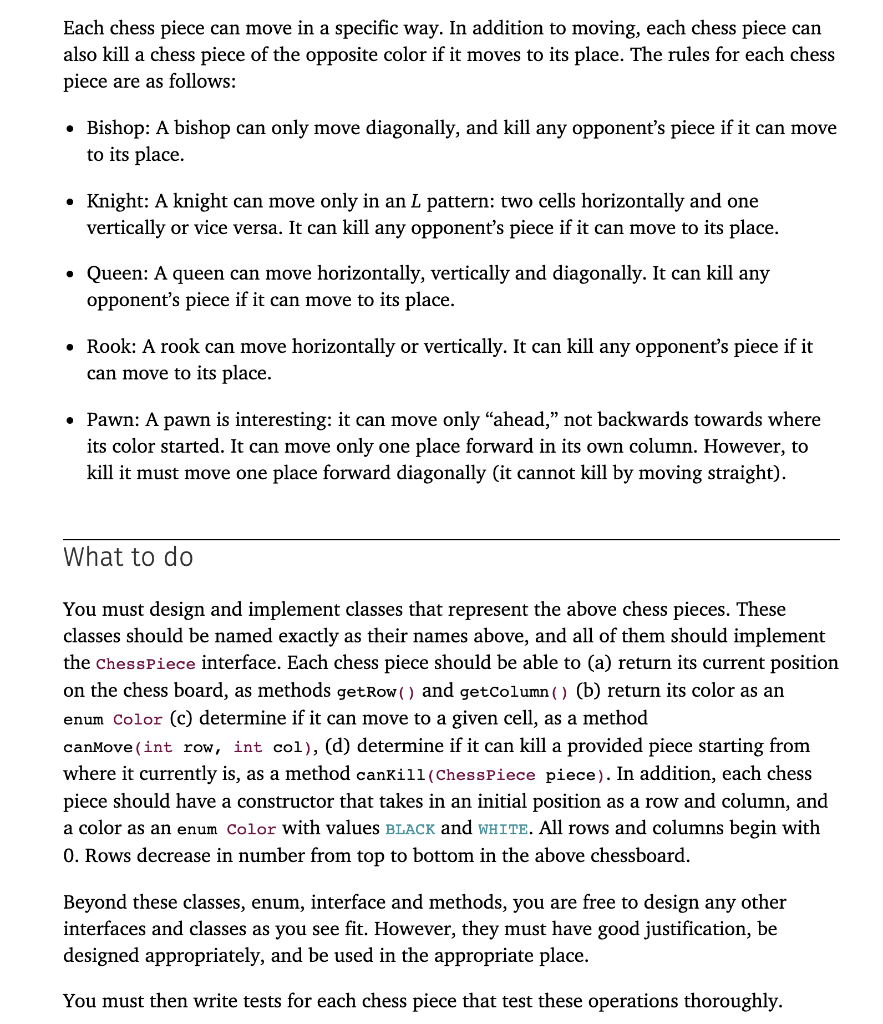
Each chess piece can move in a specific way. In addition to moving, each chess piece can also kill a chess piece of the opposite color if it moves to its place. The rules for each chess piece are as follows: Bishop: A bishop can only move diagonally, and kill any opponent's piece if it can move to its place. Knight: A knight can move only in an L pattern: two cells horizontally and one vertically or vice versa. It can kill any opponent's piece if it can move to its place. Queen: A queen can move horizontally, vertically and diagonally. It can kill any opponent's piece if it can move to its place. Rook: A rook can move horizontally or vertically. It can kill any opponent's piece if it can move to its place. Pawn: A pawn is interesting: it can move only "ahead," not backwards towards where its color started. It can move only one place forward in its own column. However, to kill it must move one place forward diagonally (it cannot kill by moving straight). What to do You must design and implement classes that represent the above chess pieces. These classes should be named exactly as their names above, and all of them should implement the ChessPiece interface. Each chess piece should be able to (a) return its current position on the chess board, as methods getRow() and getColumn ( ) (b) return its color as an enum Color (c) determine if it can move to a given cell, as a method canMove(int row, int col), (d) determine if it can kill a provided piece starting from where it currently is, as a method canKill(ChessPiece piece). In addition, each chess piece should have a constructor that takes in an initial position as a row and column, and a color as an enum Color with values BLACK and WHITE. All rows and columns begin with 0. Rows decrease in number from top to bottom in the above chessboard. Beyond these classes, enum, interface and methods, you are free to design any other interfaces and classes as you see fit. However, they must have good justification, be designed appropriately, and be used in the appropriate place. You must then write tests for each chess piece that test these operations thoroughly. Each chess piece can move in a specific way. In addition to moving, each chess piece can also kill a chess piece of the opposite color if it moves to its place. The rules for each chess piece are as follows: Bishop: A bishop can only move diagonally, and kill any opponent's piece if it can move to its place. Knight: A knight can move only in an L pattern: two cells horizontally and one vertically or vice versa. It can kill any opponent's piece if it can move to its place. Queen: A queen can move horizontally, vertically and diagonally. It can kill any opponent's piece if it can move to its place. Rook: A rook can move horizontally or vertically. It can kill any opponent's piece if it can move to its place. Pawn: A pawn is interesting: it can move only "ahead," not backwards towards where its color started. It can move only one place forward in its own column. However, to kill it must move one place forward diagonally (it cannot kill by moving straight). What to do You must design and implement classes that represent the above chess pieces. These classes should be named exactly as their names above, and all of them should implement the ChessPiece interface. Each chess piece should be able to (a) return its current position on the chess board, as methods getRow() and getColumn ( ) (b) return its color as an enum Color (c) determine if it can move to a given cell, as a method canMove(int row, int col), (d) determine if it can kill a provided piece starting from where it currently is, as a method canKill(ChessPiece piece). In addition, each chess piece should have a constructor that takes in an initial position as a row and column, and a color as an enum Color with values BLACK and WHITE. All rows and columns begin with 0. Rows decrease in number from top to bottom in the above chessboard. Beyond these classes, enum, interface and methods, you are free to design any other interfaces and classes as you see fit. However, they must have good justification, be designed appropriately, and be used in the appropriate place. You must then write tests for each chess piece that test these operations thoroughly
Step by Step Solution
There are 3 Steps involved in it

Get step-by-step solutions from verified subject matter experts
 Study Help