



Question: Choices> Think Before You Act scenario in Chapter 11. Answer all of the questions. choices > THINK S > THINK BEFORE YOU ACT > Workers
Choices> Think Before You Act scenario in Chapter 11. Answer all of the questions.
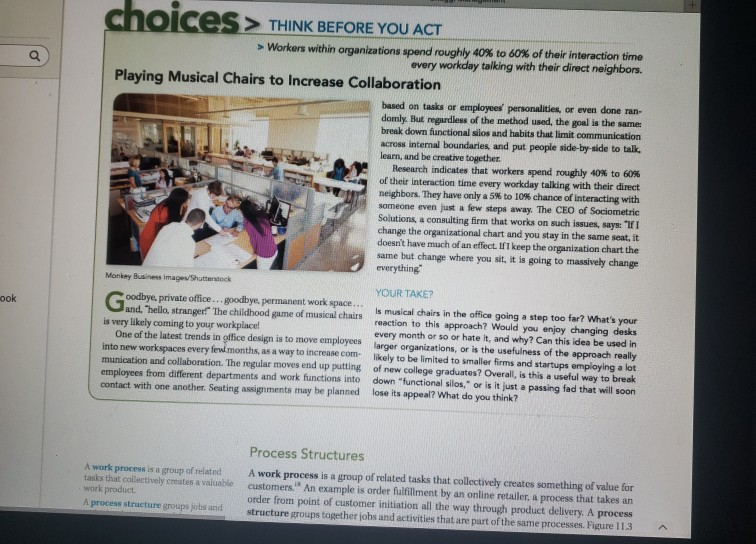
choices > THINK S > THINK BEFORE YOU ACT > Workers within organizations spend roughly 40% to 60% of their interaction time every workday talking with their direct neighbors. Playing Musical Chairs to Increase Collaboration based on tasks or employees' personalities, or even done ran- domly. But regardless of the method used, the goal is the same break down functional silos and habits that limit communication across internal boundaries, and put people side-by-side to talk learn, and be creative together Research indicates that workers spend roughly 40% to 60% of their interaction time every workday talking with their direct neighbors. They have only a 5% to 10% chance of interacting with someone even just a few steps away. The CEO of Sociometric Solutions, a consulting firm that works on such issues, says: "TI change the organizational chart and you stay in the same seat, it doesn't have much of an effect. If I keep the organization chart the same but change where you sit, it is going to massively change everything Monkey Business ImageShutterstock YOUR TAKE? oodbye, private office... goodbye, permanent work space... and "hello, stranger!" The childhood game of musical chairs Is musical chairs in the office going a step too far? What's your reaction to this approach? Would you enjoy changing desks is very likely coming to your workplace! every month or so or hate it, and why? Can this idea be used in One of the latest trends in office design is to move employees farger organizations, or is the usefulness of the approach really into new workspaces every few months, as a way to increase com likely to be limited to smaller firms and startups employing a lot munication and collaboration. The regular moves end up putting of new college graduates? Overall, is this a useful way to break employees from different departments and work functions into down "functional silos," or is it just a passing fad that will soon contact with one another Seating assignments may be planned lose its appeal? What do you think? A work process is a group of related Process Structures work process is a group of related tasks that collectively creates something of value for customers. An example is order fulfillment by an online retailer, a process that takes an order from point of customer initiation all the way through product delivery. A process structure groups together jobs and activities that are part of the same processes. Figure 113 work product A process structure groups jobs and choices > THINK S > THINK BEFORE YOU ACT > Workers within organizations spend roughly 40% to 60% of their interaction time every workday talking with their direct neighbors. Playing Musical Chairs to Increase Collaboration based on tasks or employees' personalities, or even done ran- domly. But regardless of the method used, the goal is the same break down functional silos and habits that limit communication across internal boundaries, and put people side-by-side to talk learn, and be creative together Research indicates that workers spend roughly 40% to 60% of their interaction time every workday talking with their direct neighbors. They have only a 5% to 10% chance of interacting with someone even just a few steps away. The CEO of Sociometric Solutions, a consulting firm that works on such issues, says: "TI change the organizational chart and you stay in the same seat, it doesn't have much of an effect. If I keep the organization chart the same but change where you sit, it is going to massively change everything Monkey Business ImageShutterstock YOUR TAKE? oodbye, private office... goodbye, permanent work space... and "hello, stranger!" The childhood game of musical chairs Is musical chairs in the office going a step too far? What's your reaction to this approach? Would you enjoy changing desks is very likely coming to your workplace! every month or so or hate it, and why? Can this idea be used in One of the latest trends in office design is to move employees farger organizations, or is the usefulness of the approach really into new workspaces every few months, as a way to increase com likely to be limited to smaller firms and startups employing a lot munication and collaboration. The regular moves end up putting of new college graduates? Overall, is this a useful way to break employees from different departments and work functions into down "functional silos," or is it just a passing fad that will soon contact with one another Seating assignments may be planned lose its appeal? What do you think? A work process is a group of related Process Structures work process is a group of related tasks that collectively creates something of value for customers. An example is order fulfillment by an online retailer, a process that takes an order from point of customer initiation all the way through product delivery. A process structure groups together jobs and activities that are part of the same processes. Figure 113 work product A process structure groups jobs andStep by Step Solution
There are 3 Steps involved in it
1 Expert Approved Answer
Step: 1 Unlock

Question Has Been Solved by an Expert!
Get step-by-step solutions from verified subject matter experts
Step: 2 Unlock
Step: 3 Unlock