







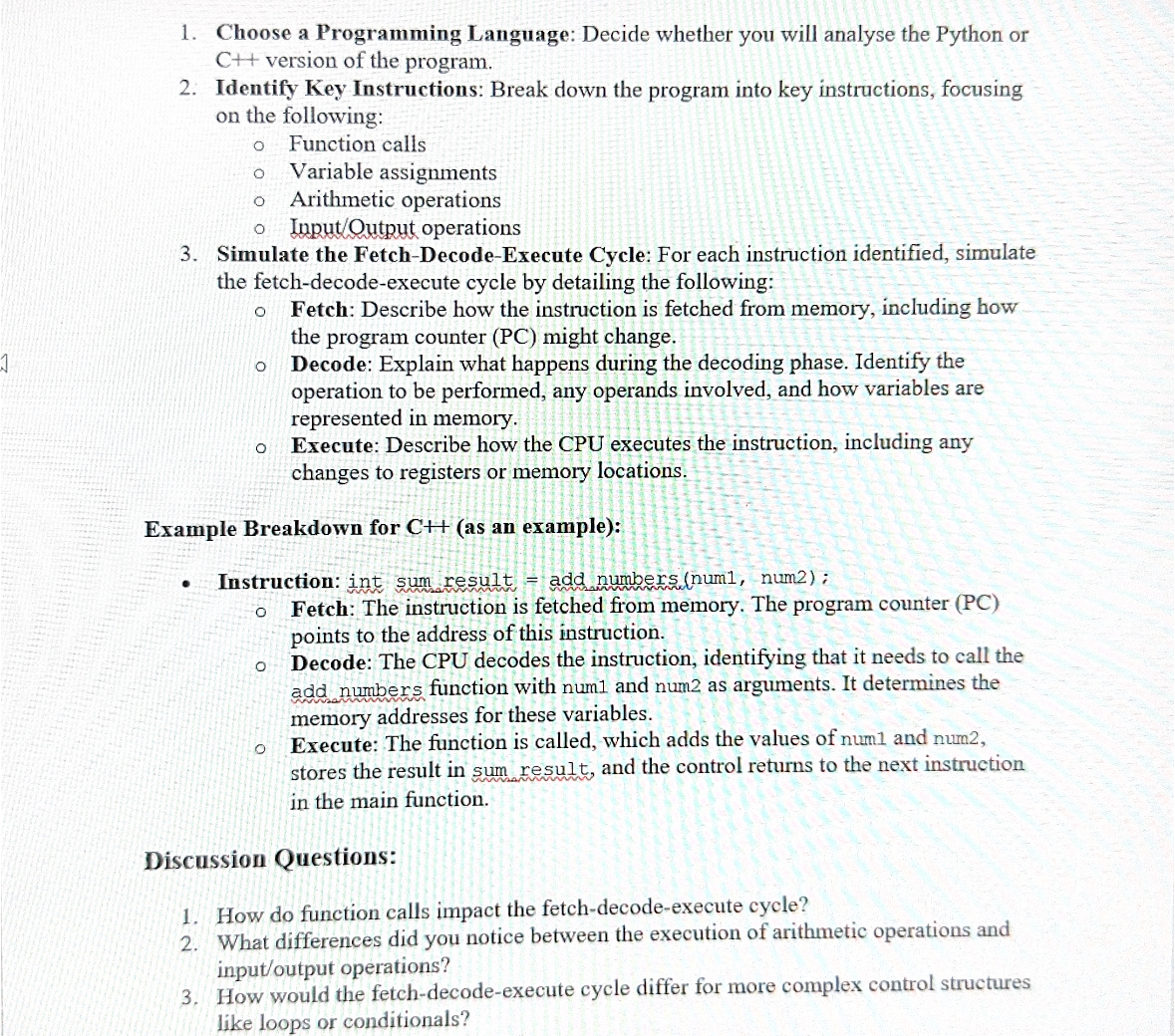
Question: Choose a Programming Language: Decide whether you will analyse the Python or C + + version of the program. Identify Key Instructions: Break down the
Choose a Programming Language: Decide whether you will analyse the Python or
version of the program.
Identify Key Instructions: Break down the program into key instructions, focusing
on the following:
Function calls
Variable assignments
Arithmetic operations
InputQutput operations
Simulate the FetchDecodeExecute Cycle: For each instruction identified, simulate
the fetchdecodeexecute cycle by detailing the following:
Fetch: Describe how the instruction is fetched from memory, including how
the program counter PC might change.
Decode: Explain what happens during the decoding phase. Identify the
operation to be performed, any operands involved, and how variables are
represented in memory.
Execute: Describe how the CPU executes the instruction, including any
changes to registers or memory locations.
Example Breakdown for as an example:
Instruction: int sum result add numbersnum num;
Fetch: The instruction is fetched from memory. The program counter PC
points to the address of this instruction.
Decode: The CPU decodes the instruction, identifying that it needs to call the
add numbers function with num and num as arguments. It determines the
memory addresses for these variables.
Execute: The function is called, which adds the values of num and num
stores the result in sum result, and the control returns to the next instruction
in the main function.
Discussion Questions:
How do function calls impact the fetchdecodeexecute cycle?
What differences did you notice between the execution of arithmetic operations and
inputoutput operations?
How would the fetchdecodeexecute cycle differ for more complex control structures
like loops or conditionals?
Step by Step Solution
There are 3 Steps involved in it
1 Expert Approved Answer
Step: 1 Unlock

Question Has Been Solved by an Expert!
Get step-by-step solutions from verified subject matter experts
Step: 2 Unlock
Step: 3 Unlock
 Study Help