







Question: . Choose an appropriate scale and plot a Force vs. Displacement graph (that's Force on the y-axis and Displacement on the x-axis) using your
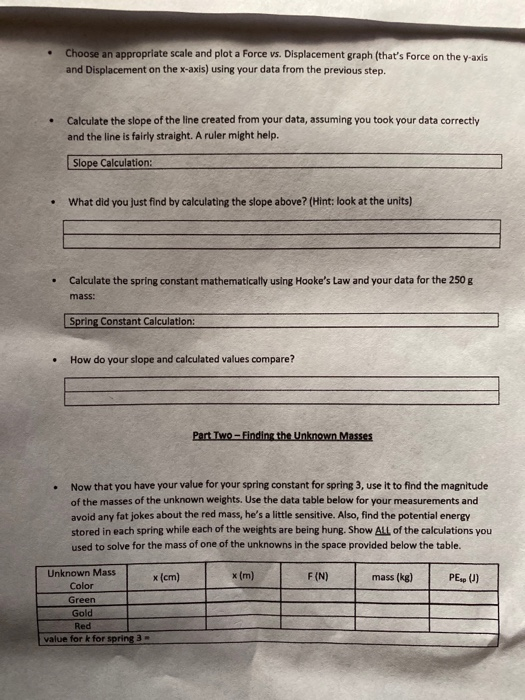
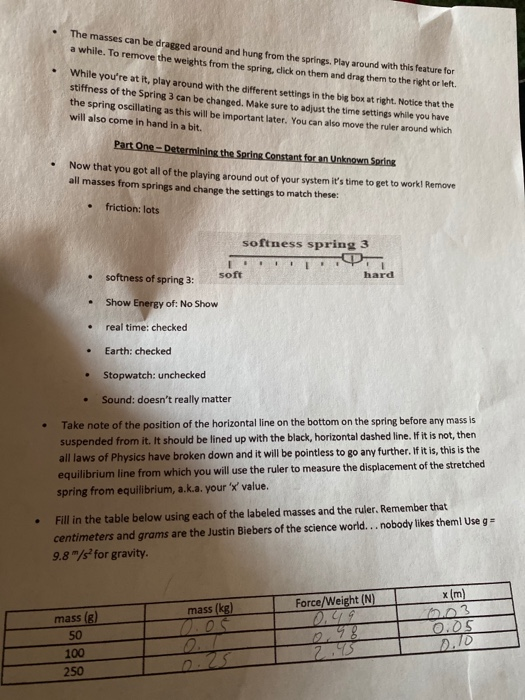
. Choose an appropriate scale and plot a Force vs. Displacement graph (that's Force on the y-axis and Displacement on the x-axis) using your data from the previous step. Calculate the slope of the line created from your data, assuming you took your data correctly and the line is fairly straight. A ruler might help. Slope Calculation: What did you just find by calculating the slope above? (Hint: look at the units) Calculate the spring constant mathematically using Hooke's Law and your data for the 250 g mass: Spring Constant Calculation: How do your slope and calculated values compare? Now that you have your value for your spring constant for spring 3, use it to find the magnitude of the masses of the unknown weights. Use the data table below for your measurements and avoid any fat jokes about the red mass, he's a little sensitive. Also, find the potential energy stored in each spring while each of the weights are being hung. Show ALL of the calculations you used to solve for the mass of one of the unknowns in the space provided below the table. mass (kg) Unknown Mass Color Green Gold Red value for k for spring 3- Part Two-Finding the Unknown Masses x (cm) x (m) F (N) PE (J) . The masses can be dragged around and hung from the springs. Play around with this feature for a while. To remove the weights from the spring, click on them and drag them to the right or left. While you're at it, play around with the different settings in the big box at right. Notice that the stiffness of the Spring 3 can be changed. Make sure to adjust the time settings while you have the spring oscillating as this will be important later. You can also move the ruler around which will also come in hand in a bit. Part One-Determining the Spring Constant for an Unknown Spring Now that you got all of the playing around out of your system it's time to get to work! Remove all masses from springs and change the settings to match these: . friction: lots . . . . . 100 250 softness of spring 3: Show Energy of: No Show real time: checked Earth: checked mass (g) 50 softness spring 3 " soft Stopwatch: unchecked. Sound: doesn't really matter Take note of the position of the horizontal line on the bottom on the spring before any mass is suspended from it. It should be lined up with the black, horizontal dashed line. If it is not, then all laws of Physics have broken down and it will be pointless to go any further. If it is, this is the equilibrium line from which you will use the ruler to measure the displacement of the stretched spring from equilibrium, a.k.a. your 'x' value. mass (kg) I I OPTI Fill in the table below using each of the labeled masses and the ruler. Remember that centimeters and grams are the Justin Biebers of the science world... nobody likes them! Use g = 9.8 m/s for gravity. hard Force/Weight (N) 0.49 2.98 2.93 x (m) 0.05 0.10
Step by Step Solution
3.58 Rating (155 Votes )
There are 3 Steps involved in it

Get step-by-step solutions from verified subject matter experts
 Study Help