







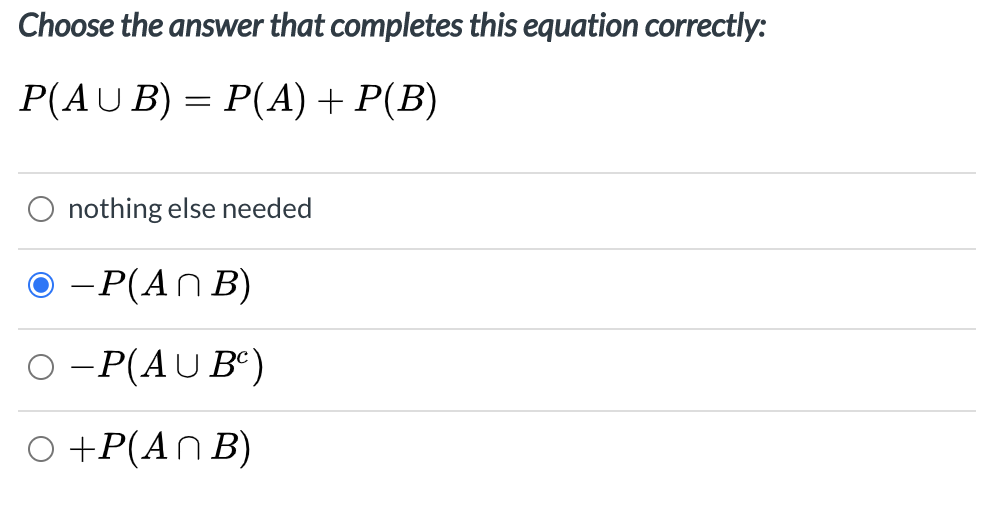
Question: Choose the answer that completes this equation correctly: P(AUB) = P(A) + P(B) O nothing else needed O -PAnB O -P(AUBC) O +P(AnB)ffTRUE or FALSE?
![of the possible V [Select] I must sum up to 1. flibbertigibbets](https://dsd5zvtm8ll6.cloudfront.net/si.experts.images/questions/2024/10/6709686b210c3_8026709686ae3b9a.jpg)
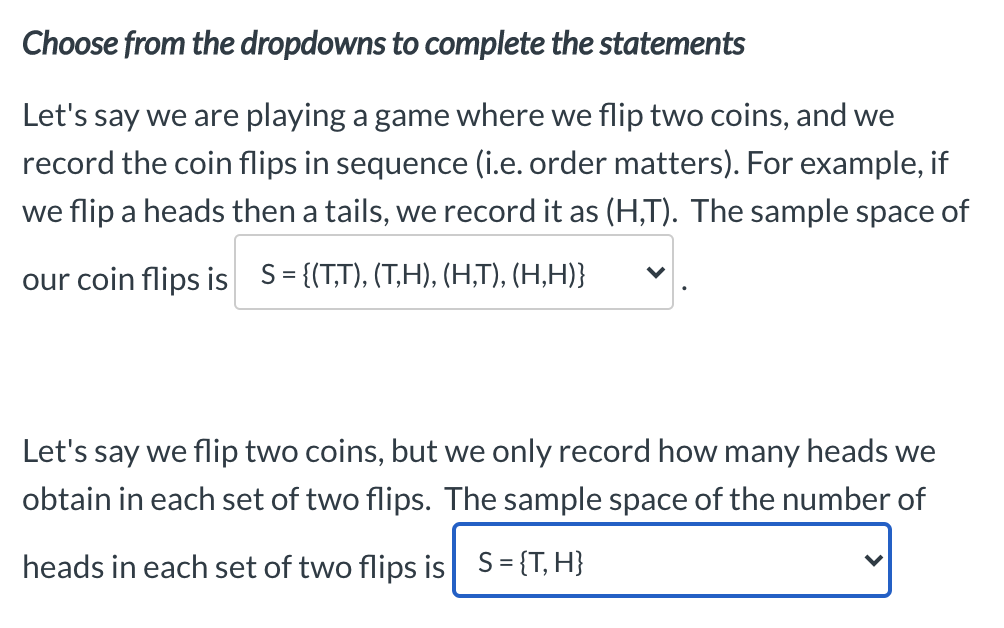
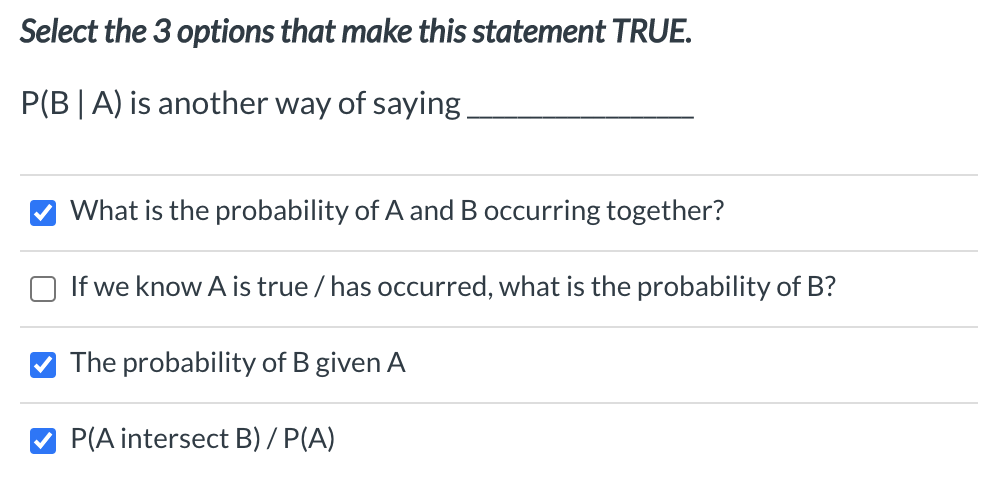
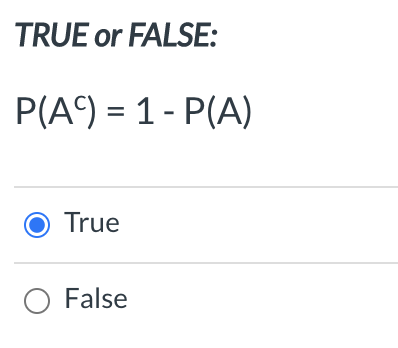
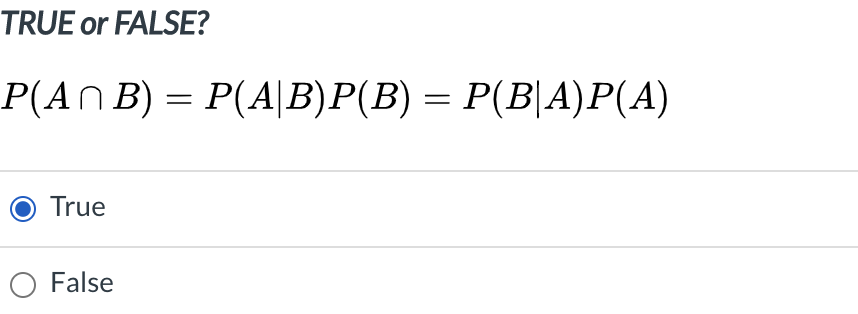
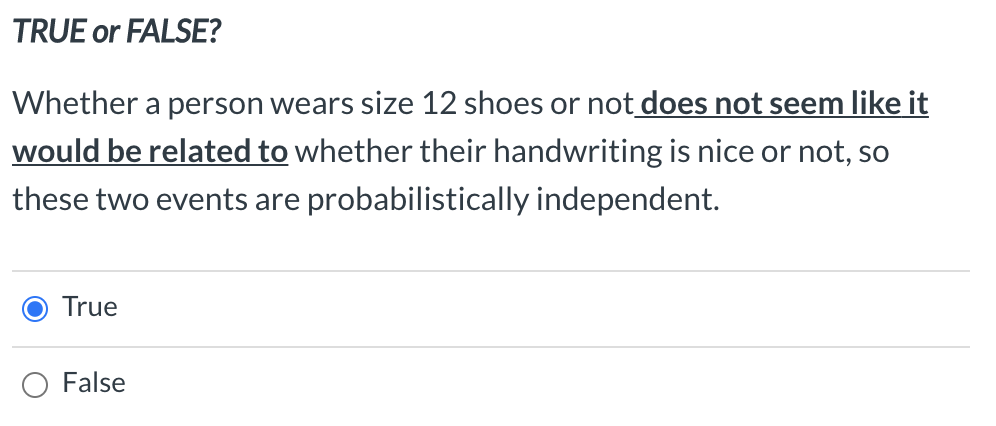
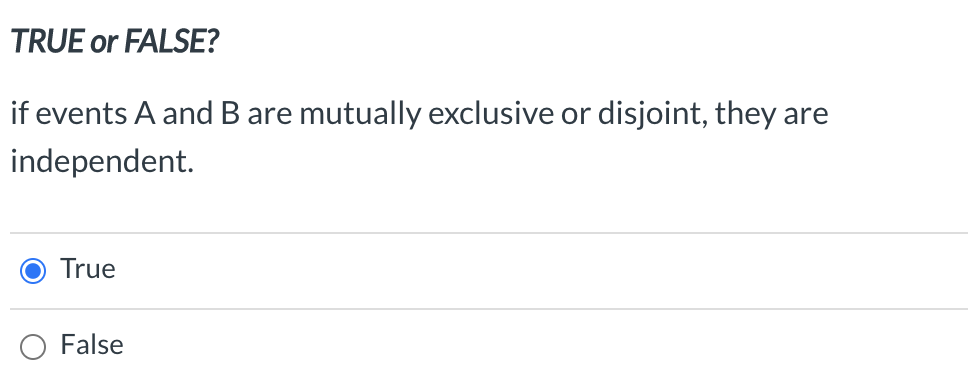
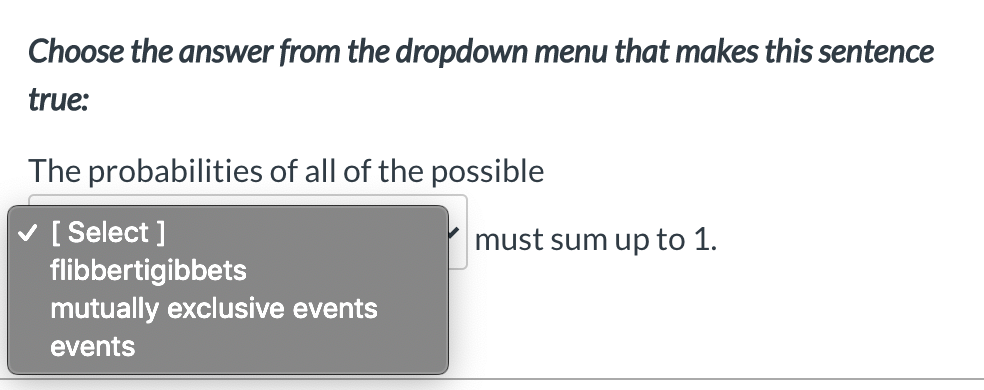
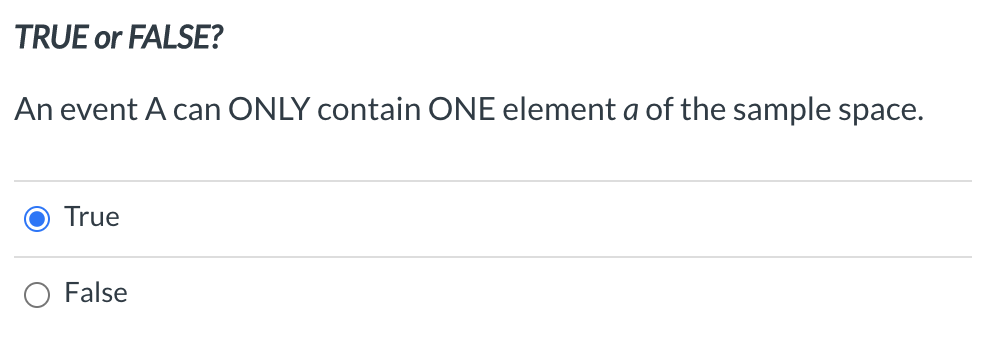
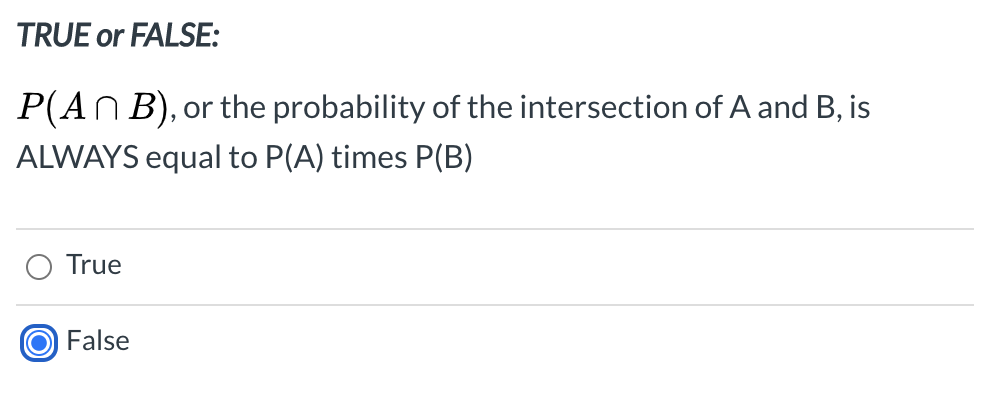
Choose the answer that completes this equation correctly: P(AUB) = P(A) + P(B) O nothing else needed O -PAnB O -P(AUBC) O +P(AnB)\f\fTRUE or FALSE? Whether a person wears size 12 shoes or not does not seem like it would be related to whether their handwriting is nice or not, so these two events are probabilistically independent. True 0 False TRUE or FALSE? if events A and B are mutually exclusive or disjoint, they are independent True 0 False Choose the answer from the dmpdown menu that makes this sentence true: The probabilities of all of the possible V [Select] I must sum up to 1. flibbertigibbets mutually exclusive events events TRUE or FALSE? An event A can ONLY contain ONE element a of the sample space. (0) True 0 False TRUE or FALSE: P(A H B), or the probability of the intersection of A and B, is ALWAYS equal to P(A) times P(B) 0 True False Choose from the dropdowns to complete the statements Let's say we are playing a game where we flip two coins, and we record the coin flips in sequence (i.e. order matters). For example, if we flip a heads then a tails, we record it as (H,T). The sample space of our coin flips is [ Select ] Let's say we flip two coins, but we only record how many heads we obtain in each set of two flips. The sample space of the number of heads in each set of two flips is [ Select ]Choose from the dropdowns to complete the statements Let's say we are playing a game where we flip two coins, and we record the coin flips in sequence (i.e. order matters). For example, if we flip a heads then a tails, we record it as (H,T). The sample space of our coin flips is S = {(T,T), (T,H), (H,T), (H,H) } V Let's say we flip two coins, but we only record how many heads we obtain in each set of two flips. The sample space of the number of heads in each set of two flips is S = {T, H}Select the 3 options that make this statement TRUE. P(B | A) is another way of saying What is the probability of A and B occurring together? C] If we know A is true / has occurred, what is the probability of B? The probability of B given A P(A intersect B)/ P(A)
Step by Step Solution
There are 3 Steps involved in it

Get step-by-step solutions from verified subject matter experts
 Study Help