





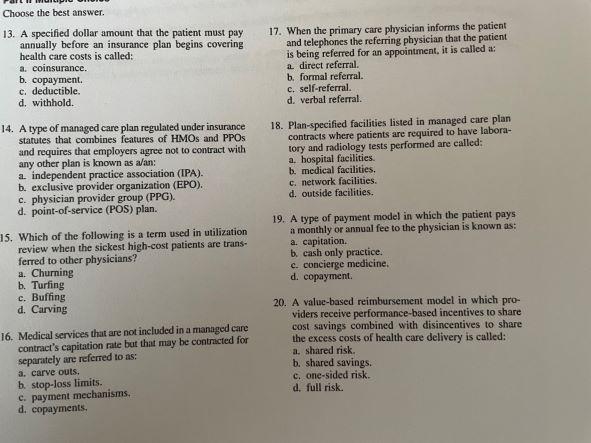
Question: Choose the best answer. 13. A specified dollar amount that the patient must pay annually before an insurance plan begins covering health care costs is
Choose the best answer. 13. A specified dollar

Choose the best answer. 13. A specified dollar amount that the patient must pay annually before an insurance plan begins covering health care costs is called: a. coinsurance. b. copayment. c. deductible. d. withhold. 17. When the primary care physician informs the patient and telephones the referring physician that the patient is being referred for an appointment, it is called a: a direct referral. b. formal referral c. self-referral d. verbal referral. 18. Plan-specified facilities listed in managed care plan contracts where patients are required to have labora- tory and radiology tests performed are called: a. hospital facilities. b. medical facilities. c. network facilities. d. outside facilities. 14. A type of managed care plan regulated under insurance statutes that combines features of HMOs and PPOs and requires that employers agree not to contract with any other plan is known as aan: a. independent practice association (IPA). b. exclusive provider organization (EPO). c. physician provider group (PPG) d. point-of-service (POS) plan. 15. Which of the following is a term used in utilization review when the sickest high-cost patients are trans- ferred to other physicians? a. Churning b. Turfing c. Buffing d. Carving 19. A type of payment model in which the patient pays a monthly or annual fee to the physician is known as: a. capitation b, cash only practice. e. concierge medicine, d. copayment 16. Medical services that are not included in a mannged care contract's capitation rate but that may be contracted for separately are referred to as: a. carve outs. h stop-loss limits. c. payment mechanisms. d. copayments 20. A value-based reimbursement model in which pro- viders receive performance-based incentives to share cost savings combined with disincentives to share the excess costs of health care delivery is called: a. shared risk. b. shared savings. c. one-sided risk. d. full risk

Step by Step Solution

There are 3 Steps involved in it

1 Expert Approved Answer
Step: 1 Unlock blur-text-image

Question Has Been Solved by an Expert!

Get step-by-step solutions from verified subject matter experts

Step: 2 Unlock
Step: 3 Unlock

Students Have Also Explored These Related General Management Questions!