





Question: Choose the CORRECT statement concerning torts: Select one: O a. Any direct intentional interference causing damage to the goods of another is a trespass to
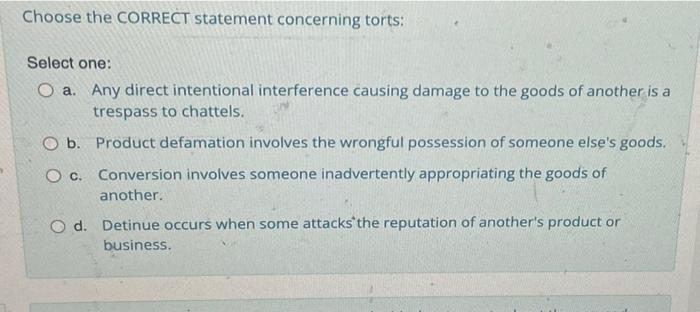
Choose the CORRECT statement concerning torts:
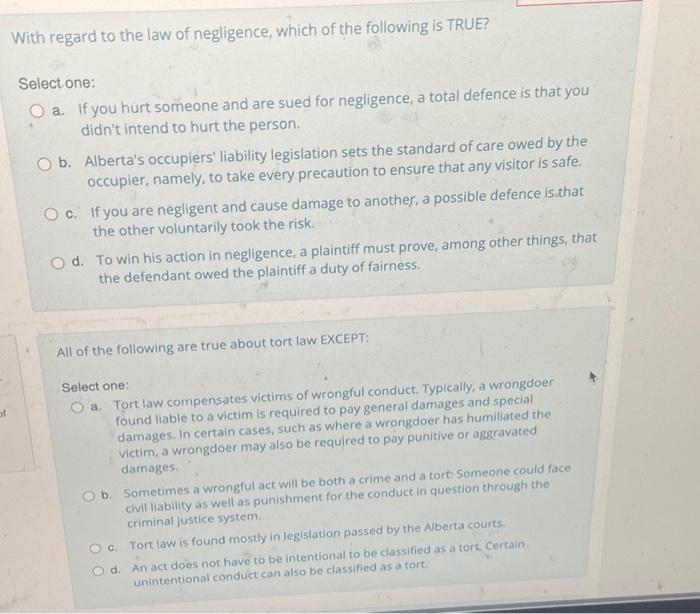
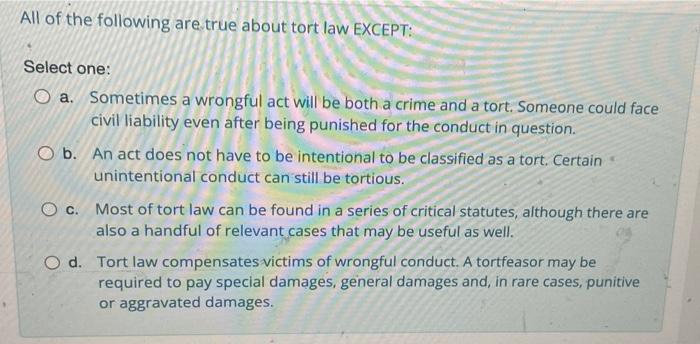
Choose the CORRECT statement concerning torts: Select one: O a. Any direct intentional interference causing damage to the goods of another is a trespass to chattels. Ob. Product defamation involves the wrongful possession of someone else's goods, Oc. Conversion involves someone inadvertently appropriating the goods of another. O d. Detinue occurs when some attacks the reputation of another's product or business. With regard to the law of negligence, which of the following is TRUE? Select one: O a. If you hurt someone and are sued for negligence, a total defence is that you didn't intend to hurt the person. b. Alberta's occupiers' liability legislation sets the standard of care owed by the occupier, namely, to take every precaution to ensure that any visitor is safe. OC. If you are negligent and cause damage to another, a possible defence is that the other voluntarily took the risk. d. To win his action in negligence, a plaintiff must prove, among other things, that the defendant owed the plaintiff a duty of fairness, All of the following are true about tort law EXCEPT: of Select one: a Tort law compensates victims of wrongful conduct. Typically, a wrongdoer found liable to a victim is required to pay general damages and special damages. In certain cases, such as where a wrongdoer has humiliated the victim, a wrongdoer may also be required to pay punitive or aggravated damages. O b. Sometimes a wrongful act will be both a crime and a tort Someone could face civil liability as well as punishment for the conduct in question through the criminal Justice system OC: Tort law is found mostly in legislation passed by the Alberta courts. Od. An act does not have to be intentional to be classified as a tort. Certain unintentional conduct can also be classified as a tort All of the following are true about tort law EXCEPT: Select one: a. Sometimes a wrongful act will be both a crime and a tort. Someone could face civil liability even after being punished for the conduct in question. O b. An act does not have to be intentional to be classified as a tort. Certain unintentional conduct can still be tortious. O c. Most of tort law can be found in a series of critical statutes, although there are also a handful of relevant cases that may be useful as well. O d. Tort law compensates victims of wrongful conduct. A tortfeasor may be required to pay special damages, general damages and, in rare cases, punitive or aggravated damages. a
Step by Step Solution

There are 3 Steps involved in it

1 Expert Approved Answer
Step: 1 Unlock blur-text-image

Question Has Been Solved by an Expert!

Get step-by-step solutions from verified subject matter experts

Step: 2 Unlock
Step: 3 Unlock

Students Have Also Explored These Related General Management Questions!