Question: Chris & Co. manufactures three products using three different machines. Selling price per unit are $21 for product 1, $22 for product 2, and $34
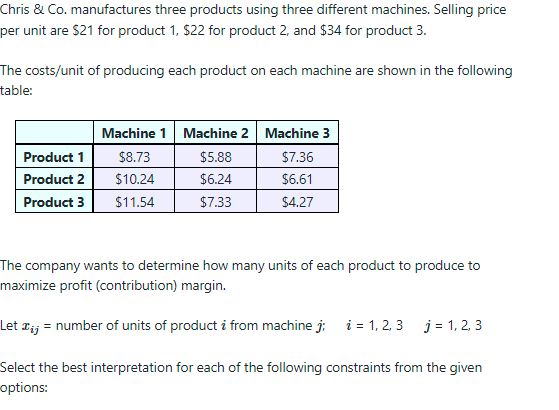
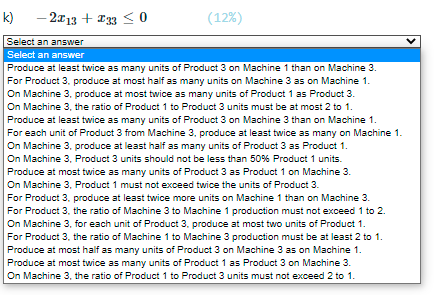
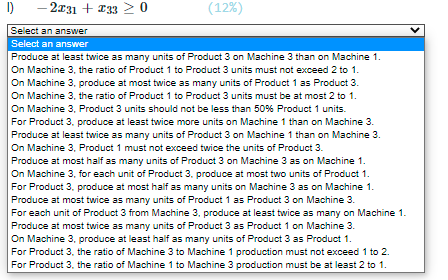
Chris & Co. manufactures three products using three different machines. Selling price per unit are $21 for product 1, $22 for product 2, and $34 for product 3. The costs/unit of producing each product on each machine are shown in the following table: Machine 1 Machine 2 Machine 3 Product 1 $8.73 $5.88 $7.36 Product 2 $10.24 $6.24 $6.61 Product 3 $11.54 $7.33 $4.27 The company wants to determine how many units of each product to produce to maximize profit (contribution) margin. Let = number of units of product i from machine j; i = 1, 2, 3 j = 1,2,3 Select the best interpretation for each of the following constraints from the given options: k) - 2x13 +233 0 Select an answer Select an answer Produce at least twice as many units of Product 3 on Machine 1 than on Machine 3. For Product 3. produce at most half as many units on Machine 3 as on Machine 1. On Machine 3, produce at most twice as many units of Product 1 as Product 3. On Machine 3, the ratio of Product 1 to Product 3 units must be at most 2 to 1. Produce at least twice as many units of Product 3 on Machine 3 than on Machine 1. For each unit of Product 3 from Machine 3, produce at least twice as many on Machine 1. On Machine 3. produce at least half as many units of Product 3 as Product 1. On Machine 3, Product 3 units should not be less than 50% Product 1 units. Produce at most twice as many units of Product 3 as Product 1 on Machine 3. On Machine 3, Product 1 must not exceed twice the units of Product 3. For Product 3. produce at least twice more units on Machine 1 than on Machine 3. For Product 3, the ratio of Machine 3 to Machine 1 production must not exceed 1 to 2. On Machine 3, for each unit of Product 3. produce at most two units of Product 1. For Product 3, the ratio of Machine 1 to Machine 3 production must be at least 2 to 1. Produce at most half as many units of Product 3 on Machine 3 as on Machine 1. Produce at most twice as many units of Product 1 as Product 3 on Machine 3. On Machine 3, the ratio of Product 1 to Product 3 units must not exceed 2 to 1. (12%) I) Select an answer Select an answer Produce at least twice as many units of Product 3 on Machine 3 than on Machine 1. On Machine 3, the ratio of Product 1 to Product 3 units must not exceed 2 to 1. On Machine 3. produce at most twice as many units of Product 1 as Product 3. On Machine 3, the ratio of Product 1 to Product 3 units must be at most 2 to 1. On Machine 3, Product 3 units should not be less than 50% Product 1 units. For Product 3. produce at least twice more units on Machine 1 than on Machine 3. Produce at least twice as many units of Product 3 on Machine 1 than on Machine 3. On Machine 3, Product 1 must not exceed twice the units of Product 3. Produce at most half as many units of Product 3 on Machine 3 as on Machine 1. On Machine 3, for each unit of Product 3. produce at most two units of Product 1. For Product 3. produce at most half as many units on Machine 3 as on Machine 1. Produce at most twice as many units of Product 1 as Product 3 on Machine 3. -2x31 +233 0 (12%) For each unit of Product 3 from Machine 3, produce at least twice as many on Machine 1. Produce at most twice as many units of Product 3 as Product 1 on Machine 3. On Machine 3, produce at least half as many units of Product 3 as Product 1. For Product 3, the ratio of Machine 3 to Machine 1 production must not exceed 1 to 2. For Product 3, the ratio of Machine 1 to Machine 3 production must be at least 2 to 1




