







Question: civil Engineering Course Title : Soil Stabilization Course Code: CE527 98 77 64 26.9 5 -- --- --- 97 Q1)a sieve analysis was carried out
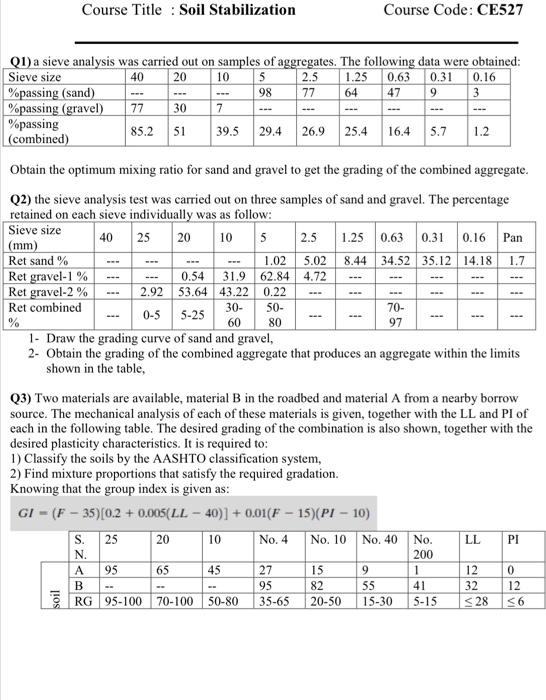
Course Title : Soil Stabilization Course Code: CE527 98 77 64 26.9 5 -- --- --- 97 Q1)a sieve analysis was carried out on samples of aggregates. The following data were obtained: Sieve size 40 20 10 5 2.5 1.25 0.63 0.31 0.16 %passing (sand) 47 9 3 %passing (gravel) 77 30 7 %passing 85.2 51 39.5 29.4 25.4 16.4 5.7 1.2 (combined) Obtain the optimum mixing ratio for sand and gravel to get the grading of the combined aggregate. Q2) the sieve analysis test was carried out on three samples of sand and gravel. The percentage retained on each sieve individually was as follow: Sieve size 40 25 20 (mm) 10 2.5 1.25 0.63 0.31 0.16 Pan Ret sand % 1.02 5.02 8.44 34.52 35.12 14.18 1.7 Ret gravel-1 % 0.54 31.9 62.844.72 Ret gravel-2% 2.92 53.64 43.22 0.22 Ret combined 30- 50- 70- % 0-5 5-25 60 80 1- Draw the grading curve of sand and gravel, 2. Obtain the grading of the combined aggregate that produces an aggregate within the limits shown in the table, Q3) Two materials are available, material B in the roadbed and material A from a nearby borrow source. The mechanical analysis of each of these materials is given, together with the LL and PI of each in the following table. The desired grading of the combination is also shown, together with the desired plasticity characteristics. It is required to: 1) Classify the soils by the AASHTO classification system, 2) Find mixture proportions that satisfy the required gradation. Knowing that the group index is given as: GI - (F 35)[0.2 +0.005( LL - 40)] +0.01(F - 15)(PI - 10) S. 25 20 10 No. 4 No. 10 No. 40 No. LL PI N 200 A 95 65 45 27 15 9 1 12 0 B 95 82 55 41 32 12 RG 95-100 70-100 50-80 35-65 20-50 15-30 5-15
Step by Step Solution
There are 3 Steps involved in it

Get step-by-step solutions from verified subject matter experts
 Study Help