Question: CIVL5266 Steel Structures - Stability Assignment 3: Direct Design Method (DDM) Project (25%) Important Notes: Due date: Before 10 June 2025 at 23.59pm Requirements: You
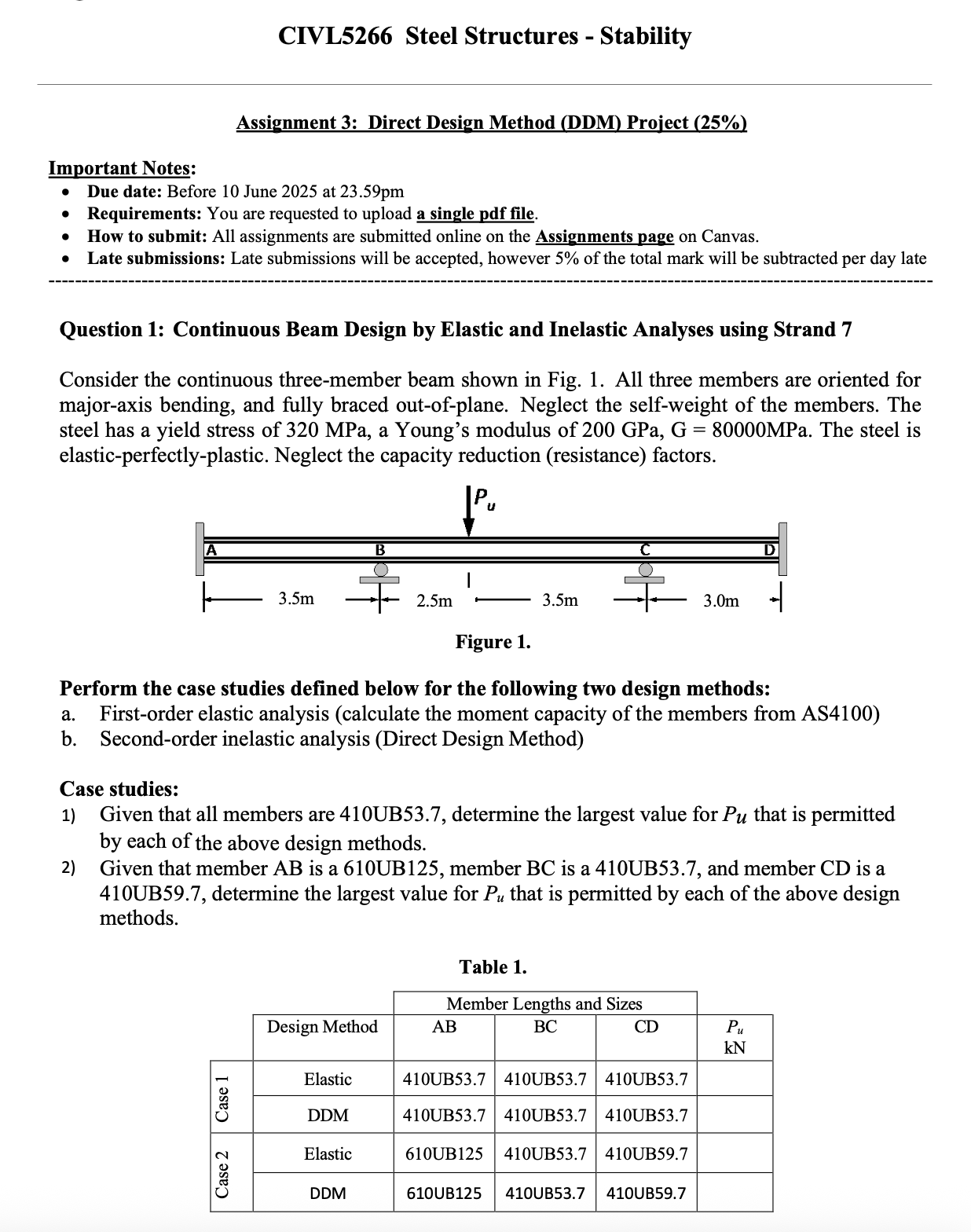
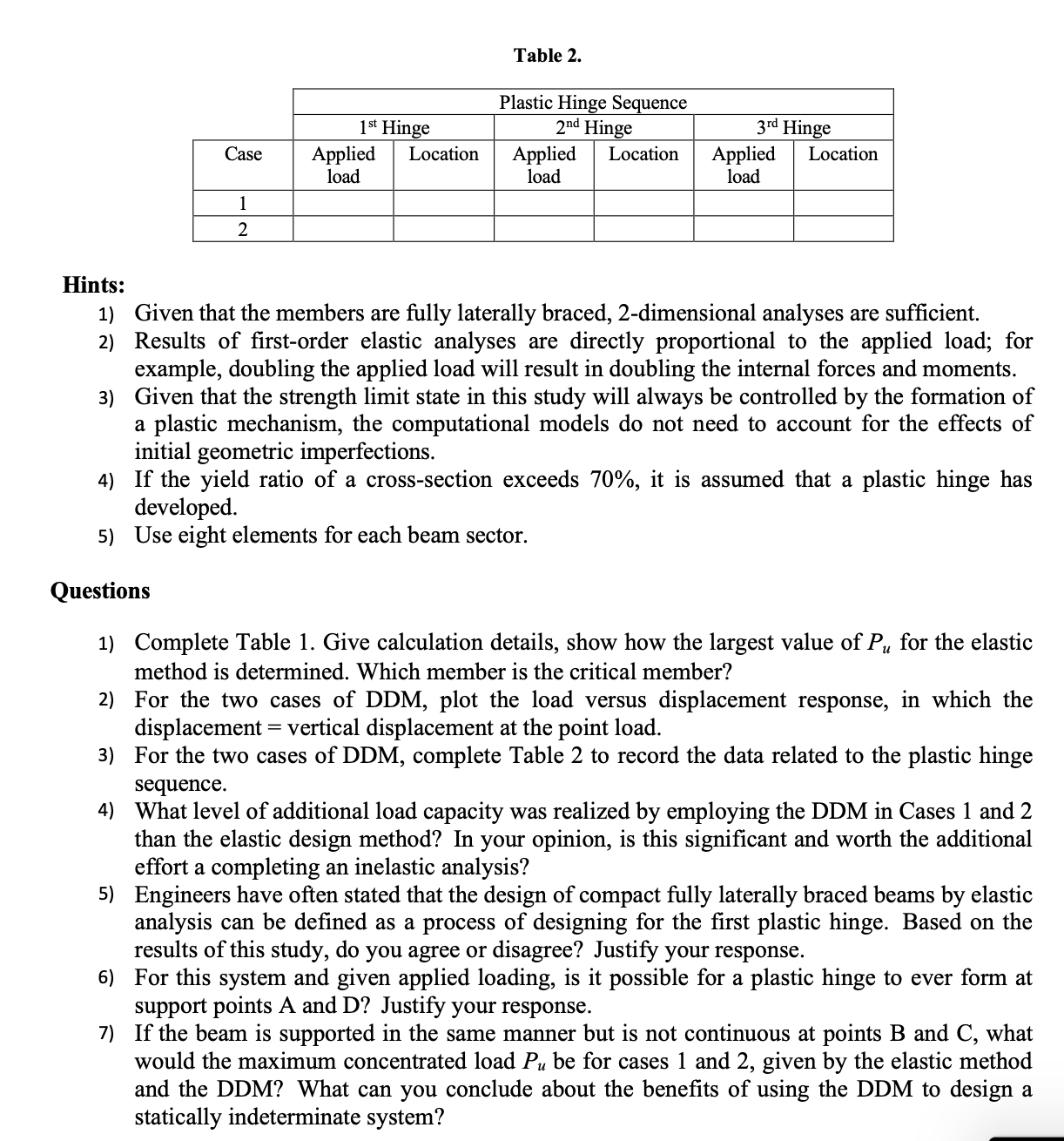
CIVL5266 Steel Structures - Stability Assignment 3: Direct Design Method (DDM) Project (25%) Important Notes: Due date: Before 10 June 2025 at 23.59pm Requirements: You are requested to upload a single pdf file. . . How to submit: All assignments are submitted online on the Assignments page on Canvas. . Late submissions: Late submissions will be accepted, however 5% of the total mark will be subtracted per day late Question 1: Continuous Beam Design by Elastic and Inelastic Analyses using Strand 7 Consider the continuous three-member beam shown in Fig. 1. All three members are oriented for major-axis bending, and fully braced out-of-plane. Neglect the self-weight of the members. The steel has a yield stress of 320 MPa, a Young's modulus of 200 GPa, G = 80000MPa. The steel is elastic-perfectly-plastic. Neglect the capacity reduction (resistance) factors. 3.5m 2.5m 3.5m 3.0m Figure 1. Perform the case studies defined below for the following two design methods: a. First-order elastic analysis (calculate the moment capacity of the members from AS4100) b. Second-order inelastic analysis (Direct Design Method) Case studies: 1) Given that all members are 410UB53.7, determine the largest value for Pu that is permitted by each of the above design methods. Given that member AB is a 610UB125, member BC is a 410UB53.7, and member CD is a 410UB59.7, determine the largest value for Pu that is permitted by each of the above design methods. Table 1. Member Lengths and Sizes Design Method AB BC CD Pu KN Elastic 410UB53.7 410UB53.7 410UB53.7 Case 1 DDM 410UB53.7 410UB53.7 410UB53.7 Elastic 610UB125 410UB53.7 410UB59.7 Case 2 DDM 610UB125 410UB53.7 410UB59.7Table 2. Plastic Hinge Sequence 1% Hinge 2" Hinge 3" Hinge Case Applied | Location | Applied | Location | Applied | Location load load load | | | 2 | Hints: 1) Given that the members are fully laterally braced, 2-dimensional analyses are sufficient. 2) Results of first-order elastic analyses are directly proportional to the applied load; for example, doubling the applied load will result in doubling the internal forces and moments. 3) Given that the strength limit state in this study will always be controlled by the formation of a plastic mechanism, the computational models do not need to account for the effects of initial geometric imperfections. 4) If the yield ratio of a cross-section exceeds 70%, it is assumed that a plastic hinge has developed. 5) Use eight elements for each beam sector. Questions 1) Complete Table 1. Give calculation details, show how the largest value of P, for the elastic method is determined. Which member is the critical member? 2) For the two cases of DDM, plot the load versus displacement response, in which the displacement = vertical displacement at the point load. 3) For the two cases of DDM, complete Table 2 to record the data related to the plastic hinge sequence. 4) What level of additional load capacity was realized by employing the DDM in Cases 1 and 2 than the elastic design method? In your opinion, is this significant and worth the additional effort a completing an inelastic analysis? 5) Engineers have often stated that the design of compact fully laterally braced beams by elastic analysis can be defined as a process of designing for the first plastic hinge. Based on the results of this study, do you agree or disagree? Justify your response. 6) For this system and given applied loading, is it possible for a plastic hinge to ever form at support points A and D? Justify your response. 7) Ifthe beam is supported in the same manner but is not continuous at points B and C, what would the maximum concentrated load P, be for cases 1 and 2, given by the elastic method and the DDM? What can you conclude about the benefits of using the DDM to design a statically indeterminate system
Step by Step Solution
There are 3 Steps involved in it
1 Expert Approved Answer
Step: 1 Unlock
Question Has Been Solved by an Expert!
Get step-by-step solutions from verified subject matter experts
Step: 2 Unlock
Step: 3 Unlock
Students Have Also Explored These Related Accounting Questions!









 Study Help