Question: Claim Email Before completing this assignment, you should be sure to read Chapter 3 (on persuasion), Chapter 14 (on professional emails) and the selection from
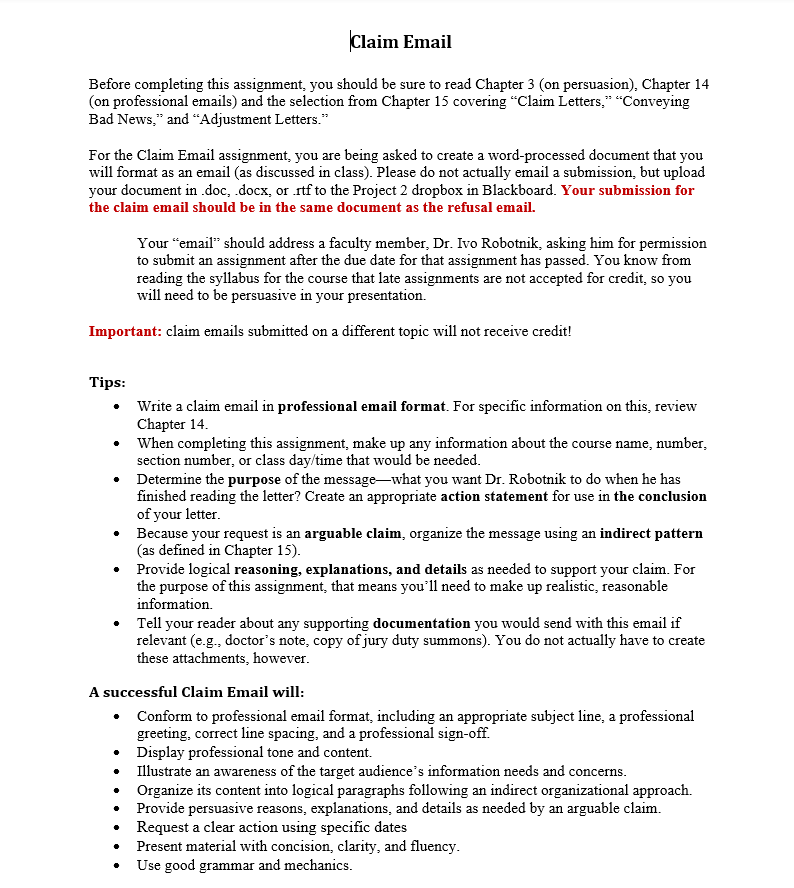
Claim Email Before completing this assignment, you should be sure to read Chapter 3 (on persuasion), Chapter 14 (on professional emails) and the selection from Chapter 15 covering "Claim Letters," "Conveying Bad News," and "Adjustment Letters." For the Claim Email assignment, you are being asked to create a word-processed document that you will format as an email (as discussed in class). Please do not actually email a submission, but upload your document in .doc, docx, or .rtf to the Project 2 dropbox in Blackboard. Your submission for the claim email should be in the same document as the refusal email. Your "email" should address a faculty member, Dr. Ivo Robotnik, asking him for permission to submit an assignment after the due date for that assignment has passed. You know from reading the syllabus for the course that late assignments are not accepted for credit, so you will need to be persuasive in your presentation. Important: claim emails submitted on a different topic will not receive credit! Tips: - Write a claim email in professional email format. For specific information on this, review Chapter 14. - When completing this assignment, make up any information about the course name, number, section number, or class day/time that would be needed. - Determine the purpose of the message-what you want Dr. Robotnik to do when he has finished reading the letter? Create an appropriate action statement for use in the conclusion of your letter. - Because your request is an arguable claim, organize the message using an indirect pattern (as defined in Chapter 15). - Provide logical reasoning, explanations, and details as needed to support your claim. For the purpose of this assignment, that means you'll need to make up realistic, reasonable information. - Tell your reader about any supporting documentation you would send with this email if relevant (e.g., doctor's note, copy of jury duty summons). You do not actually have to create these attachments, however. A successful Claim Email will: - Conform to professional email format, including an appropriate subject line, a professional greeting, correct line spacing, and a professional sign-off. - Display professional tone and content. - Illustrate an awareness of the target audience's information needs and concerns. - Organize its content into logical paragraphs following an indirect organizational approach. - Provide persuasive reasons, explanations, and details as needed by an arguable claim. - Request a clear action using specific dates - Present material with concision, clarity, and fluency. - Use good grammar and mechanics









 Study Help