Question: Clarify your current worldview. Follow the instructions presented in point 1 on page 4 of the publication and reflect on your current worldview. Evaluate one
-
Clarify your current worldview. Follow the instructions presented in point 1 on page 4 of the publication and reflect on your current worldview.
-
Evaluate one of your recent decisions. Follow the steps listed in point 2 on page 4 of the publication and evaluate one of your recent decisions against your current worldview.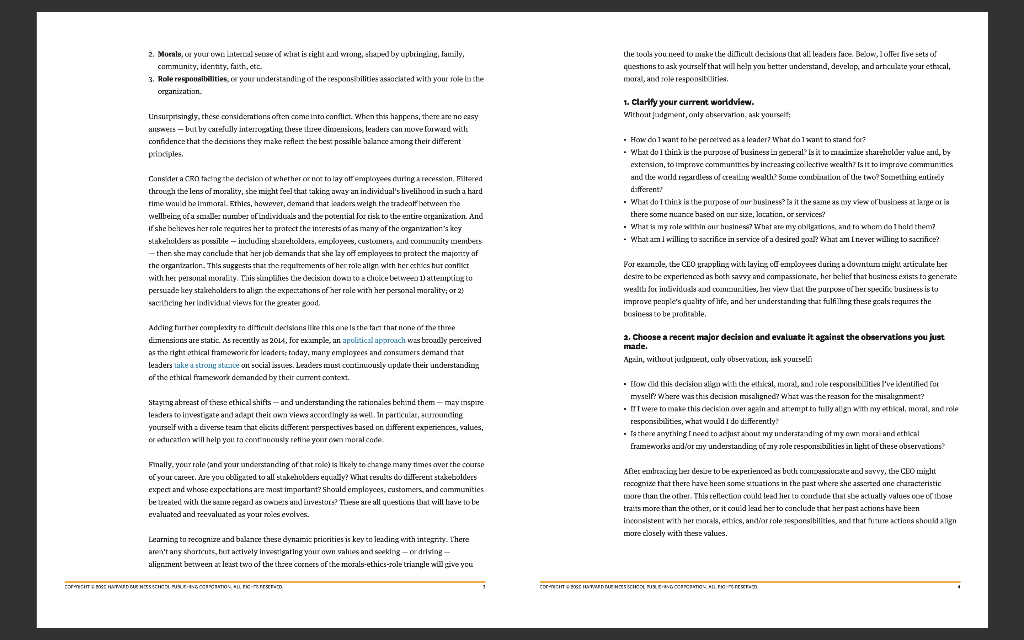
2. Morals, or your wintexual sense of what is tight and wrong, apel by upbringing Family, community, identity, faith, etc. 3. Role responsibilities, your understanding of the responsibilities associated with your role in the organization. Le louls you need to make the difficult decisions that all leaders face. Below, lollies live sets of questions to ask yourself that will help you heter understand, develop, and articulate your ethical, moral, and role responsibilities 1. clarify your current worldview. Without judgment, only ohrvation, ask yourself Linsurprisingly, these considerations often come into conflict. When this happens, there are no casy answers - but by carefully interventing these buree dimensions, leaders can move forward will confidence that the decisions they make reflect the best possible balance among their diferent pelociples Consider a Croacing the decision of whether or not to lay off employees during a recession. Filtered through the lens of morality, sbe might feel that taking away an individual's livelihood in such a hard time would be Immoral. Ethics, however, demand that leaders weigh the tradeoff between the wellbeice of a smaller number of individuals and the potential for risk to the entire ucranization. And if she believes her role requires her to protect the interests of as many of the organization's ley Slakelulders as possible - including, barellders, employees, customers, and wity members -ther she may conclude that her job demands that she lay off employees to pratect the majority of the organization. This suggests that the requirements of her role align with her ethics but contact will let personal morality. This simplifies We decision donu to achwice betweea 1) attempting to persuade key stalireholders to align the expectations of her role with her personal morality; or 2) sacricing her individual views for the greater good. How do I want to be perceived as a leader? What do I want to stand for? . Wbut du I think is the purpose of business in geceral Ls it to maximize shareholder value and, d. by extension, to improve communities by increasing collective wealth? Is it to improve communities anul le would regardless of creating wealul Sune combination of the Lu? Suuret entirely different . What do I thick is the purpose of our business? Is it the same as may view olbusiness at large or is there some nuance based on our size, location, or services? . What is my role within our business? What are my obligations, and to whom da held them What am I willing to sacrifice in service of a desired goal? What am I never willing to sacrifice? Por examale, the CIO uppling with layice employees curiga duwtwo night articulate bec desire to be experienced as both savvy and compassionate, her be Hef that husiness exists ta generate wealth fut inulividuals and mucities, les view bet the purpose oC her specific business is to improve people's quality of life, and her understanding that fulfilling these goals requires the business to be profitable Adding Parther complexity to difficult decisions like this one is the fact that none of the three dimensions are static. As recently as 2014, for example, an apolitical approuch was broudly perceived as the right otirical framewors for leaders today, many employees and consumers demand that leaders take a strong stane on social issues. Leaders must coatinuously update their understanding of the chical framework demanded by their current context. 2. Choose a recent major decision and evaluate it against the observations you just made. Again, witlwut judgment, only observation, ask yourself Staying abreast of these ethical shifts and understanding the nationales behind them - may inspire leaders to investigate and adapt their own views accordinely as well. In particular, surrounding yourself with a diverse tesimthat elicits different perspectives based on different experiences, values, or education will help you ta continuously retine your own moral code. tlow did this decision align with the ethical, moral, and role responsibilities I've identified for myself? Where was this decision misaligned? What was the reason for the misalignment? . IT were to make this decision aver again and attempt to fully align with my ethical, moral, and role resposibilities, what would I do differently . Ta there anything I need to adjust about my understanding of my own moral and ethical Erumenords and/or my understanding of any role responsibilities in light of these observations? Finally, your role and your understanding of that role is kely to change many times over the course of your career. Are you obligated to all stakeholders equally? What results do different stakebolders expect and whose expectations are most important? Should employees, customers, and communities be treated with the same regard as unders and investors? These are all questious that will have to be evaluated and reevaluated as your roles evolves. After abracing, bes desire to be experienced as both our site and savvy, the CD might recognize that there have heen some situations in the past where she asserted and chancteristic more than the other. This tellection valdled her to conclude that she actually values ce of the traits more than the other, or it could lead her to conclude that her past actions have been inconsistent with her morals, ethics, andior role responsibilities, and that future actions should align more closely with these values. Learning to recognize and balance these dynamic priorities is key to leading with integrity. There Aren't any shortcuts, but actively investigating your own values and seeking - driving alignment between at least two of the three corners of the morals-ethics-Tole triangle will give you CorCHT KERTAADUENTSBEHOOL PUSLEHOG OCENITIOU ALLTIGERS OCHT NE HATHEDENTS SCHOOL USHING OCIENTOV ULTICOS 2. Morals, or your wintexual sense of what is tight and wrong, apel by upbringing Family, community, identity, faith, etc. 3. Role responsibilities, your understanding of the responsibilities associated with your role in the organization. Le louls you need to make the difficult decisions that all leaders face. Below, lollies live sets of questions to ask yourself that will help you heter understand, develop, and articulate your ethical, moral, and role responsibilities 1. clarify your current worldview. Without judgment, only ohrvation, ask yourself Linsurprisingly, these considerations often come into conflict. When this happens, there are no casy answers - but by carefully interventing these buree dimensions, leaders can move forward will confidence that the decisions they make reflect the best possible balance among their diferent pelociples Consider a Croacing the decision of whether or not to lay off employees during a recession. Filtered through the lens of morality, sbe might feel that taking away an individual's livelihood in such a hard time would be Immoral. Ethics, however, demand that leaders weigh the tradeoff between the wellbeice of a smaller number of individuals and the potential for risk to the entire ucranization. And if she believes her role requires her to protect the interests of as many of the organization's ley Slakelulders as possible - including, barellders, employees, customers, and wity members -ther she may conclude that her job demands that she lay off employees to pratect the majority of the organization. This suggests that the requirements of her role align with her ethics but contact will let personal morality. This simplifies We decision donu to achwice betweea 1) attempting to persuade key stalireholders to align the expectations of her role with her personal morality; or 2) sacricing her individual views for the greater good. How do I want to be perceived as a leader? What do I want to stand for? . Wbut du I think is the purpose of business in geceral Ls it to maximize shareholder value and, d. by extension, to improve communities by increasing collective wealth? Is it to improve communities anul le would regardless of creating wealul Sune combination of the Lu? Suuret entirely different . What do I thick is the purpose of our business? Is it the same as may view olbusiness at large or is there some nuance based on our size, location, or services? . What is my role within our business? What are my obligations, and to whom da held them What am I willing to sacrifice in service of a desired goal? What am I never willing to sacrifice? Por examale, the CIO uppling with layice employees curiga duwtwo night articulate bec desire to be experienced as both savvy and compassionate, her be Hef that husiness exists ta generate wealth fut inulividuals and mucities, les view bet the purpose oC her specific business is to improve people's quality of life, and her understanding that fulfilling these goals requires the business to be profitable Adding Parther complexity to difficult decisions like this one is the fact that none of the three dimensions are static. As recently as 2014, for example, an apolitical approuch was broudly perceived as the right otirical framewors for leaders today, many employees and consumers demand that leaders take a strong stane on social issues. Leaders must coatinuously update their understanding of the chical framework demanded by their current context. 2. Choose a recent major decision and evaluate it against the observations you just made. Again, witlwut judgment, only observation, ask yourself Staying abreast of these ethical shifts and understanding the nationales behind them - may inspire leaders to investigate and adapt their own views accordinely as well. In particular, surrounding yourself with a diverse tesimthat elicits different perspectives based on different experiences, values, or education will help you ta continuously retine your own moral code. tlow did this decision align with the ethical, moral, and role responsibilities I've identified for myself? Where was this decision misaligned? What was the reason for the misalignment? . IT were to make this decision aver again and attempt to fully align with my ethical, moral, and role resposibilities, what would I do differently . Ta there anything I need to adjust about my understanding of my own moral and ethical Erumenords and/or my understanding of any role responsibilities in light of these observations? Finally, your role and your understanding of that role is kely to change many times over the course of your career. Are you obligated to all stakeholders equally? What results do different stakebolders expect and whose expectations are most important? Should employees, customers, and communities be treated with the same regard as unders and investors? These are all questious that will have to be evaluated and reevaluated as your roles evolves. After abracing, bes desire to be experienced as both our site and savvy, the CD might recognize that there have heen some situations in the past where she asserted and chancteristic more than the other. This tellection valdled her to conclude that she actually values ce of the traits more than the other, or it could lead her to conclude that her past actions have been inconsistent with her morals, ethics, andior role responsibilities, and that future actions should align more closely with these values. Learning to recognize and balance these dynamic priorities is key to leading with integrity. There Aren't any shortcuts, but actively investigating your own values and seeking - driving alignment between at least two of the three corners of the morals-ethics-Tole triangle will give you CorCHT KERTAADUENTSBEHOOL PUSLEHOG OCENITIOU ALLTIGERS OCHT NE HATHEDENTS SCHOOL USHING OCIENTOV ULTICOS









 Study Help