







Question: Class #3: In Class Exercise Pareto Efficient Allocation Allocation of resources in which it is impossible to make any one individual better off without making
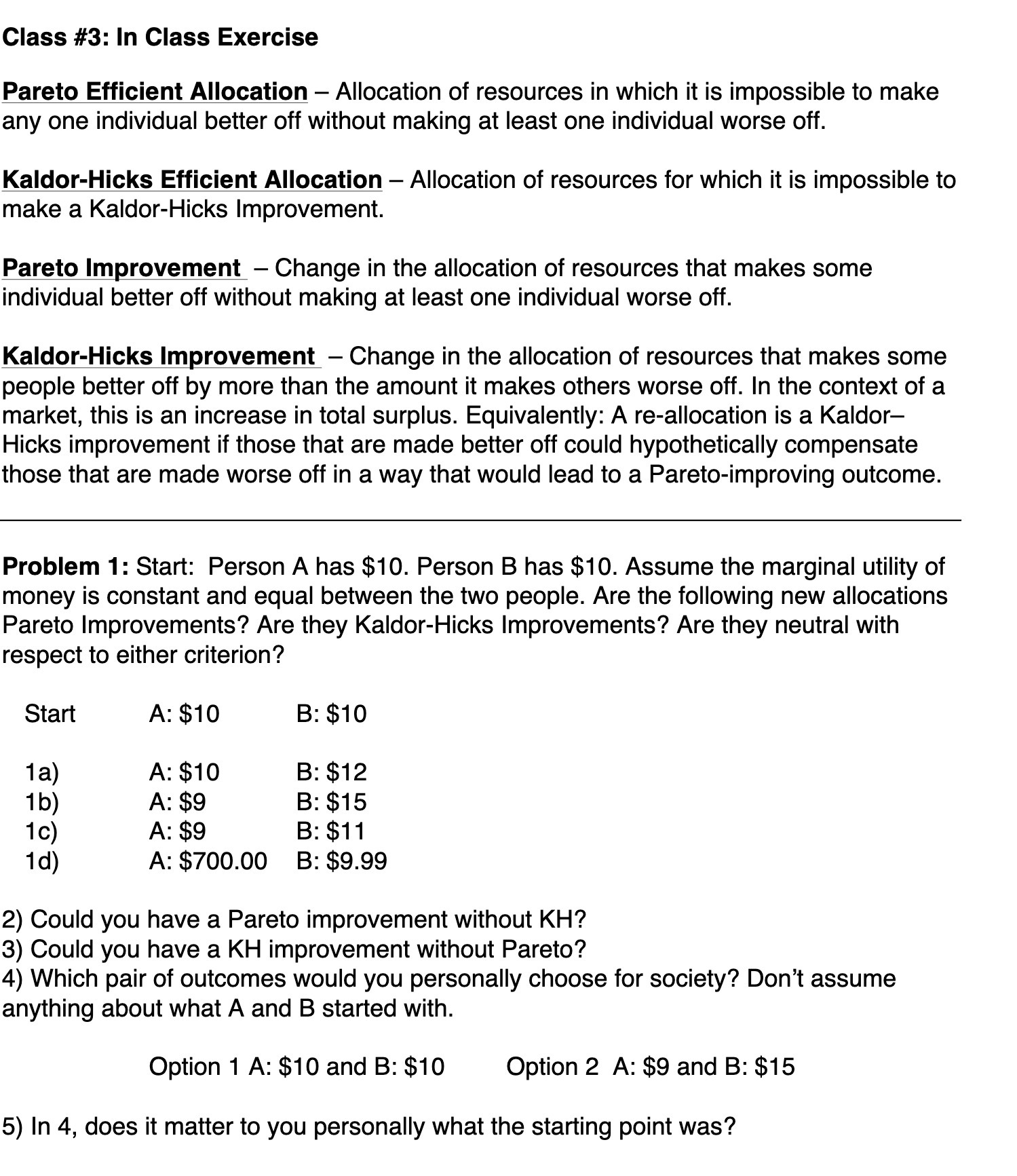
Class #3: In Class Exercise Pareto Efficient Allocation Allocation of resources in which it is impossible to make any one individual better off without making at least one individual worse off. Kaldor-Hicks Efficient Allocation Allocation of resources for which it is impossible to make a Kaldor-Hicks Improvement. Pareto Improvement Change in the allocation of resources that makes some individual better off without making at least one individual worse off. Kaldor-Hicks Improvement Change in the allocation of resources that makes some people better off by more than the amount it makes others worse off. In the context of a market, this is an increase in total surplus. Equivalently: A re-allocation is a Kaldor Hicks improvement if those that are made better off could hypothetically compensate those that are made worse off in a way that would lead to a Pareto-improving outcome. Problem 1: Start: Person A has $10. Person B has $10. Assume the marginal utility of money is constant and equal between the two people. Are the following new allocations Pareto Improvements? Are they Kaldor-Hicks Improvements? Are they neutral with respect to either criterion? Start A: $10 B: $10 1a) A: $10 B: $12 1b) A: $9 B: $15 1c) A: $9 B: $11 1d) A: $700.00 B: $9.99 2) Could you have a Pareto improvement without KH? 3) Could you have a KH improvement without Pareto? 4) Which pair of outcomes would you personally choose for society? Don't assume anything about what A and B started with. Option 1 A: $10 and B: $10 Option 2 A: $9 and B: $15 5) In 4, does it matter to you personally what the starting point was
Step by Step Solution
There are 3 Steps involved in it

Get step-by-step solutions from verified subject matter experts
 Study Help