







Question: class One { Consider the following Java code: public char func1 (){ return a ; } public void display () { System.out.println( 1 +
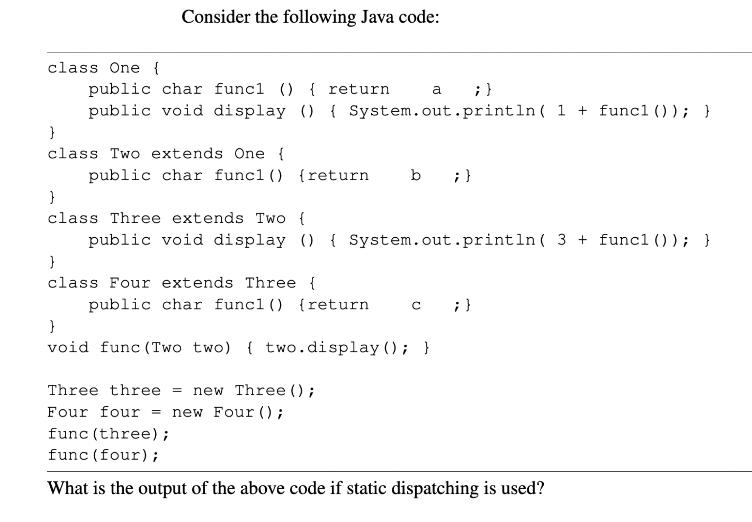
class One { Consider the following Java code: public char func1 (){ return a ; } public void display () { System.out.println( 1 + func1()); } } class Two extends One { public char func1() {return } class Three extends Two { public void display () { System.out.println( 3 func1 ()); } } class Four extends Three { b;} public char func1() {return ; } } void func (Two two) ( two.display (); } Three three = new Three (); Four four = new Four (); func (three); func (four); What is the output of the above code if static dispatching is used?
Step by Step Solution
There are 3 Steps involved in it
In the given Java code there seems to be a few errors such as missing semicolons and undeclared vari... View full answer

Get step-by-step solutions from verified subject matter experts
 Study Help