







Question: Class Project In this exercise, we will apply what we learned in chapters 1 0 and 1 1 to real - world data. Part I.
Class Project
In this exercise, we will apply what we learned in chapters and to realworld data.
Part I.
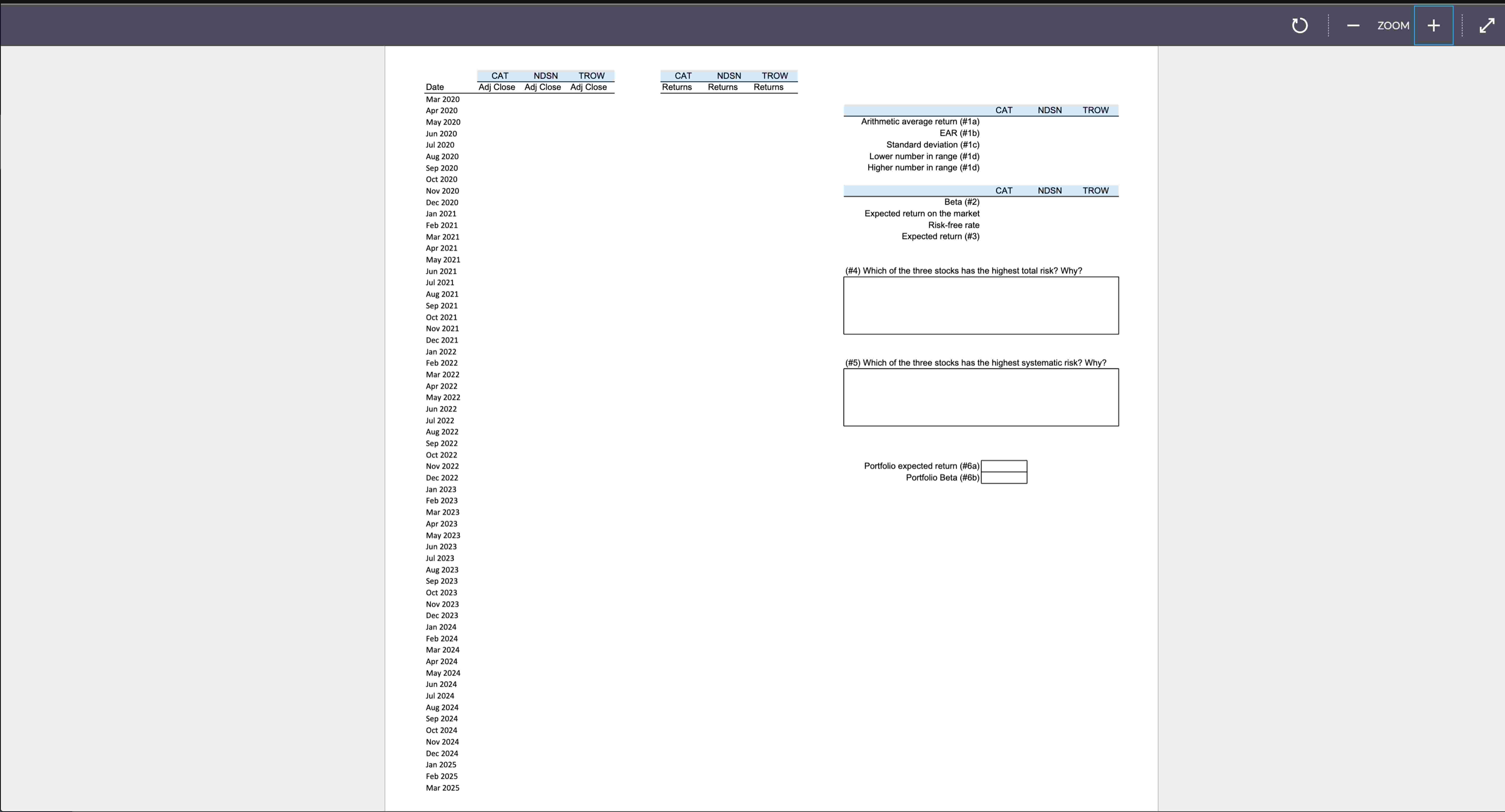
Copy and paste the Adjusted Close prices from each of the individual stock data files onto the Excel
template provided for this project.
Part II Answer the following questions by filling in the appropriate cell in the Excel template. All the
inputs stock prices, beta, expected return on the market, and the riskfree rate must be hard coded ie typed in as a number To get full credit, your answers to # # and # must be typed in as formulas and
not hard coded this means you need to reference the cells containing your inputs.
Calculate the monthly return for each of the three stocks. points For each stock,
a What is the arithmetic average monthly return? points
b Using your answer to a above, what is the EAR? points
c What is the standard deviation? points
d What range of returns should you expect to see with a percent probability? points
What is the beta of each stock? points. Note: You can get beta from the Summary page on
Yahoo!Finance.
Assuming an expected return on the market of and a riskfree rate of what is the
expected return for each stock according to the CAPM? points
Which of the three stocks has the highest total risk? points Why? points. Hint: the correct
reason is based on one of your answers from # through # above. You need to cite that measure
in your answer to this question. Read sections and in the etextbook for more
information.
Which of the three stocks has the highest systematic risk? points Why? points. Hint: the
correct reason is based on one of your answers from # through # above. You need to cite that
measure in your answer to this question. Read sections and in the etextbook for more
information.
If you form a portfolio with invested in TROW, and the remainder split equally between
CAT and NDSN
a What is the expected return on your portfolio? points
b What is the beta of your portfolio? points
Step by Step Solution
There are 3 Steps involved in it
1 Expert Approved Answer
Step: 1 Unlock

Question Has Been Solved by an Expert!
Get step-by-step solutions from verified subject matter experts
Step: 2 Unlock
Step: 3 Unlock
 Study Help