Question: Class Test: Chapter 8 Investment Decision Rules 8.1 The NPV Decision Rule 1. Tanner is choosing between two investment options. He can invest 5500 now
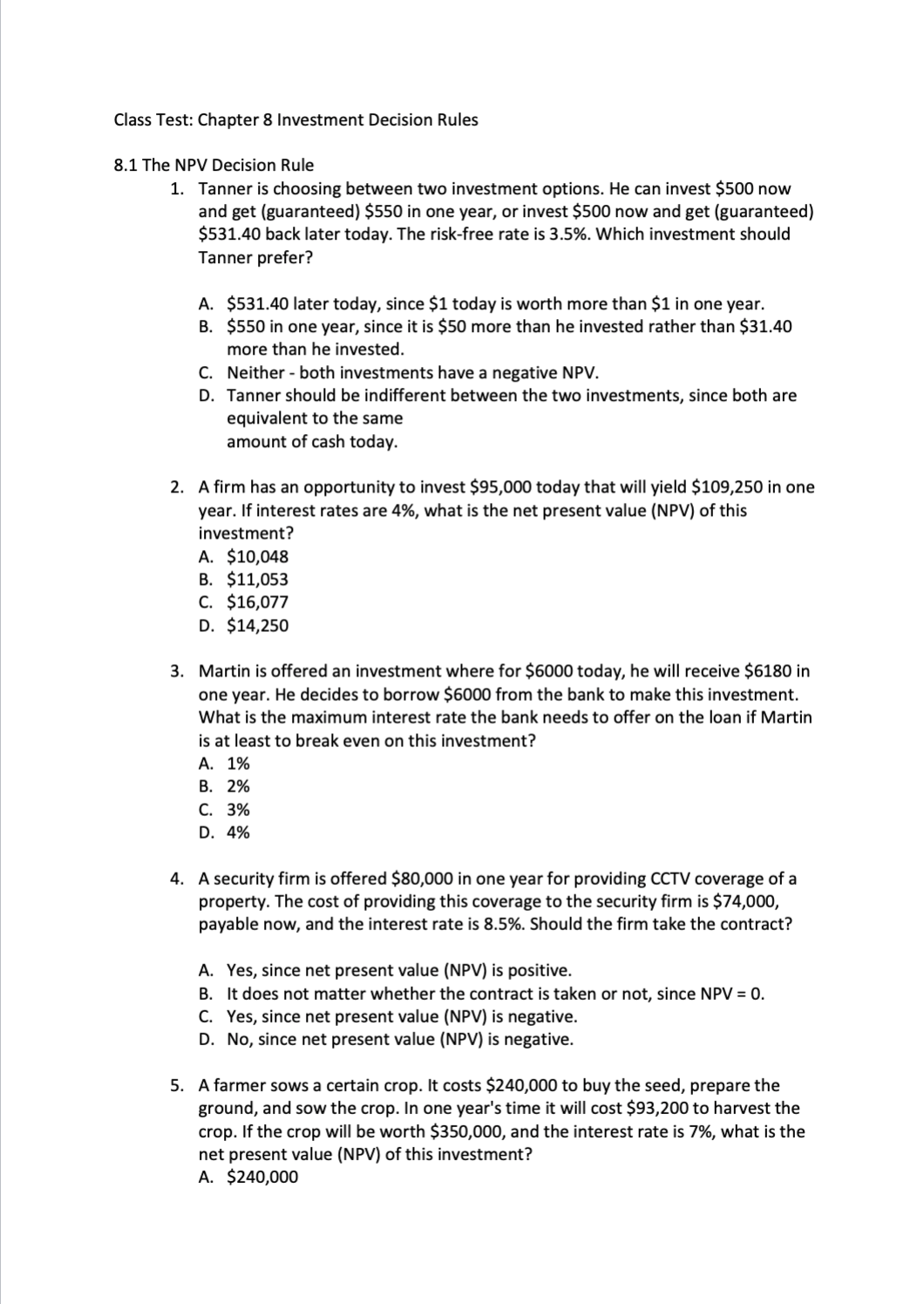
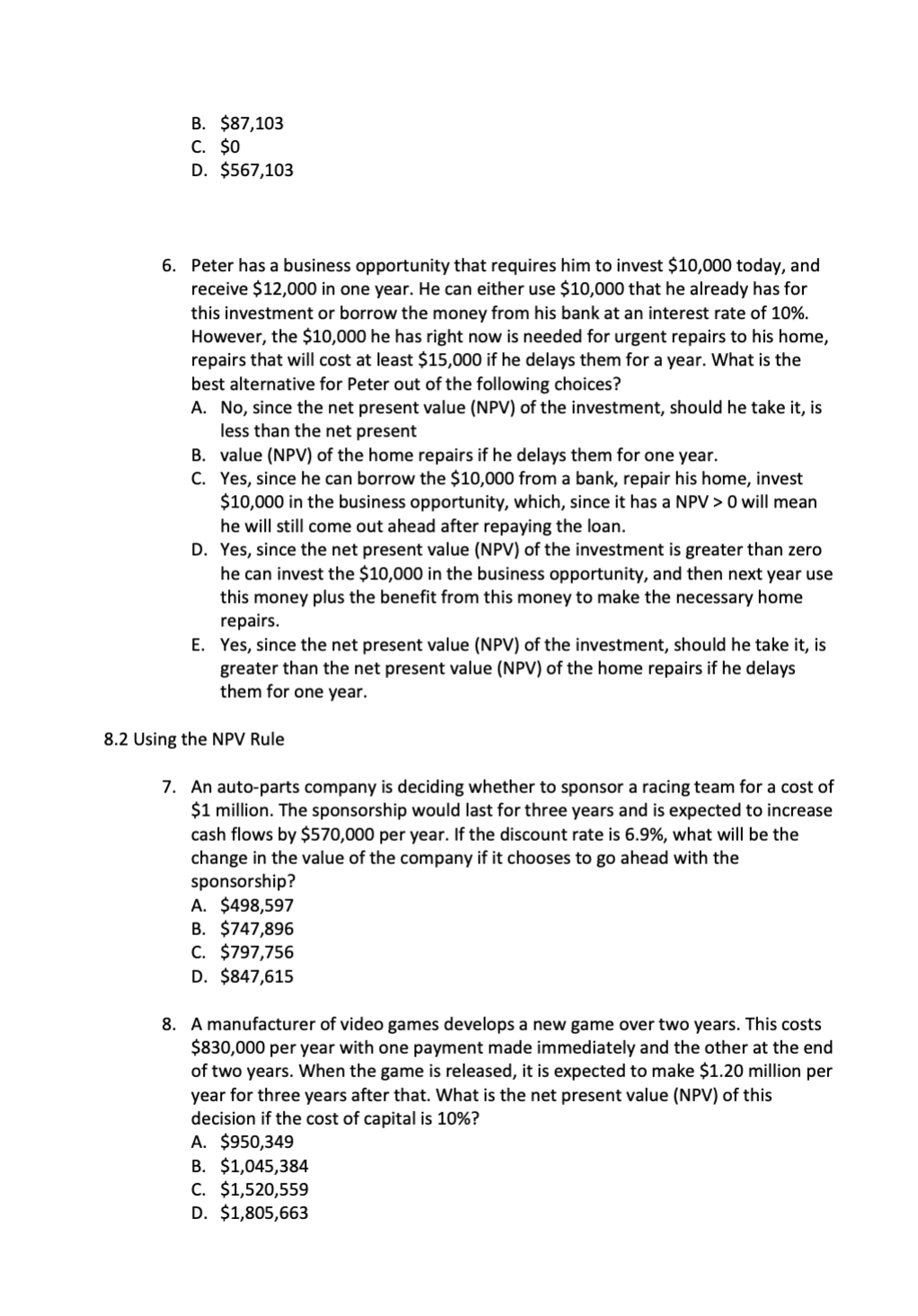
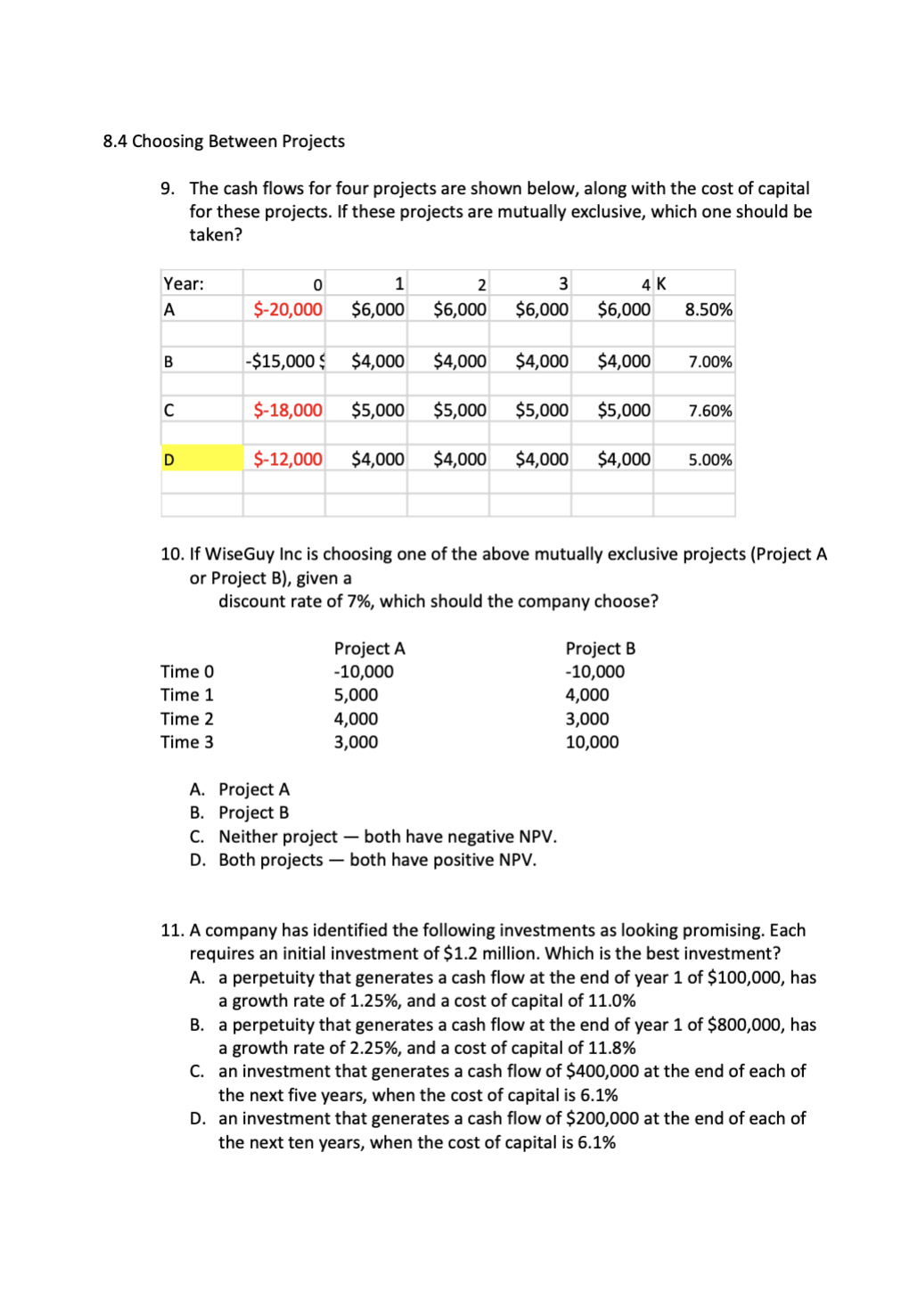
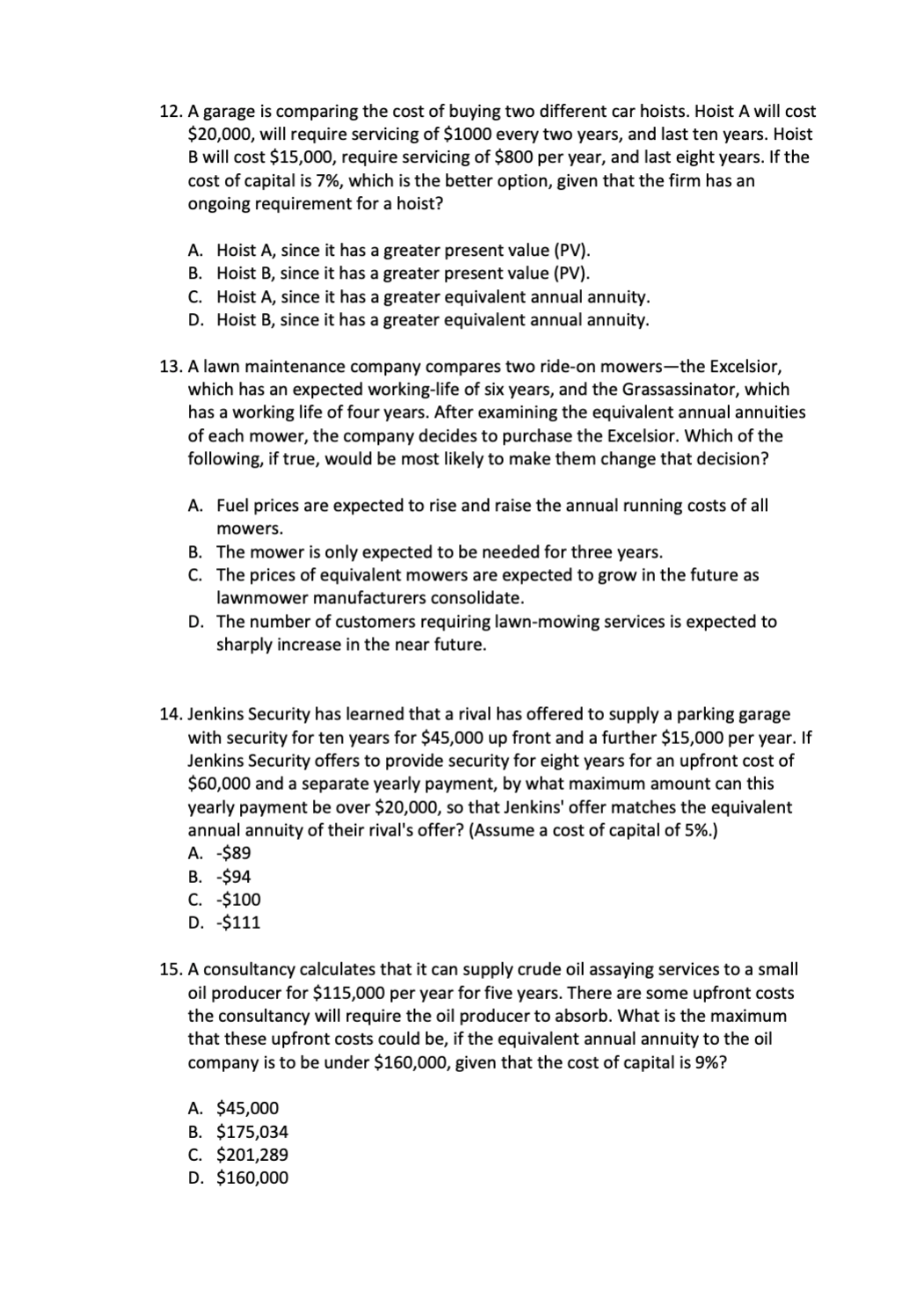
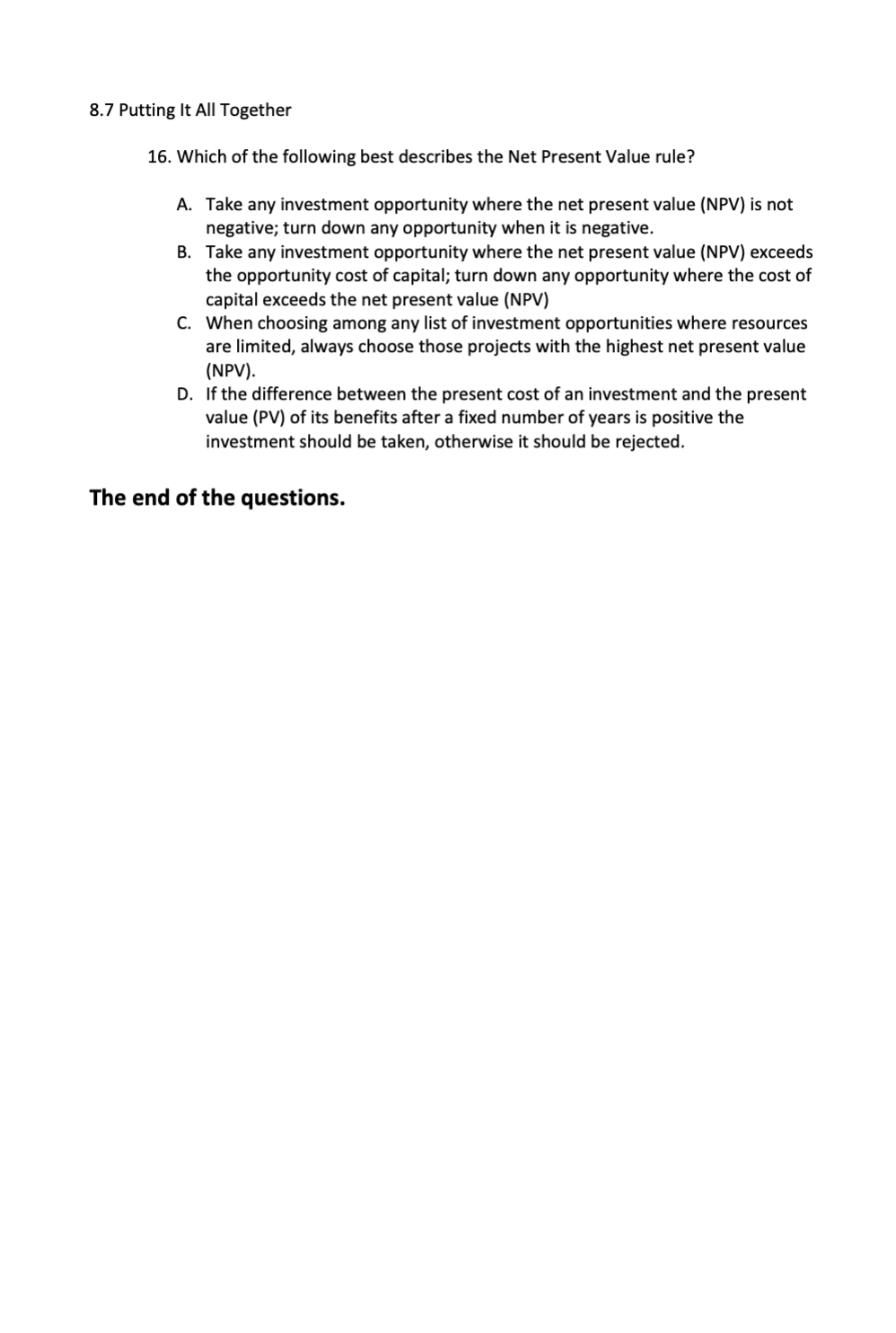
Class Test: Chapter 8 Investment Decision Rules 8.1 The NPV Decision Rule 1. Tanner is choosing between two investment options. He can invest 5500 now and get (guaranteed) $550 in one year, or invest $500 new and get {guaranteed} $531.40 back later today. The risk-free rate is 3.5%. Which investment should Tanner prefer? A. $531.40 later today, since 51 today is worth more than $1 in one year. B. $550 in one year, since it is $50 more than he invested rather than $31.40 more than he invested. C. Neither - both investments have a negative NPV. D. Tanner should be indifferent between the two investments, since both are equivalent to the same amount of cash today. 2. A firm has an opportunity to invest $95,000 today that will yield $109,250 in one year. If interest rates are 4%, what is the net present value (NPV) of this investment? A. $10,048 B. 511,053 C. $16,077 0. $14,250 3. Martin is offered an investment where for $6000 today, he will receive $6180 in one year. He decides to borrow $6000 from the bank to make this investment. What is the maximum interest rate the bank needs to offer on the loan if Martin is at least to break even on this investment? A. 1% B. 2% C. 3% D. 4% 4. A security firm is offered $80,000 in one year for providing CCTV coverage of a property. The cost of providing this coverage to the security rm is $74,000, payable now, and the interest rate is 8.5%. Should the rm take the contract? A. Yes, since net present value (NPV) is positive. B. It does not matter whether the contract is taken or not, since NPV = 0. C. Yes, since net present value (NPV) is negative. 0. No, since net present value (NPV) is negative. 5. A farmer sows a certain crop. It costs $240,000 to buy the seed, prepare the ground, and sow the crop. In one year's time it will cost $93,200 to harvest the crop. If the crop will be worth $350,000, and the interest rate is 7%, what is the net present value (NW) of this investment? A. $240,000 B. $87,103 C. $0 D. $567,103 6. Peter has a business opportunity that requires him to invest $10,000 today, and receive $12,000 in one year. He can either use $10,000 that he already has for this investment or borrow the money from his bank at an interest rate of 10%. However, the $10,000 he has right now is needed for urgent repairs to his home, repairs that will cost at least $15,000 if he delays them for a year. What is the best alternative for Peter out of the following choices? A. No, since the net present value (NPVJ of the investment, should he take it, is less than the net present B. value (NPV) of the home repairs if he delays them for one year. C. Yes, since he can borrow the $10,000 from a bank, repair his home, invest $10,000 in the business opportunity, which, since it has a NPV > 0 will mean he will still come out ahead after repaying the loan. 0. Yes, since the net present value (NPV} ofthe investment is greater than zero he can invest the $10,000 in the business opportunity, and then next year use this money plus the benet from this money to make the necessary home repairs. E. Yes, since the net present value {NPV) ofthe investment, should he take it, is greater than the net present value (NPV) of the home repairs if he delays them for one year. 8.2 Using the NPV Rule 7. An auto-parts company is deciding whether to sponsor a racing team for a cost of $1 million. The sponsorship would last for three years and is expected to increase cash flows by $570,000 per year. Ifthe discount rate is 6.9%, what will be the change in the value of the company if it chooses to go ahead with the sponsorship? A. $493,597 B. $747,896 c. $797,756 D. $847,615 8. A manufacturer of video games develops a new game overtwo years. This costs $830,000 per year with one payment made immediately and the other at the end of two years. When the game is released, it is expected to make $1.20 million per year for three years after that. What is the net present value (N PV) of this decision if the cost of capital is 10%? A. $950,349 B. $1,045, 334 C. $1,520,559 0. $1,805,663 8.4 Choosing Between Projects 9. The cash ows for four projects are shown below, along with the cost of capital for these projects. If these projects are mutually exclusive, which one should be taken? Year: 0 1 2 3 4 K A $20,000 $6,000 $6,000 $6,000 55,000 8.50% B -$15,000 5 $4,000 $4,000 $4,000 54,000 7.00% (2 $48,000 $5.000 $5.000 $5,000 55.000 7.50% 0 $42,000 $4,000 $4,000 $4.000 54.000 5.00% 10. If WiseGuy Inc is choosing one of the above mutually exclusive projects (Project A or Project B), given a discount rate of 7%, which should the company choose? Project A Project B Time 0 -10,000 -10,000 Time 1 5,000 4,000 Time 2 4,000 3,000 Time 3 3,000 10,000 Project A Project B Neither project both have negative NPV. Both projects both have positive NPV. POP\"? 11. A company has identified the following investments as looking promising. Each requires an initial investment of $1.2 million. Which is the best investment? A. a perpetuity that generates a cash ow at the end of year 1 of $100,000, has a growth rate of 1.25%, and a cost of capital of 11.0% B. a perpetuity that generates a cash ow at the end of year 1 of $800,000, has a growth rate of 2.25%, and a cost of capital of 11.8% C. an investment that generates a cash ow of $400,000 at the end of each of the next five years, when the cost of capital is 6.1% D. an investment that generates a cash ow of $200,000 at the end of each of the next ten yea rs, when the cost of capital is 6.1% 12. 13. 14. 15. A garage is comparing the cost of buying two different car hoists. Hoist A will cost $20,000, will require servicing of $1000 every two years, and last ten years. Hoist B will cost $15,000, require servicing of $800 per year, and last eight years. If the cost of capital is 7%, which is the better option, given that the firm has an ongoing requirement for a hoist? Hoist A, since it has a greater present value (PV). Hoist B, since it has a greater present value (PV). Hoist A, since it has a greater equivalent annual annuity. Hoist B, since it has a greater equivalent annual annuity. POP\"? A lawn maintenance company compares two ride-on mowersthe Excelsior, which has an expected working-life of six years, and the Grassassinator, which has a working life of four years. After examining the equivalent annual annuities of each mower, the company decides to purchase the Excelsior. Which of the following, if true, would be most likely to make them change that decision? A. Fuel prices are expected to rise and raise the annual running costs of all mowers. B. The mower is only expected to be needed for three years. C. The prices of equivalent mowers are expected to grow in the future as lawnmower manufacturers consolidate. D. The number of customers requiring lawn-mowing services is expected to sharply increase in the near future. Jenkins Security has learned that a rival has offered to supply a parking garage with security for ten years for $45,000 up front and a further $15,000 per year. If Jenkins Security offers to provide security for eight years for an upfront cost of $60,000 and a separate yearly payment, by what maximum amount can this yearly payment be over $20,000, so that Jenkins' offer matches the equivalent annual annuity of their rival's offer? (Assume a cost of capital of 5%.) A. -589 B. -$94 (2. -$100 D. -$111 A consultancy calculates that it can supply crude oil assaying services to a small oil producer for $115,000 per year for five years. There are some upfront costs the consultancy will require the oil producer to absorb. What is the maximum that these upfront costs could be, if the equivalent annual annuity to the oil company is to be under $160,000, given that the cost of capital is 9%? A. $45,000 B. $175,034 c. $201,289 D. $160,000 8.? Putting It All Together 16. Which of the following best describes the Net Present Value rule? A. Take any investment opportunity where the net present value (NPV) is not negative; turn down any opportunity when it is negative. B. Take any investment opportunity where the net present value (NPV) exceeds the opportunity cost of capital; turn down any opportunity where the cost of capital exceeds the net present value (NPV) C. When choosing among any list of investment opportunities where resources are limited, always choose those projects with the highest net present value (NPV). D. If the difference between the present cost of an investment and the present value (PV) of its benefits after a xed number of years is positive the investment should be taken, othenvise it should be rejected. The end of the questions
Step by Step Solution
There are 3 Steps involved in it
1 Expert Approved Answer
Step: 1 Unlock
Lets go through each question stepbystep 1 Tanners Investment Choice Option 1 Invest 500 now get 531... View full answer
Question Has Been Solved by an Expert!
Get step-by-step solutions from verified subject matter experts
Step: 2 Unlock
Step: 3 Unlock
Students Have Also Explored These Related Finance Questions!









 Study Help