







Question: Clear solutions please Jllll L a) b) An individual faces two decision problems: She can choose between (1a) winning 10,000 for sure and (1b) winning
Clear solutions please
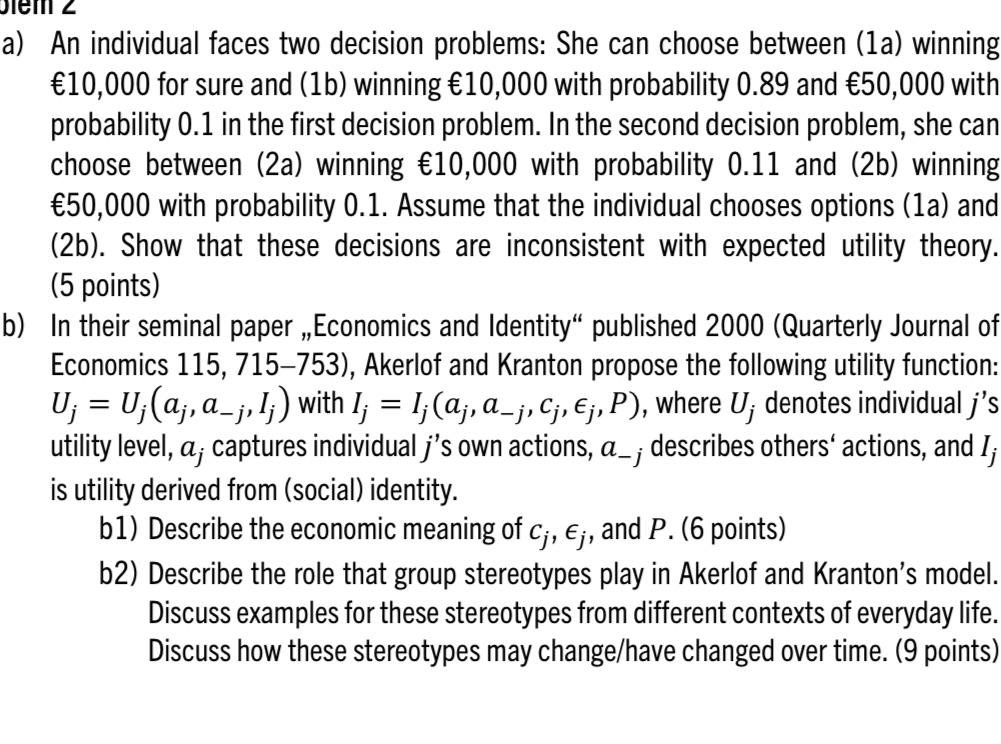
Jllll L a) b) An individual faces two decision problems: She can choose between (1a) winning 10,000 for sure and (1b) winning 10,000 with probability 0.89 and 50,000 with probability 0.1 in the first decision problem. In the second decision problem, she can choose between (2a) winning 10,000 with probability 0.11 and (2b) winning 50,000 with probability 0.1. Assume that the individual chooses options (1a) and (2b). Show that these decisions are inconsistent with expected utility theory. (5 points) In their seminal paper ,,Economics and Identity\" published 2000 (Quarterly Journal of Economics 115, 715753), Akerlof and Kranton propose the following utility function: it} = Uj(aj,a_j,fj) with I}- = 13-01}, LL}, are}, P), where U; denotes individual j's utility level, aj captures individual j's own actions, LL}. describes others' actions, and I}- is utility derived from (social) identity. b1) Describe the economic meaning of C}, 6;, and P. (6 points) b2) Describe the role that group stereotypes play in Akerlof and Kranton's model. Discuss examples for these stereotypes from different contexts of everyday life. Discuss how these stereotypes may change/have changed over time. (9 points)
Step by Step Solution
There are 3 Steps involved in it

Get step-by-step solutions from verified subject matter experts
 Study Help