







Question: CO2 and CH4 are the two main gases causing global warming through the greenhouse gas effect. They are also the main components of biogas (roughly
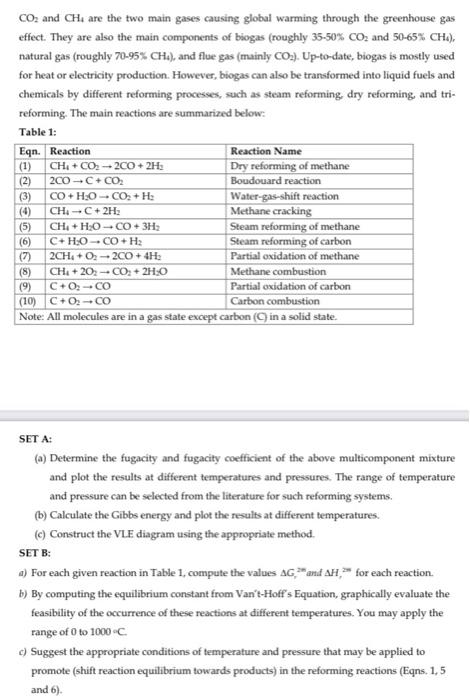
CO2 and CH4 are the two main gases causing global warming through the greenhouse gas effect. They are also the main components of biogas (roughly 3550%CO2 and 5065%CH4 ), natural gas (roughly 70-95\% CH4 ), and flue gas (mainly CO2 ). Up-to-date, biogas is mostly used for heat or electricity production. However, biogas can also be transformed into liquid fuels and chemicals by different reforming processes, such as steam reforming dry reforming, and trireforming. The main reactions are summarized below: Table 1: SET A: (a) Determine the fugacity and fugacity coefficient of the above multicomponent mixture and plot the results at different temperatures and pressures. The range of temperature and pressure can be selected from the literature for such reforming systems. (b) Calculate the Gibbs energy and plot the results at different temperatures. (c) Construct the VLE diagram using the appropriate method. SEI B; a) For each given reaction in Table 1, compute the values G2m and H2, for each reaction. b) By computing the equilibrium constant from Van't-Hoff's Equation, graphically evaluate the feasibility of the occurrence of these reactions at different temperatures. You may apply the range of 0 to 1000 oC c) Suggest the appropriate conditions of temperature and pressure that may be applied to promote (shift reaction equilibrium towards products) in the reforming reactions (Eqns, 1, 5 and 6). CO2 and CH4 are the two main gases causing global warming through the greenhouse gas effect. They are also the main components of biogas (roughly 3550%CO2 and 5065%CH4 ), natural gas (roughly 70-95\% CH4 ), and flue gas (mainly CO2 ). Up-to-date, biogas is mostly used for heat or electricity production. However, biogas can also be transformed into liquid fuels and chemicals by different reforming processes, such as steam reforming dry reforming, and trireforming. The main reactions are summarized below: Table 1: SET A: (a) Determine the fugacity and fugacity coefficient of the above multicomponent mixture and plot the results at different temperatures and pressures. The range of temperature and pressure can be selected from the literature for such reforming systems. (b) Calculate the Gibbs energy and plot the results at different temperatures. (c) Construct the VLE diagram using the appropriate method. SEI B; a) For each given reaction in Table 1, compute the values G2m and H2, for each reaction. b) By computing the equilibrium constant from Van't-Hoff's Equation, graphically evaluate the feasibility of the occurrence of these reactions at different temperatures. You may apply the range of 0 to 1000 oC c) Suggest the appropriate conditions of temperature and pressure that may be applied to promote (shift reaction equilibrium towards products) in the reforming reactions (Eqns, 1, 5 and 6)
Step by Step Solution
There are 3 Steps involved in it

Get step-by-step solutions from verified subject matter experts
 Study Help