







Question: Code: 4. This problem will be completed in class on Wednesday 3/10. We will interpolate the following points with cubic splines: (1,3), (3,2), (7.4), (12.8).

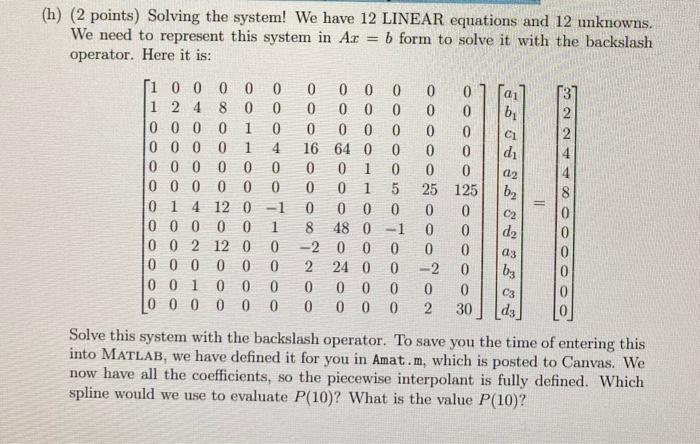
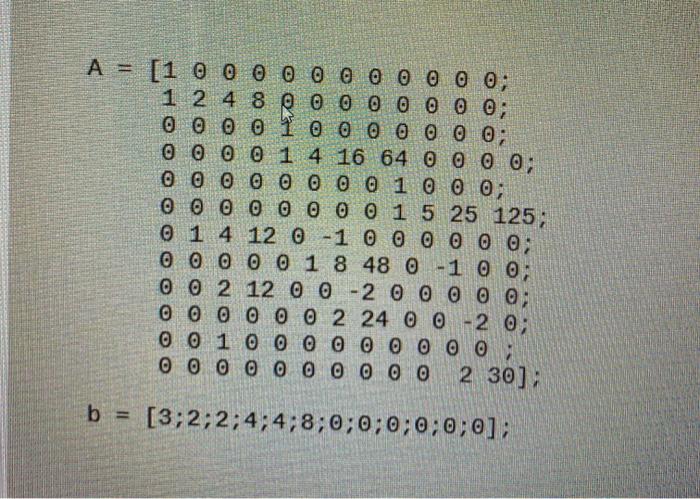
4. This problem will be completed in class on Wednesday 3/10. We will interpolate the following points with cubic splines: (1,3), (3,2), (7.4), (12.8). 11. Malena minh clotch on naner (not in MATLAB) of the four points and (h) (2 points) Solving the system! We have 12 LINEAR equations and 12 unknowns. We need to represent this system in Az b form to solve it with the backslash operator. Here it is: [1 0 0 0 0 0 0 0 0 0 0 0 1 2 4 80 0 0 0 0 0 0 0 bi 0 0 0 0 1 0 0 0 0 0 0 0 0 0 0 0 1 4 16 64 0 0 0 0 0 0 0 0 0 0 0 0 1 0 0 0 0 0 0 0 0 0 0 0 1 5 25 125 0 1 4 12 0 -1 0 0 0 0 0 0 0 0 0 0 0 1 8 48 0-1 0 0 0 0 2120 0 - 2 0 0 0 0 0 0 0 0 0 0 0 2 24 0 0 - 2 0 0 0 1 0 0 0 0 0 0 0 0 C3 10 0 0 0 0 0 0 0 0 0 2 30 d3 CI di (12 | b2 C2 d2 03 b3 ooo Yaco al OOOO = Solve this system with the backslash operator. To save you the time of entering this into MATLAB, we have defined it for you in Amat.m, which is posted to Canvas. We now have all the coefficients, so the piecewise interpolant is fully defined. Which spline would we use to evaluate P(10)? What is the value P(10)? = [1 0 0 0 0 0 0 0 0 0 0 0; 1 2 4 8 0 0 0 0 0 0 0 0; 0 0 0 0 1 0 0 0 0 0 0 0; 0 0 0 0 1 4 16 64 0 0 0 0; 0 0 0 0 0 0 0 0 1 0 0 0; 0 0 0 0 0 0 0 0 1 5 25 125, 0 1 4 12 0-1 0 0 0 0 0 0; 0 0 0 0 0 1 8 48 0 - 1 0 0; 0 0 2 12 0 0 - 2 0 0 0 0 0; 0 0 0 0 0 0 2 24 0 0 - 2 0; 0 0 1 0 0 0 0 0 0 0 0 0 0 0 0 0 0 0 0 0 0 0 230]; b = [3;2;2;4;4;8;0;0;0;0;0;] 4. This problem will be completed in class on Wednesday 3/10. We will interpolate the following points with cubic splines: (1,3), (3,2), (7.4), (12.8). 11. Malena minh clotch on naner (not in MATLAB) of the four points and (h) (2 points) Solving the system! We have 12 LINEAR equations and 12 unknowns. We need to represent this system in Az b form to solve it with the backslash operator. Here it is: [1 0 0 0 0 0 0 0 0 0 0 0 1 2 4 80 0 0 0 0 0 0 0 bi 0 0 0 0 1 0 0 0 0 0 0 0 0 0 0 0 1 4 16 64 0 0 0 0 0 0 0 0 0 0 0 0 1 0 0 0 0 0 0 0 0 0 0 0 1 5 25 125 0 1 4 12 0 -1 0 0 0 0 0 0 0 0 0 0 0 1 8 48 0-1 0 0 0 0 2120 0 - 2 0 0 0 0 0 0 0 0 0 0 0 2 24 0 0 - 2 0 0 0 1 0 0 0 0 0 0 0 0 C3 10 0 0 0 0 0 0 0 0 0 2 30 d3 CI di (12 | b2 C2 d2 03 b3 ooo Yaco al OOOO = Solve this system with the backslash operator. To save you the time of entering this into MATLAB, we have defined it for you in Amat.m, which is posted to Canvas. We now have all the coefficients, so the piecewise interpolant is fully defined. Which spline would we use to evaluate P(10)? What is the value P(10)? = [1 0 0 0 0 0 0 0 0 0 0 0; 1 2 4 8 0 0 0 0 0 0 0 0; 0 0 0 0 1 0 0 0 0 0 0 0; 0 0 0 0 1 4 16 64 0 0 0 0; 0 0 0 0 0 0 0 0 1 0 0 0; 0 0 0 0 0 0 0 0 1 5 25 125, 0 1 4 12 0-1 0 0 0 0 0 0; 0 0 0 0 0 1 8 48 0 - 1 0 0; 0 0 2 12 0 0 - 2 0 0 0 0 0; 0 0 0 0 0 0 2 24 0 0 - 2 0; 0 0 1 0 0 0 0 0 0 0 0 0 0 0 0 0 0 0 0 0 0 0 230]; b = [3;2;2;4;4;8;0;0;0;0;0;]
Step by Step Solution
There are 3 Steps involved in it

Get step-by-step solutions from verified subject matter experts
 Study Help