







Question: Code in C++, PLEASE DO NOT WRITE THE CODE SO THAT IT ONLY WORKS FOR QUITEGOOD 100 ETC, it must work for any number inside
Code in C++, PLEASE DO NOT WRITE THE CODE SO THAT IT ONLY WORKS FOR QUITEGOOD 100 ETC, it must work for any number inside the parameter
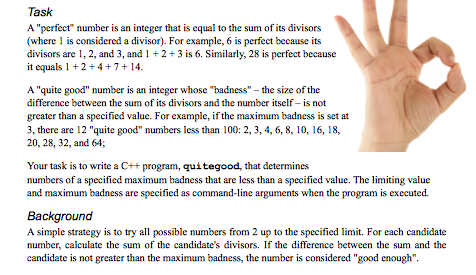
Task A "perfect" number is an integer that is equal to the sum of its divisors (where is considered a divisor). For example, 6 is perfect because its divisors are 1, 2, and 3, and 1 2 +3 is 6. Similarly, 28 is perfect because It equals l+2+4+7+14. A "quite good" number is an integer whose "badness" - the size of the difference between the sum of its divisors and the number itself -is not greater than a specified value. For example, if the maximum badness is set at 3, there are 12 "quite good" numbers less than 100: 2, 3,4, 6, 8, 10, 16, 18, 20, 28, 32, and 64; Your task is to write a C++ program, quitegood, that determines numbers of a specified maximum badness that are less than a specified value. The limiting value and maximum badness are specified as command-line arguments when the program is executed. Background A simple strategy is to try all possible numbers from 2 up to the specified limit. For each candidate number, calculate the sum of the candidate's divisors. If the difference between the sum and the candidate is not greater than the maximum badness, the number is considered "good enough
Step by Step Solution
There are 3 Steps involved in it

Get step-by-step solutions from verified subject matter experts
 Study Help