







Question: CODE IN EXCEL VBA PLEASE ISEN 230 - Homework 5 VBA code due in canvas Upload to canvas an Excel file that includes your code
CODE IN EXCEL VBA PLEASE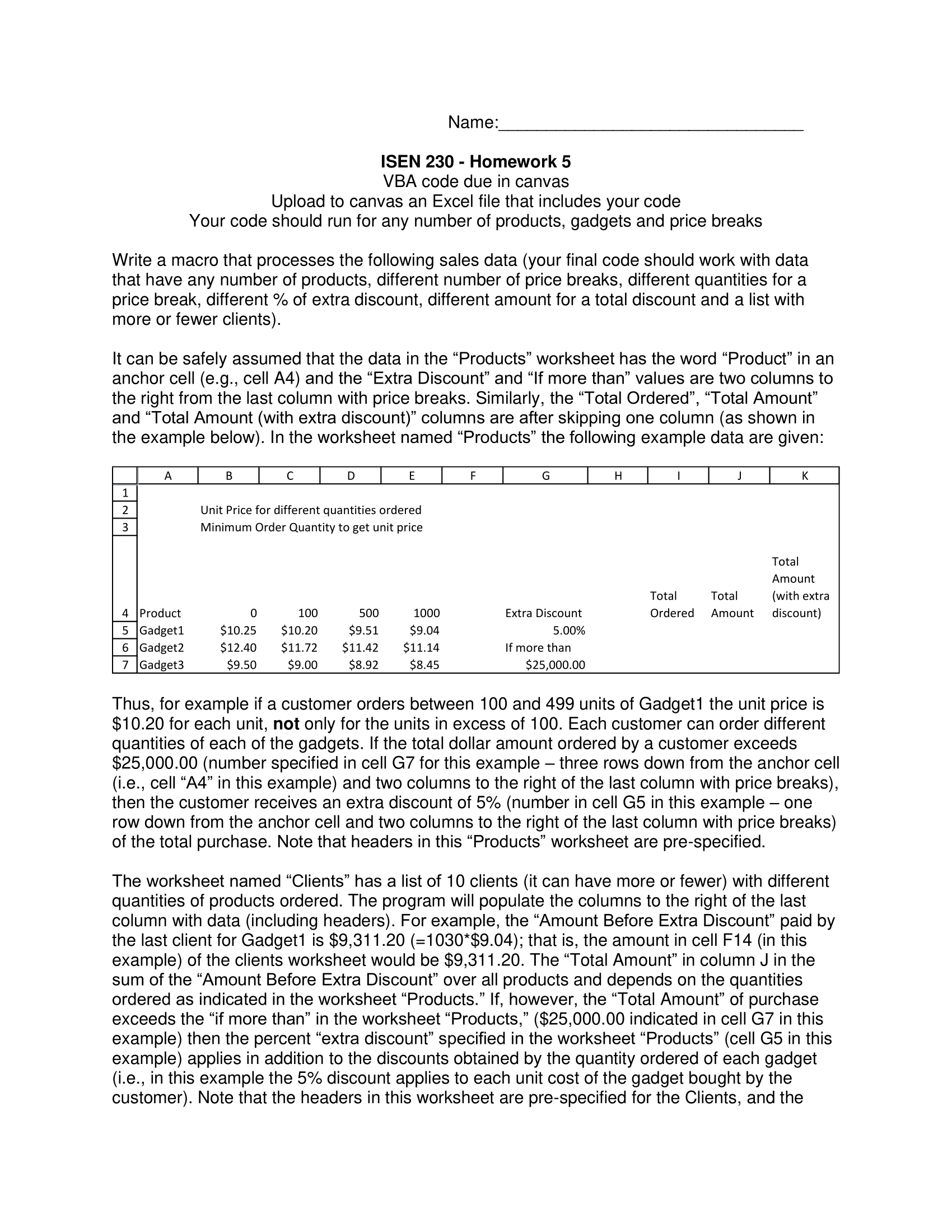
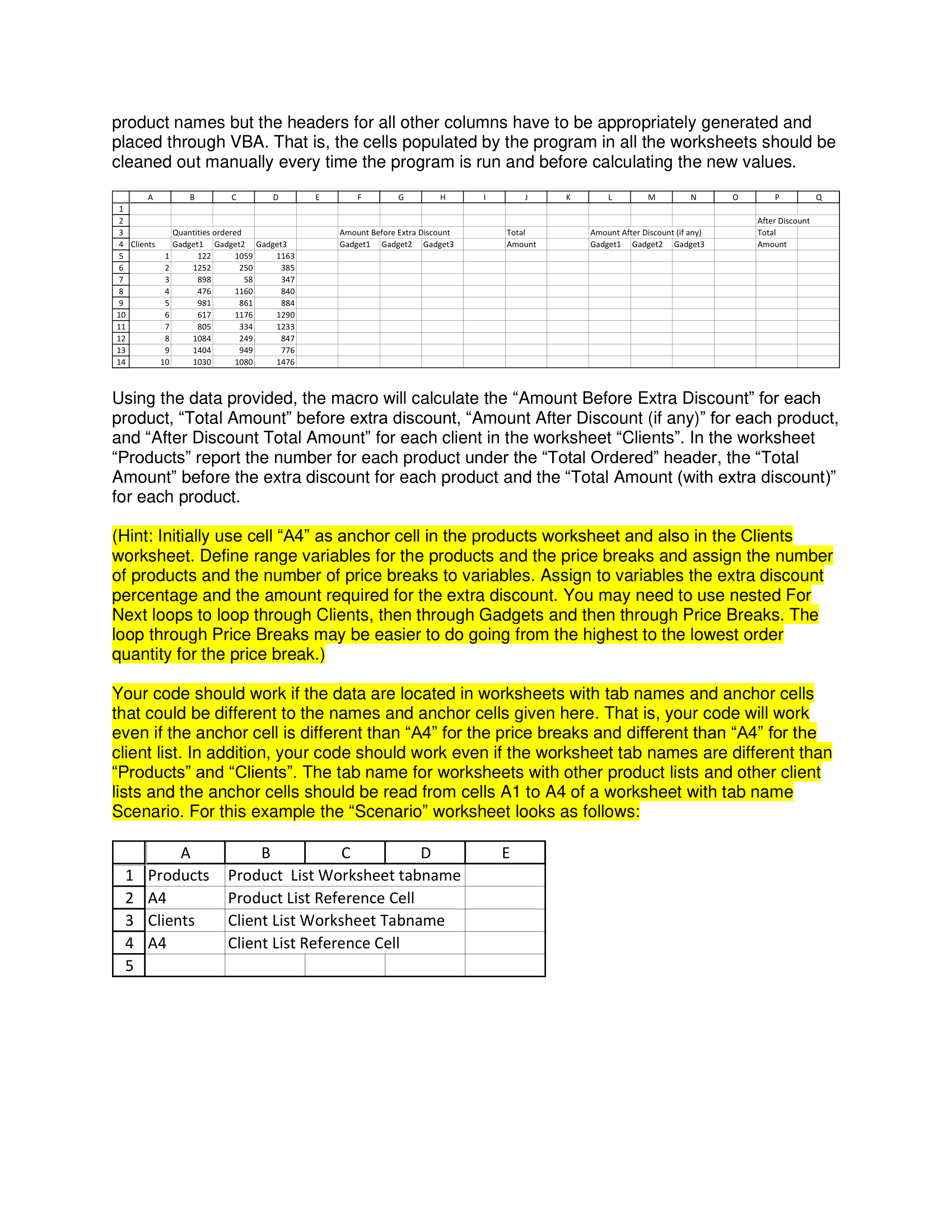
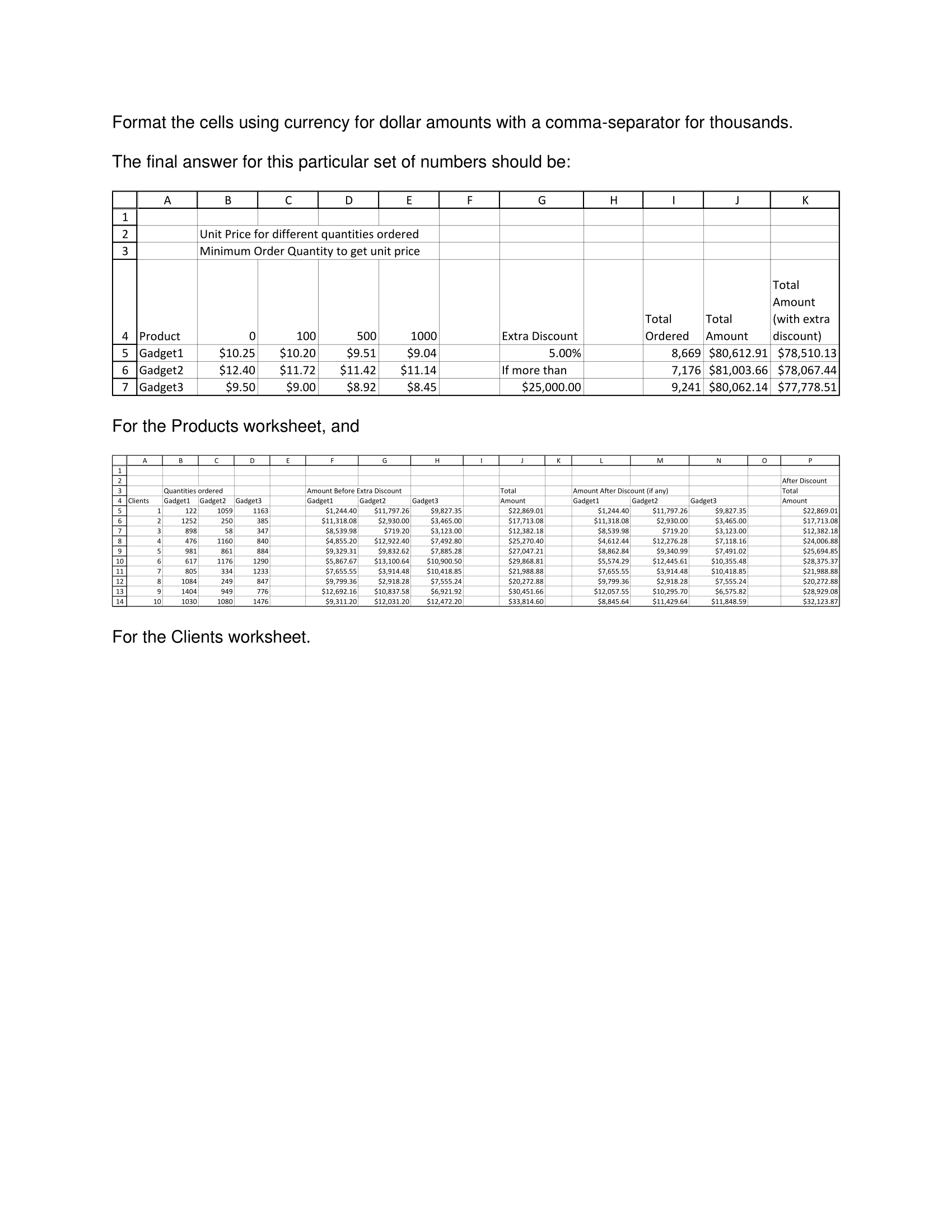
ISEN 230 - Homework 5 VBA code due in canvas Upload to canvas an Excel file that includes your code Your code should run for any number of products, gadgets and price breaks Write a macro that processes the following sales data (your final code should work with data that have any number of products, different number of price breaks, different quantities for a price break, different \% of extra discount, different amount for a total discount and a list with more or fewer clients). It can be safely assumed that the data in the "Products" worksheet has the word "Product" in an anchor cell (e.g., cell A4) and the "Extra Discount" and "If more than" values are two columns to the right from the last column with price breaks. Similarly, the "Total Ordered", "Total Amount" and "Total Amount (with extra discount)" columns are after skipping one column (as shown in the example below). In the worksheet named "Products" the following example data are given: Thus, for example if a customer orders between 100 and 499 units of Gadget 1 the unit price is $10.20 for each unit, not only for the units in excess of 100. Each customer can order different quantities of each of the gadgets. If the total dollar amount ordered by a customer exceeds $25,000.00 (number specified in cell G7 for this example - three rows down from the anchor cell (i.e., cell "A4" in this example) and two columns to the right of the last column with price breaks), then the customer receives an extra discount of 5% (number in cell G5 in this example - one row down from the anchor cell and two columns to the right of the last column with price breaks) of the total purchase. Note that headers in this "Products" worksheet are pre-specified. The worksheet named "Clients" has a list of 10 clients (it can have more or fewer) with different quantities of products ordered. The program will populate the columns to the right of the last column with data (including headers). For example, the "Amount Before Extra Discount" paid by the last client for Gadget 1 is $9,311.20(=1030$9.04); that is, the amount in cell F14 (in this example) of the clients worksheet would be $9,311.20. The "Total Amount" in column J in the sum of the "Amount Before Extra Discount" over all products and depends on the quantities ordered as indicated in the worksheet "Products." If, however, the "Total Amount" of purchase exceeds the "if more than" in the worksheet "Products," (\$25,000.00 indicated in cell G7 in this example) then the percent "extra discount" specified in the worksheet "Products" (cell G5 in this example) applies in addition to the discounts obtained by the quantity ordered of each gadget (i.e., in this example the 5% discount applies to each unit cost of the gadget bought by the customer). Note that the headers in this worksheet are pre-specified for the Clients, and the product names but the headers for all other columns have to be appropriately generated and placed through VBA. That is, the cells populated by the program in all the worksheets should be cleaned out manually every time the program is run and before calculating the new values. Using the data provided, the macro will calculate the "Amount Before Extra Discount" for each product, "Total Amount" before extra discount, "Amount After Discount (if any)" for each product, and "After Discount Total Amount" for each client in the worksheet "Clients". In the worksheet "Products" report the number for each product under the "Total Ordered" header, the "Total Amount" before the extra discount for each product and the "Total Amount (with extra discount)" for each product. (Hint: Initially use cell "A4" as anchor cell in the products worksheet and also in the Clients worksheet. Define range variables for the products and the price breaks and assign the number of products and the number of price breaks to variables. Assign to variables the extra discount percentage and the amount required for the extra discount. You may need to use nested For Next loops to loop through Clients, then through Gadgets and then through Price Breaks. The loop through Price Breaks may be easier to do going from the highest to the lowest order quantity for the price break.) Your code should work if the data are located in worksheets with tab names and anchor cells that could be different to the names and anchor cells given here. That is, your code will work even if the anchor cell is different than "A4" for the price breaks and different than "A4" for the client list. In addition, your code should work even if the worksheet tab names are different than "Products" and "Clients". The tab name for worksheets with other product lists and other client lists and the anchor cells should be read from cells A1 to A4 of a worksheet with tab name Scenario. For this example the "Scenario" worksheet looks as follows: Format the cells using currency for dollar amounts with a comma-separator for thousands. The final answer for this particular set of numbers should be: For the Products worksheet, and For the Clients worksheet. ISEN 230 - Homework 5 VBA code due in canvas Upload to canvas an Excel file that includes your code Your code should run for any number of products, gadgets and price breaks Write a macro that processes the following sales data (your final code should work with data that have any number of products, different number of price breaks, different quantities for a price break, different \% of extra discount, different amount for a total discount and a list with more or fewer clients). It can be safely assumed that the data in the "Products" worksheet has the word "Product" in an anchor cell (e.g., cell A4) and the "Extra Discount" and "If more than" values are two columns to the right from the last column with price breaks. Similarly, the "Total Ordered", "Total Amount" and "Total Amount (with extra discount)" columns are after skipping one column (as shown in the example below). In the worksheet named "Products" the following example data are given: Thus, for example if a customer orders between 100 and 499 units of Gadget 1 the unit price is $10.20 for each unit, not only for the units in excess of 100. Each customer can order different quantities of each of the gadgets. If the total dollar amount ordered by a customer exceeds $25,000.00 (number specified in cell G7 for this example - three rows down from the anchor cell (i.e., cell "A4" in this example) and two columns to the right of the last column with price breaks), then the customer receives an extra discount of 5% (number in cell G5 in this example - one row down from the anchor cell and two columns to the right of the last column with price breaks) of the total purchase. Note that headers in this "Products" worksheet are pre-specified. The worksheet named "Clients" has a list of 10 clients (it can have more or fewer) with different quantities of products ordered. The program will populate the columns to the right of the last column with data (including headers). For example, the "Amount Before Extra Discount" paid by the last client for Gadget 1 is $9,311.20(=1030$9.04); that is, the amount in cell F14 (in this example) of the clients worksheet would be $9,311.20. The "Total Amount" in column J in the sum of the "Amount Before Extra Discount" over all products and depends on the quantities ordered as indicated in the worksheet "Products." If, however, the "Total Amount" of purchase exceeds the "if more than" in the worksheet "Products," (\$25,000.00 indicated in cell G7 in this example) then the percent "extra discount" specified in the worksheet "Products" (cell G5 in this example) applies in addition to the discounts obtained by the quantity ordered of each gadget (i.e., in this example the 5% discount applies to each unit cost of the gadget bought by the customer). Note that the headers in this worksheet are pre-specified for the Clients, and the product names but the headers for all other columns have to be appropriately generated and placed through VBA. That is, the cells populated by the program in all the worksheets should be cleaned out manually every time the program is run and before calculating the new values. Using the data provided, the macro will calculate the "Amount Before Extra Discount" for each product, "Total Amount" before extra discount, "Amount After Discount (if any)" for each product, and "After Discount Total Amount" for each client in the worksheet "Clients". In the worksheet "Products" report the number for each product under the "Total Ordered" header, the "Total Amount" before the extra discount for each product and the "Total Amount (with extra discount)" for each product. (Hint: Initially use cell "A4" as anchor cell in the products worksheet and also in the Clients worksheet. Define range variables for the products and the price breaks and assign the number of products and the number of price breaks to variables. Assign to variables the extra discount percentage and the amount required for the extra discount. You may need to use nested For Next loops to loop through Clients, then through Gadgets and then through Price Breaks. The loop through Price Breaks may be easier to do going from the highest to the lowest order quantity for the price break.) Your code should work if the data are located in worksheets with tab names and anchor cells that could be different to the names and anchor cells given here. That is, your code will work even if the anchor cell is different than "A4" for the price breaks and different than "A4" for the client list. In addition, your code should work even if the worksheet tab names are different than "Products" and "Clients". The tab name for worksheets with other product lists and other client lists and the anchor cells should be read from cells A1 to A4 of a worksheet with tab name Scenario. For this example the "Scenario" worksheet looks as follows: Format the cells using currency for dollar amounts with a comma-separator for thousands. The final answer for this particular set of numbers should be: For the Products worksheet, and For the Clients worksheet
Step by Step Solution
There are 3 Steps involved in it

Get step-by-step solutions from verified subject matter experts
 Study Help