







Question: CODE IN JAVA LinkedStack.java public class LinkedStack implements Stack { private SinglyLinkedList list = new SinglyLinkedList(); public LinkedStack(){} public int size(){ return list.size(); } public
CODE IN JAVA
LinkedStack.java
public class LinkedStack
private SinglyLinkedList
public LinkedStack(){}
public int size(){
return list.size();
}
public boolean isEmpty(){
return list.isEmpty();
}
public void push(E element) {
list.addFirst(element);
}
public E top(){
return list.first();
}
public E pop(){
return list.removeFirst();
}
}
Stack.java
public interface Stack
/**
* Returns the number of elements in the stack.
* @return number of elements in the stack
*/
int size();
/**
* Tests whether the stack is empty.
* @return true if the stack is empty, false otherwise
*/
boolean isEmpty();
/**
* Inserts an element at the top of the stack.
* @param e the element to be inserted
*/
void push(E e);
/**
* Returns, but does not remove, the element at the top of the stack.
* @return top element in the stack (or null if empty)
*/
E top();
/**
* Removes and returns the top element from the stack.
* @return element removed (or null if empty)
*/
E pop();
}
SinglyLinkedList.java
public class SinglyLinkedList
//---------------- nested Node class ----------------
private static class Node
private E element;
private Node
public Node(E e, Node
element = e;
next = n;
}
public E getElement() {
return element;
}
public Node
return next;
}
public void setNext(Node
next = n;
}
} //----------- end of nested Node class -----------
private Node
private Node
private int size = 0;
public SinglyLinkedList() {
}
public int size() {
return size;
}
public boolean isEmpty() {
return size == 0;
}
public E first() {
if (isEmpty()) {
return null;
}
return head.getElement();
}
public E last() {
if (isEmpty()) {
return null;
}
return tail.getElement();
}
// update methods
public void addFirst(E e) {
head = new Node(e, head);
if (size == 0) {
tail = head;
}
size++;
}
public void addLast(E e) {
Node
if (isEmpty()) {
head = newest;
} else {
tail.setNext(newest);
}
tail = newest;
size++;
}
public E removeFirst() {
if (isEmpty()) {
return null;
}
E answer = head.getElement();
head = head.getNext();
size--;
if (size == 0) {
tail = null;
}
return answer;
}
public String toString() {
StringBuilder sb = new StringBuilder("[");
Node
while (n != null) {
sb.append(n.getElement());
if (!n.equals(tail)) {
sb.append(", ");
}
n = n.getNext();
}
sb.append("]");
return sb.toString();
}
}
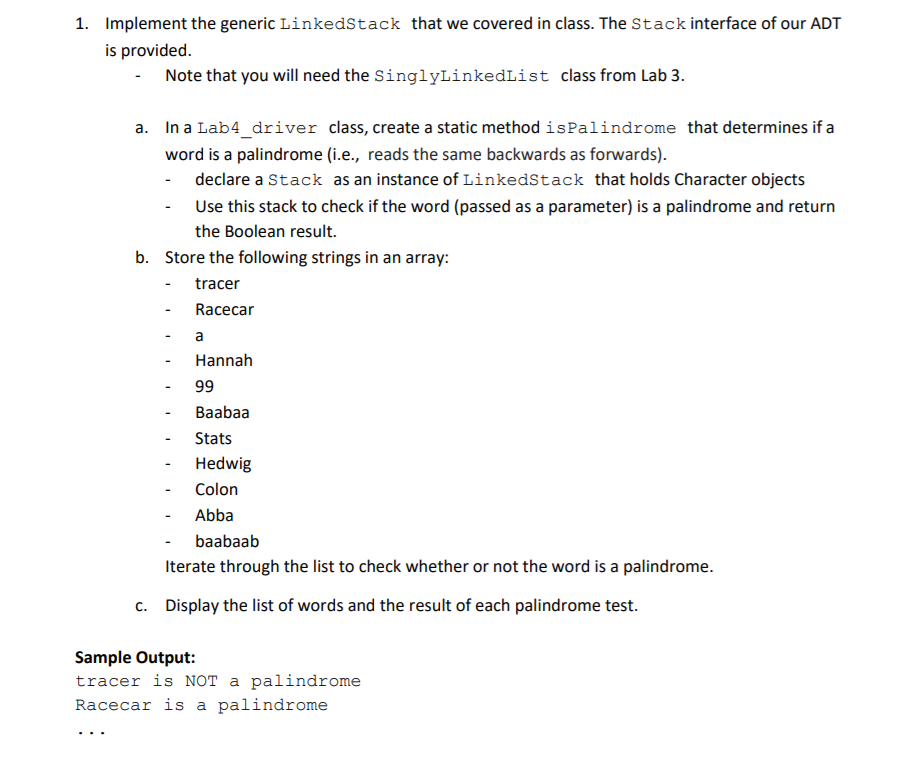
1. Implement the generic LinkedStack that we covered in class. The Stack interface of our ADT is provided. Note that you will need the SinglyLinkedList class from Lab 3. a. In a Lab4_driver class, create a static method ispalindrome that determines if a word is a palindrome (i.e., reads the same backwards as forwards). - declare a Stack as an instance of LinkedStack that holds Character objects Use this stack to check if the word (passed as a parameter) is a palindrome and return the Boolean result. b. Store the following strings in an array: tracer Racecar a Hannah 99 Baabaa Stats Hedwig Colon Abba baabaab Iterate through the list to check whether or not the word is a palindrome. C. Display the list of words and the result of each palindrome test. - Sample Output: tracer is NOT a palindrome Racecar is a palindrome
Step by Step Solution
There are 3 Steps involved in it

Get step-by-step solutions from verified subject matter experts
 Study Help