







Question: Code in Python language. In lectures, we learned Fibonacci numbers, where the number in index 0 is 0 , the number in index 1 is
Code in Python language.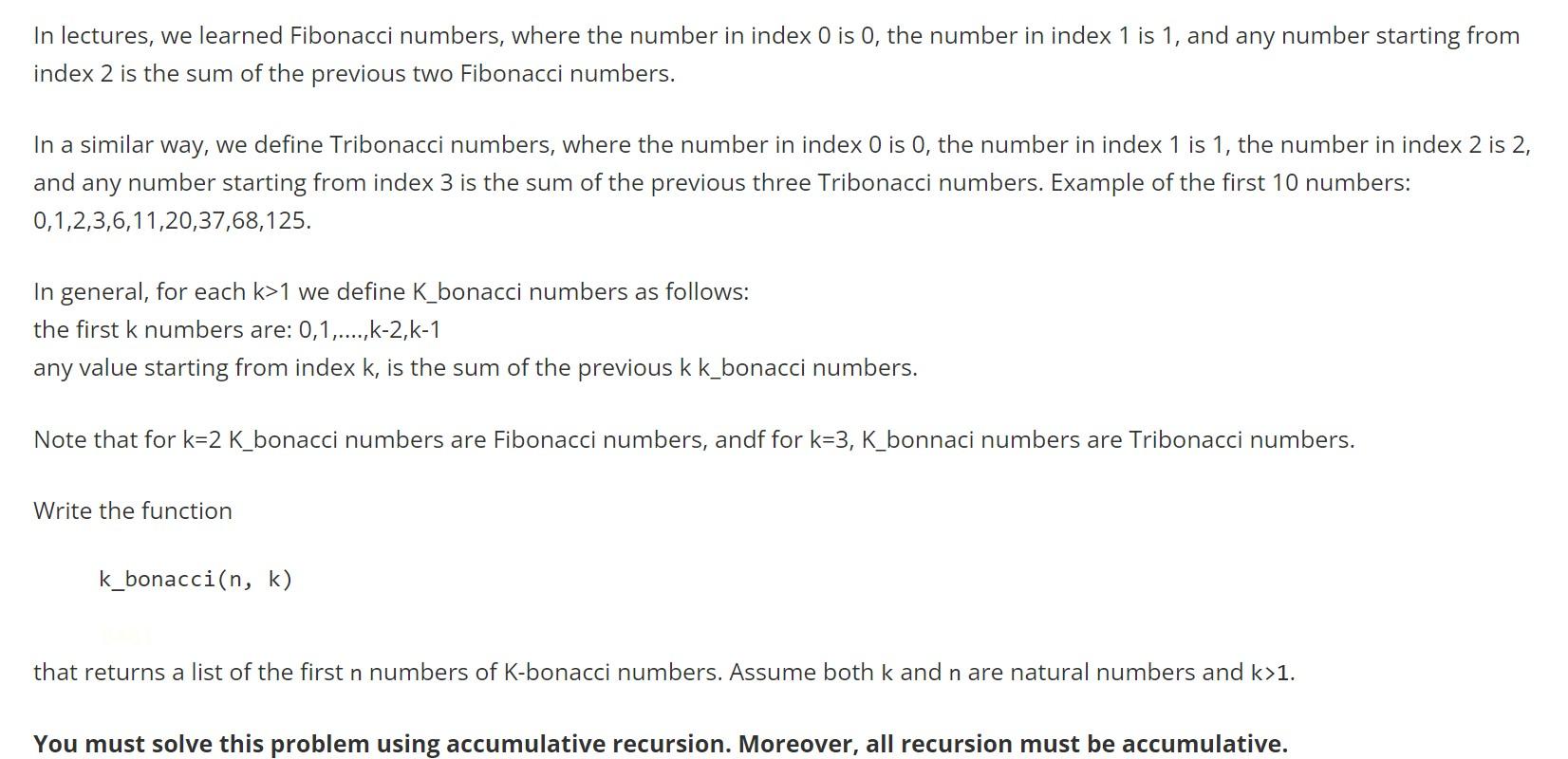
In lectures, we learned Fibonacci numbers, where the number in index 0 is 0 , the number in index 1 is 1 , and any number starting from index 2 is the sum of the previous two Fibonacci numbers. In a similar way, we define Tribonacci numbers, where the number in index 0 is 0 , the number in index 1 is 1 , the number in index 2 is 2 and any number starting from index 3 is the sum of the previous three Tribonacci numbers. Example of the first 10 numbers: 0,1,2,3,6,11,20,37,68,125 In general, for each k>1 we define K_bonacci numbers as follows: the first k numbers are: 0,1,,k2,k1 any value starting from index k, is the sum of the previous k k_bonacci numbers. Note that for k=2 K_bonacci numbers are Fibonacci numbers, andf for k=3, K_bonnaci numbers are Tribonacci numbers. Write the function k_bonacci (n,k) that returns a list of the first n numbers of K-bonacci numbers. Assume both k and n are natural numbers and k>1. You must solve this problem using accumulative recursion. Moreover, all recursion must be accumulative
Step by Step Solution
There are 3 Steps involved in it

Get step-by-step solutions from verified subject matter experts
 Study Help