







Question: CODE IN PYTHON PLEASE (.PY) .Create pseudo code as well please Requirements: The latest production of a science-fiction blockbuster has transferred to the stage. It
CODE IN PYTHON PLEASE (.PY) .Create pseudo code as well please
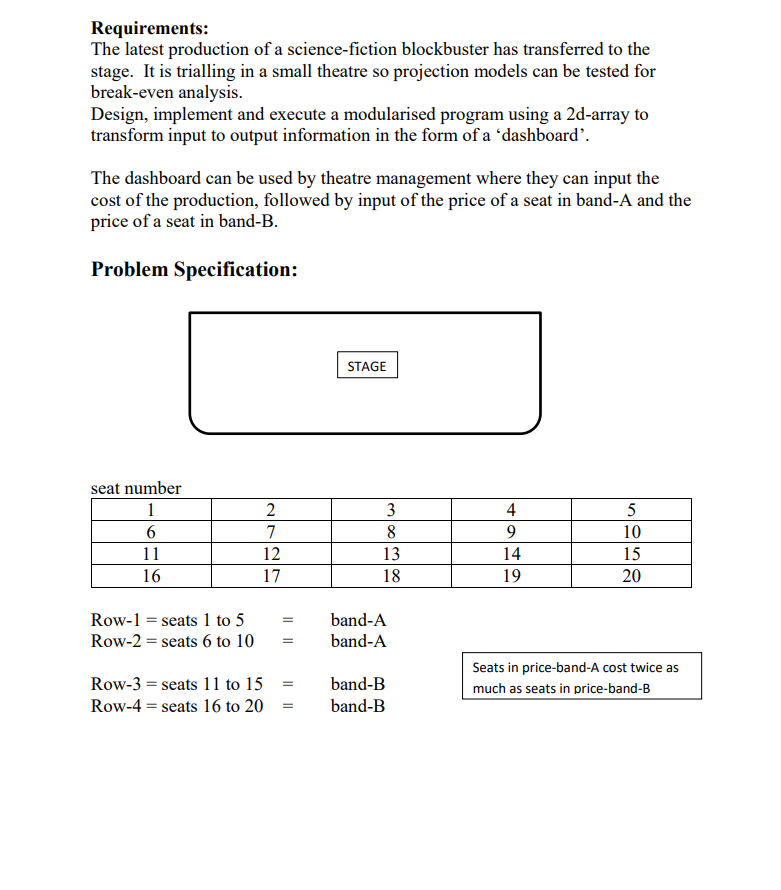
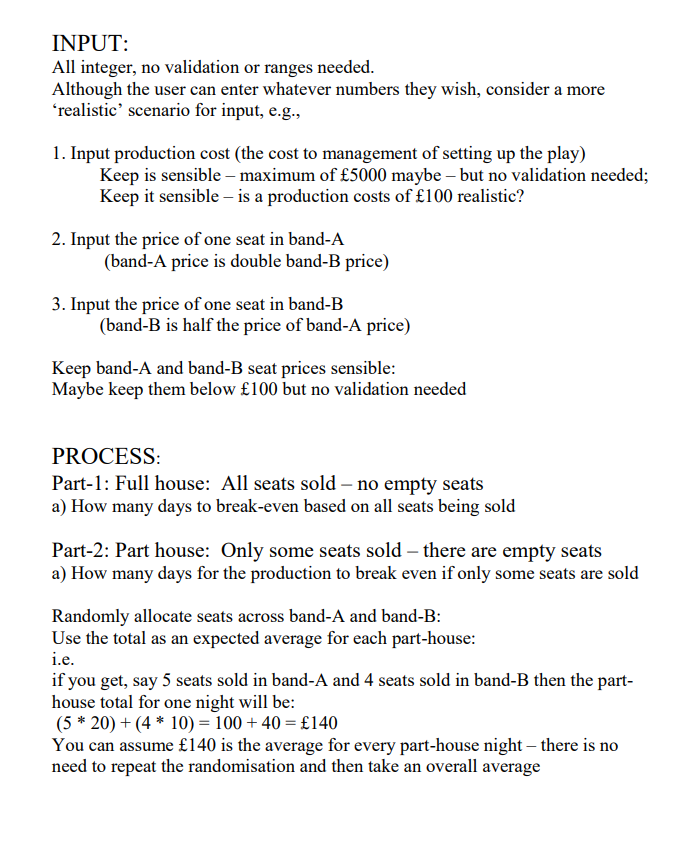
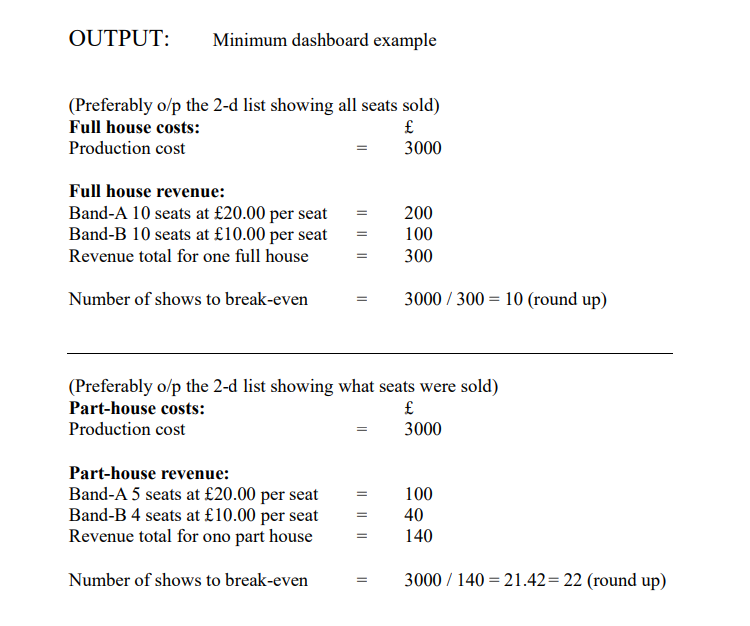
Requirements: The latest production of a science-fiction blockbuster has transferred to the stage. It is trialling in a small theatre so projection models can be tested for break-even analysis. Design, implement and execute a modularised program using a 2d-array to transform input to output information in the form of a 'dashboard'. The dashboard can be used by theatre management where they can input the cost of the production, followed by input of the price of a seat in band-A and the price of a seat in band-B. Problem Specification: STAGE seat number 1 6 11 16 2 7 12 17 3 8 13 18 4 9 14 19 5 10 15 20 = Row-1 = seats 1 to 5 Row-2 = seats 6 to 10 band-A band-A Row-3 = seats 11 to 15 = Row-4 = seats 16 to 20 band-B band-B Seats in price-band-A cost twice as much as seats in price-band-B INPUT: All integer, no validation or ranges needed. Although the user can enter whatever numbers they wish, consider a more realistic scenario for input, e.g., 1. Input production cost (the cost to management of setting up the play) Keep is sensible maximum of 5000 maybe but no validation needed; Keep it sensible is a production costs of 100 realistic? 2. Input the price of one seat in band-A (band-A price is double band-B price) 3. Input the price of one seat in band-B (band-B is half the price of band-A price) Keep band-A and band-B seat prices sensible: Maybe keep them below 100 but no validation needed PROCESS: Part-1: Full house: All seats sold no empty seats a) How many days to break-even based on all seats being sold Part-2: Part house: Only some seats sold there are empty seats a) How many days for the production to break even if only some seats are sold Randomly allocate seats across band-A and band-B: Use the total as an expected average for each part-house: i.e. if you get, say 5 seats sold in band-A and 4 seats sold in band-B then the part- house total for one night will be: (5 * 20)+(4 * 10) = 100 + 40 = 140 You can assume 140 is the average for every part-house night there is no need to repeat the randomisation and then take an overall average OUTPUT: Minimum dashboard example (Preferably o/p the 2-d list showing all seats sold) Full house costs: Production cost 3000 II Full house revenue: Band-A 10 seats at 20.00 per seat Band-B 10 seats at 10.00 per seat Revenue total for one full house 200 100 300 Number of shows to break-even 3000 / 300 = 10 (round up) (Preferably o/p the 2-d list showing what seats were sold) Part-house costs: Production cost 3000 Part-house revenue: Band-A 5 seats at 20.00 per seat Band-B 4 seats at 10.00 per seat Revenue total for ono part house 100 40 140 II Number of shows to break-even 3000 / 140 = 21.42= 22 (round up)
Step by Step Solution
There are 3 Steps involved in it

Get step-by-step solutions from verified subject matter experts
 Study Help