







Question: Code in Python Problem 3A (i) (4 pts.) Consider the frequency fo = 420 Hz and the sampling rate f. = 600 samples / sec.
Code in Python
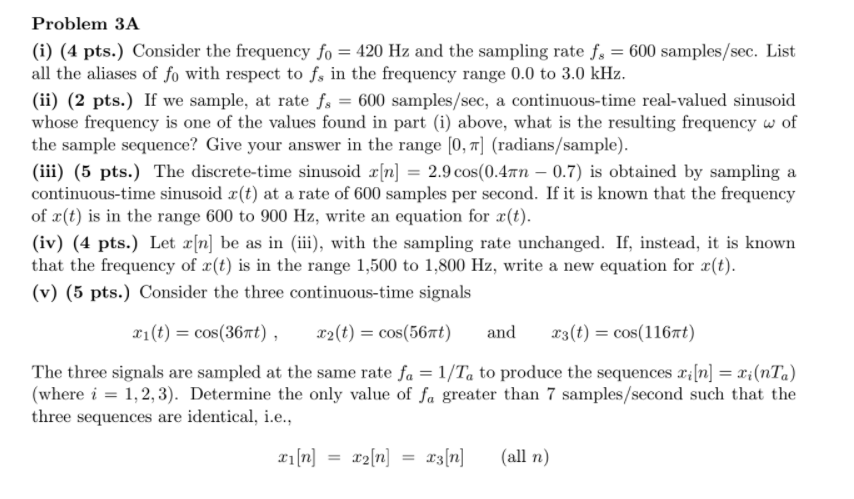
Problem 3A (i) (4 pts.) Consider the frequency fo = 420 Hz and the sampling rate f. = 600 samples / sec. List all the aliases of fo with respect to fs in the frequency range 0.0 to 3.0 kHz. (ii) (2 pts.) If we sample, at rate f. = 600 samples/sec, a continuous-time real-valued sinusoid whose frequency is one of the values found in part (i) above, what is the resulting frequency w of the sample sequence? Give your answer in the range [0, 1] (radians/sample). (iii) (5 pts.) The discrete-time sinusoid x[n] = 2.9 cos(0.4Tn 0.7) is obtained by sampling a continuous-time sinusoid z(t) at a rate of 600 samples per second. If it is known that the frequency of z(t) is in the range 600 to 900 Hz, write an equation for c(t). (iv) (4 pts.) Let x[n] be as in (iii), with the sampling rate unchanged. If, instead, it is known that the frequency of r(t) is in the range 1,500 to 1,800 Hz, write a new equation for r(t). (v) (5 pts.) Consider the three continuous-time signals ri(t) = cos(36mt), 12(t) = cos(56mt) and 13(t) = cos(116mt) The three signals are sampled at the same rate fa = 1/T, to produce the sequences ; [n] = x;(NT) (where i = 1, 2, 3). Determine the only value of fa greater than 7 samples / second such that the three sequences are identical, i.e., 21 [n] = x2(n) = 13[n] (all n) Problem 3A (i) (4 pts.) Consider the frequency fo = 420 Hz and the sampling rate f. = 600 samples / sec. List all the aliases of fo with respect to fs in the frequency range 0.0 to 3.0 kHz. (ii) (2 pts.) If we sample, at rate f. = 600 samples/sec, a continuous-time real-valued sinusoid whose frequency is one of the values found in part (i) above, what is the resulting frequency w of the sample sequence? Give your answer in the range [0, 1] (radians/sample). (iii) (5 pts.) The discrete-time sinusoid x[n] = 2.9 cos(0.4Tn 0.7) is obtained by sampling a continuous-time sinusoid z(t) at a rate of 600 samples per second. If it is known that the frequency of z(t) is in the range 600 to 900 Hz, write an equation for c(t). (iv) (4 pts.) Let x[n] be as in (iii), with the sampling rate unchanged. If, instead, it is known that the frequency of r(t) is in the range 1,500 to 1,800 Hz, write a new equation for r(t). (v) (5 pts.) Consider the three continuous-time signals ri(t) = cos(36mt), 12(t) = cos(56mt) and 13(t) = cos(116mt) The three signals are sampled at the same rate fa = 1/T, to produce the sequences ; [n] = x;(NT) (where i = 1, 2, 3). Determine the only value of fa greater than 7 samples / second such that the three sequences are identical, i.e., 21 [n] = x2(n) = 13[n] (all n)
Step by Step Solution
There are 3 Steps involved in it

Get step-by-step solutions from verified subject matter experts
 Study Help