







Question: code is in python Submission: Zip and upload all relevant.py or.ipynb files. Include a README specifying your version of Python and any special running instructions
code is in python
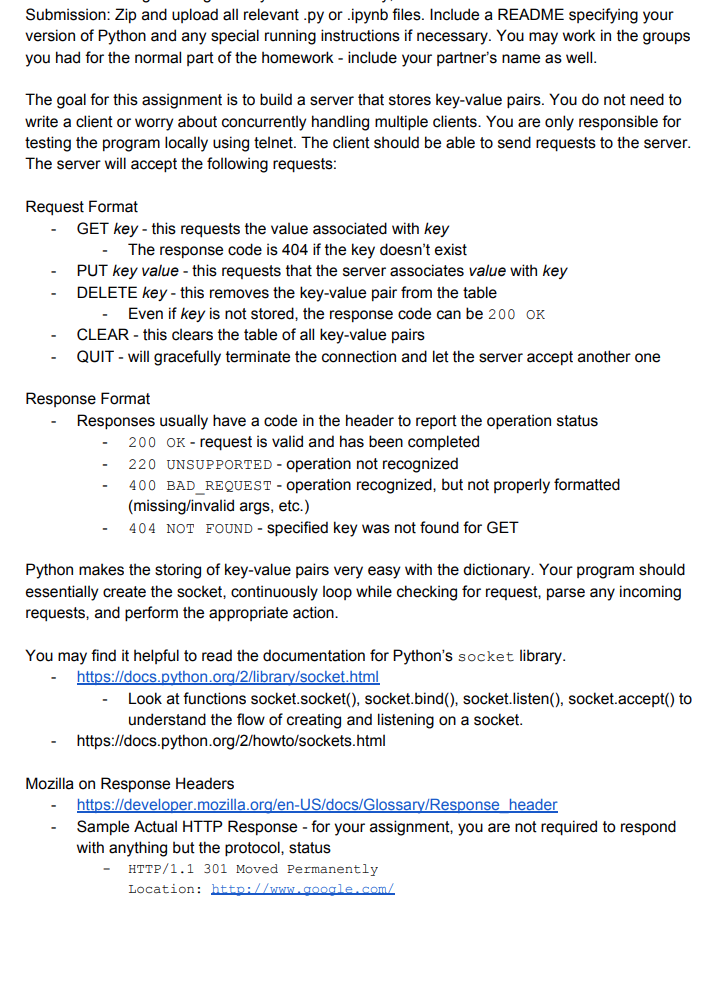
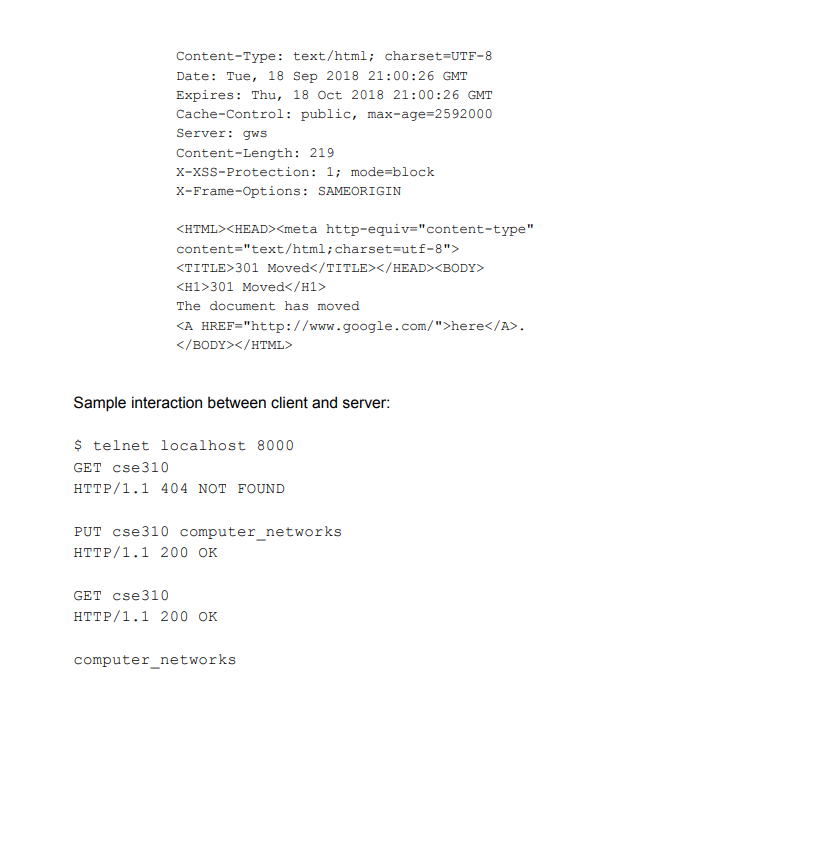
Submission: Zip and upload all relevant.py or.ipynb files. Include a README specifying your version of Python and any special running instructions if necessary. You may work in the groups you had for the normal part of the homework - include your partner's name as wel The goal for this assignment is to build a server that stores key-value pairs. You do not need to write a client or worry about concurrently handling multiple clients. You are only responsible for testing the program locally using telnet. The client should be able to send requests to the server. The server will accept the following requests Request Format - GET key- this requests the value associated with key The response code is 404 if the key doesn't exist - PUT key value this requests that the server associates value with key DELETE key-this removes the key-value pair from the table -Even if key is not stored, the response code can be 200 OK CLEAR - this clears the table of all key-value pairs QUIT will gracefully terminate the connection and let the server accept another one Response Format Responses usually have a code in the header to report the operation status - 200 OK- request is valid and has been completed - 220 UNSUPPORTED-operation not recognized - 400 BADREQUEST- operation recognized, but not properly formatted (missing/invalid args, etc.) - 404 NOT FOUND - specified key was not found for GET Python makes the storing of key-value pairs very easy with the dictionary. Your program should essentially create the socket, continuously loop while checking for request, parse any incoming requests, and perform the appropriate action You may find it helpful to read the documentation for Python's socket library Look at functions socket.socket(), socket.bind), socket.listen(), socket.accept) to understand the flow of creating and listening on a socket. - - https:/ldocs.python.org/2/howto/sockets.html Mozilla on Response Headers Sample Actual HTTP Response for your assignment, you are not required to respond with anything but the protocol, status -HTTP/1.1 301 Moved Permanently Location: htt Submission: Zip and upload all relevant.py or.ipynb files. Include a README specifying your version of Python and any special running instructions if necessary. You may work in the groups you had for the normal part of the homework - include your partner's name as wel The goal for this assignment is to build a server that stores key-value pairs. You do not need to write a client or worry about concurrently handling multiple clients. You are only responsible for testing the program locally using telnet. The client should be able to send requests to the server. The server will accept the following requests Request Format - GET key- this requests the value associated with key The response code is 404 if the key doesn't exist - PUT key value this requests that the server associates value with key DELETE key-this removes the key-value pair from the table -Even if key is not stored, the response code can be 200 OK CLEAR - this clears the table of all key-value pairs QUIT will gracefully terminate the connection and let the server accept another one Response Format Responses usually have a code in the header to report the operation status - 200 OK- request is valid and has been completed - 220 UNSUPPORTED-operation not recognized - 400 BADREQUEST- operation recognized, but not properly formatted (missing/invalid args, etc.) - 404 NOT FOUND - specified key was not found for GET Python makes the storing of key-value pairs very easy with the dictionary. Your program should essentially create the socket, continuously loop while checking for request, parse any incoming requests, and perform the appropriate action You may find it helpful to read the documentation for Python's socket library Look at functions socket.socket(), socket.bind), socket.listen(), socket.accept) to understand the flow of creating and listening on a socket. - - https:/ldocs.python.org/2/howto/sockets.html Mozilla on Response Headers Sample Actual HTTP Response for your assignment, you are not required to respond with anything but the protocol, status -HTTP/1.1 301 Moved Permanently Location: htt
Step by Step Solution
There are 3 Steps involved in it

Get step-by-step solutions from verified subject matter experts
 Study Help