







Question: Code Python: I have received your answer, but I still do not understand the difference between % and / / , and when I use
Code Python:
I have received your answer, but I still do not understand the difference between and and when I use and and why xn is using and why xy is can you please help and explain, thanks a lot!
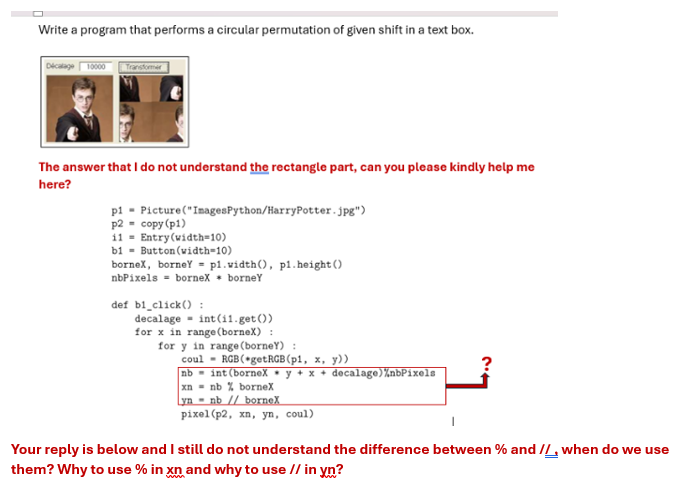
Write a program that performs a circular permutation of given shift in a text box.
The answer that I do not understand the rectangle part, can you please kindly help me here?
p PictureImagesPythonHarryPotterjpg
p copyp
i Entrywidth
b Buttonwidth
borneX, borneY pwidth pheight
nbPixels borneX borneY
def bclick :
decalage intilget
for x in rangeborneX :
for y in rangeborneY :
coul RGBgetRGBp x y
nb intborneX y x decalagenbPixels
xn nb borneX
yntextrmnb borneX
pixelp xn yn coul
Your reply is below and I still do not understand the difference between and underlineunderline when do we use them? Why to use in xn and why to use in yn Pixel Shift Calculation:
nb intborneX y x decalage nbPixels
xn nb borneX
yn nb borneX
st step:
nb: Calculates a new "shifted" index for each pixel by combining its original position x y with the decalage.
nbPixels: Ensures the index wraps around the image size, creating a circular effect.
x n and y n : Convert the D index nb back into D coordinates x nmathrmyn to place each pixel at its new position.
Step by Step Solution
There are 3 Steps involved in it
1 Expert Approved Answer
Step: 1 Unlock

Question Has Been Solved by an Expert!
Get step-by-step solutions from verified subject matter experts
Step: 2 Unlock
Step: 3 Unlock
 Study Help