







Question: coding in python using jupyter hub 3. In this question you will do a version of the dice rolling problem we did in lecture. Instead
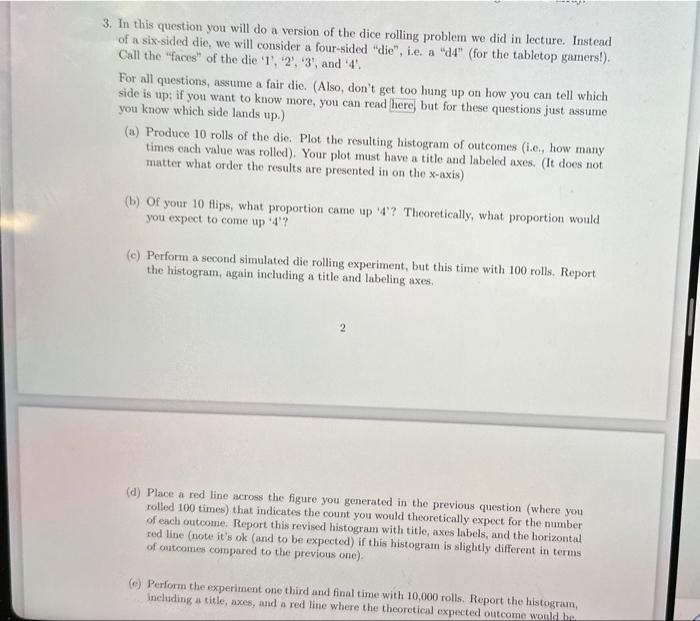
3. In this question you will do a version of the dice rolling problem we did in lecture. Instead of a six-sided die, we will consider a four-sided "die", i.e. a "d4" (for the tabletop gamers!). Call the "faces" of the die ' 1 ', '2', '3', and '4'. For all questions, assume a fair die. (Also, don't get too hung up on how you can tell which side is up: if you want to know more, you can read here, but for these questions just assume you know which side lands up.) (a) Produce 10 rolls of the die. Plot the resulting histogram of outcomes (i.e, how many times each value was rolled). Your plot must have a title and labeled axes. (It does not matter what order the results are presented in on the x-axis) (b) Of your 10 flips, what proportion came up '4'? Theoretically, what proportion would you expect to come up '4'? (c) Perform a second simulated die rolling experiment, but this time with 100 rolls. Report the histogram, again including a title and labeling axes. (d) Place a red line across the figure you generated in the previous question (where you rolled 100 times) that indicates the count you would theoretically expect for the number of each outeome. Report this revised histogram with title, axes labels, and the horizontal red line (note it's ok (and to be expected) if this histogram is slightly different in terms of outcomes compared to the previous one). (c) Perform the experiment one third and final time with 10,000 rolls. Report the histogran, including a title, axes, and a red line where the theoretical expected outcome would ber
Step by Step Solution
There are 3 Steps involved in it

Get step-by-step solutions from verified subject matter experts
 Study Help