







Question: Coding Theory and Cryptography You intercept the encrypted message DXM SCE DCCUVGX which was enciphered using an affine map on digraphs in a 30-letter alphabet
Coding Theory
and
Cryptography
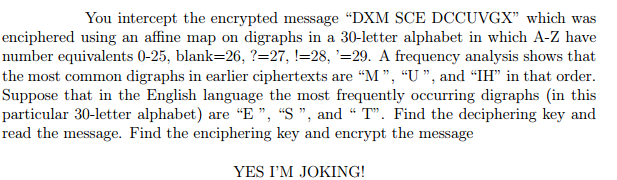
You intercept the encrypted message "DXM SCE DCCUVGX" which was enciphered using an affine map on digraphs in a 30-letter alphabet in which A-Z have number equivalents 0-25, blank = 26, ? 27, ! = 28, '=29. A frequency analysis shows that the most common digraphs in earlier ciphertexts are "M" "U", and "IH" in that order. Suppose that in the English language the most frequently occurring digraphs (in this particular 30-letter alphabet) are "E" "S", and "T". Find the deciphering key and read the message. Find the enciphering key and encrypt the message You intercept the encrypted message "DXM SCE DCCUVGX" which was enciphered using an affine map on digraphs in a 30-letter alphabet in which A-Z have number equivalents 0-25, blank = 26, ? 27, ! = 28, '=29. A frequency analysis shows that the most common digraphs in earlier ciphertexts are "M" "U", and "IH" in that order. Suppose that in the English language the most frequently occurring digraphs (in this particular 30-letter alphabet) are "E" "S", and "T". Find the deciphering key and read the message. Find the enciphering key and encrypt the message
Step by Step Solution
There are 3 Steps involved in it

Get step-by-step solutions from verified subject matter experts
 Study Help