







Question: Coding using C++. Implement a program that takes one user input (n). Implement a scquential program that multiples matrices from 1*1, 2*2, to nn (n
Coding using C++.
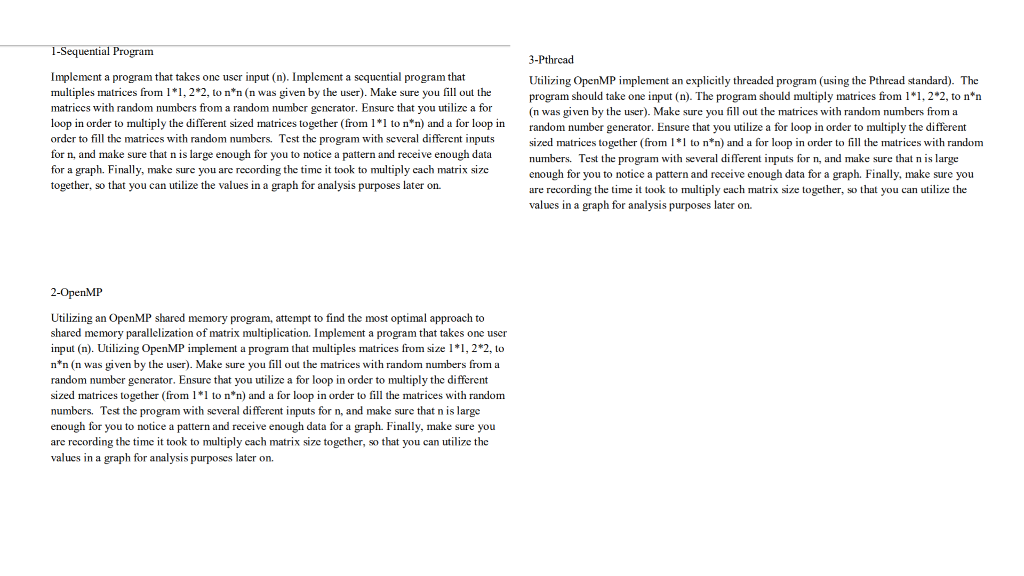
Implement a program that takes one user input (n). Implement a scquential program that multiples matrices from 1*1, 2*2, to nn (n was given by the user). Make sure you ill out the matriccs with random numbcrs from a random numbcr gcncrator. Ensurc that you utilize a for loop in order to multiply the different sized matrices together (from 1*1 to n'n) and a for loop order to fill the matriccs with random numbers. Test the program with several different inputs for n and make sure that n is large enough for you to notice a pattern and receive enough data for a graph. Finally, make sure you are recording the time it took to multiply cach matrix size together, so that you can utilize the values in a graph for analysis purposes later on. Utilizing OpenMP implement an explicitly threaded program (using the Pthread standard). The program should take one input (n). The program should multiply matrices from 1*1, 2*2, to n n (n was given by the user). Make sure you fill out the matrices with random numbers from a n random number generator. Ensure that you utilize a for loop in order to mltiply the different sized matrices together (from to n*n) and a for loop in order to fill the matrices with random numbers. Test the program with several different inputs for n, and make sure that n is large enough for you to notice a pattern and receive enough data for a graph. Finally, make sure you are recording the timeit took to multiply each matrix size together, so that you can utilize the values in a graph for analysis purposes later on. 2-OpenMP Utilizing an OpenMP shared memory program, attempt to find the most optimal approach to shared memory parallelization of matrix multiplication. Implement a program that takes one user input (n). Utilizing OpenMP implement a program that multiples matrices from size 1*1, 2*2, to n'n (n was given by the user). Make sure you fill out the matrices with random numbers from a random number gencrator. Ensure that you utilize a for loop in order to multiply the different sized matrices together (from 1*1 to n*n) and a for loop in order to fill the matrices with random numbers. Test the program with several different inputs for n, and make sure that n is largc enough for you to notice a pattern and receive enough data for a graph. Finally, make sure you are recording the time it took to multiply cach matrix size togcther, so that you can utilize the values in a graph for analysis purposes later on Implement a program that takes one user input (n). Implement a scquential program that multiples matrices from 1*1, 2*2, to nn (n was given by the user). Make sure you ill out the matriccs with random numbcrs from a random numbcr gcncrator. Ensurc that you utilize a for loop in order to multiply the different sized matrices together (from 1*1 to n'n) and a for loop order to fill the matriccs with random numbers. Test the program with several different inputs for n and make sure that n is large enough for you to notice a pattern and receive enough data for a graph. Finally, make sure you are recording the time it took to multiply cach matrix size together, so that you can utilize the values in a graph for analysis purposes later on. Utilizing OpenMP implement an explicitly threaded program (using the Pthread standard). The program should take one input (n). The program should multiply matrices from 1*1, 2*2, to n n (n was given by the user). Make sure you fill out the matrices with random numbers from a n random number generator. Ensure that you utilize a for loop in order to mltiply the different sized matrices together (from to n*n) and a for loop in order to fill the matrices with random numbers. Test the program with several different inputs for n, and make sure that n is large enough for you to notice a pattern and receive enough data for a graph. Finally, make sure you are recording the timeit took to multiply each matrix size together, so that you can utilize the values in a graph for analysis purposes later on. 2-OpenMP Utilizing an OpenMP shared memory program, attempt to find the most optimal approach to shared memory parallelization of matrix multiplication. Implement a program that takes one user input (n). Utilizing OpenMP implement a program that multiples matrices from size 1*1, 2*2, to n'n (n was given by the user). Make sure you fill out the matrices with random numbers from a random number gencrator. Ensure that you utilize a for loop in order to multiply the different sized matrices together (from 1*1 to n*n) and a for loop in order to fill the matrices with random numbers. Test the program with several different inputs for n, and make sure that n is largc enough for you to notice a pattern and receive enough data for a graph. Finally, make sure you are recording the time it took to multiply cach matrix size togcther, so that you can utilize the values in a graph for analysis purposes later on
Step by Step Solution
There are 3 Steps involved in it

Get step-by-step solutions from verified subject matter experts
 Study Help