







Question: COLLABORATION - Team Assignment The collaboration is a student-led discussion on current events in the news relative to the material in the course. Your professor
COLLABORATION - Team Assignment
- The collaboration is a student-led discussion on current events in the news relative to the material in the course.
- Your professor will put you in a team that you will interact with to choose collaboration articles during the class. Groups are found under the People tab (at the top - Collaboration and Study Group Tab). You can email your group from the Inbox Student Group drop-down menu.
- You will choose your own team leader this week. The leader is to initiate an online discussion amongst the members of the team and summarize the article and provide an explanation for the choice of the article and relate it to the materials in the class.
The articles that are posted are to be related to the material covered in the weekly reading with an emphasis based on the topics of the course.
- The team leader will post the article for their FIRST POST.
- For the remaining posts that week you may respond to your Professor's topics.
- You may respond to your own team, other teams, and your professor's posts.
- You must post 3 times with high-quality posts to receive full credit.
- The Collaboration cannot be made up if missed.
That leader is to initiate an online discussion amongst the members of the team and summarize the article and provide an explanation for the choice of the article and relate it to the materials in the class. The article should be posted on Sunday or Monday and the initial responses from team members should be online by Wednesday. The professor will review the responses and post additional thoughts and/or questions. Please note that you are responsible for three quality posts each week. (A quality post is either in agreement or not in agreement with your fellow member's post that includes your supporting reasoning.)
You must post on 3 different days with high-quality posts and the first post on Sunday or Monday if you are the group leader and by Wednesday if you are a group member. Only the first post should be related to the group leader's topic while all other posts should be based on the Professor's topics or other material studied from the ebook that week.

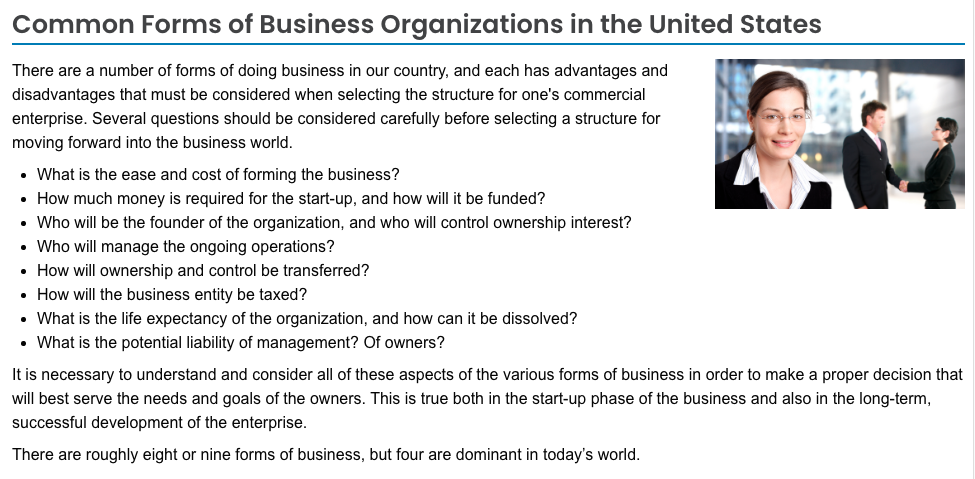
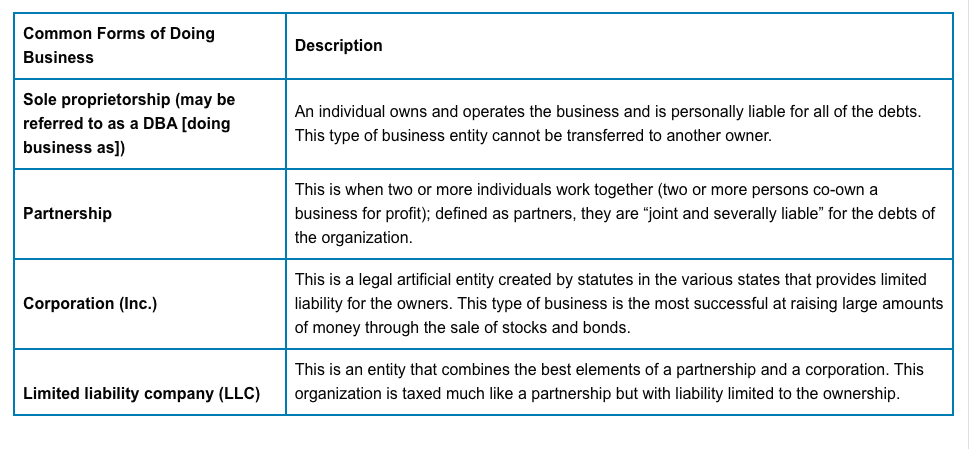
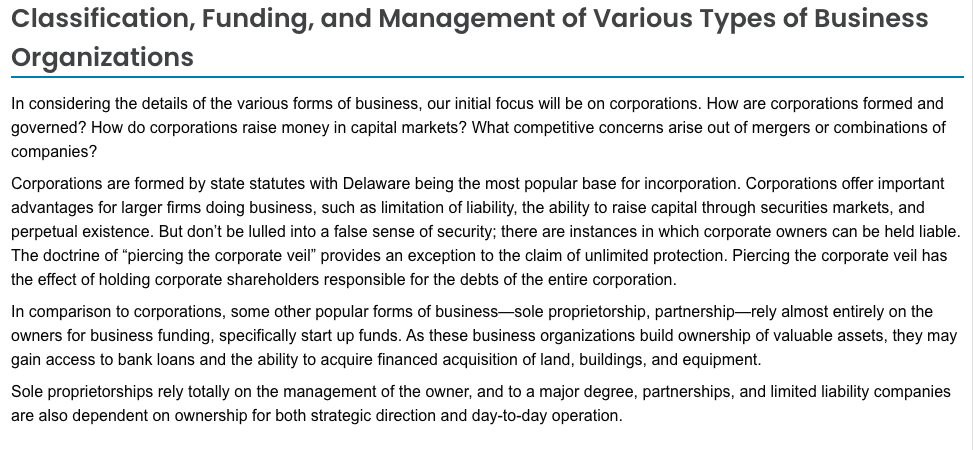
Business Associations and Corporations Introduction This week we begin by reviewing the various legal forms of doing business. Although there are numerous possibilities, four such business forms currently dominate the market. . Sole proprietorship (DBA) . General partnership . Corporation (Inc.) . Limited liability company (LLC) Financing and operation of these various business types differ greatly. We are all familiar with giant publicly traded companies that flourish on the New York Stock Exchange. But many small companies, even corporations, raise significant funds and are factors on the competitive business environment.Common Forms of Business Organizations in the United States There are a number of forms of doing business in our country, and each has advantages and disadvantages that must be considered when selecting the structure for one's commercial enterprise. Several questions should be considered carefully before selecting a structure for moving forward into the business world. . What is the ease and cost of forming the business? . How much money is required for the start-up, and how will it be funded? . Who will be the founder of the organization. and who will control ownership interest? . Who will manage the ongoing operations? . How will ownership and control be transferred? . How will the business entity be taxed? . What is the life expectancy of the organization, and how can it be dissolved? . What is the potential liability of management? Of owners? It is necessary to understand and consider all of these aspects of the various forms of business in order to make a proper decision that will best serve the needs and goals of the owners. This is true both in the start-up phase of the business and also in the long-tenn, successful development of the enterprise. There are roughly eight or nine forms of business, but four are dominant in today's world. Common Forms of Doing Business Sole proprietorship (may be referred to as a DBA [doing business as\" Partnership Corporation (Inc.} Limited liability company {LLC} Description An individual owns and operates the business and is personally liable for all of the debts. This type of business entity cannot be transferred to another owner. This is when two or more individuals work together {Mo or more persons co-own a business for prot}; dened as partners. they are \"joint and severally liable\" for the debts of the organization. This is a legal artificial entity created by statutes in the various states that provides limited liability for the owners. This type of business is the most successful at raising large amounts of money through the sale of stocks and bonds. This is an entity that combines the best elements of a partnership and a corporation. This organization is taxed much like a partnership but with liability limited to the ownership. Classification, Funding. and Management of Various Types of Business Organizations In considering the details of the various forms of business. our initial focus will be on corporations. How are corporations formed and governed? How do corporations raise money in capital markets? What competitive concerns arise outof mergers or combinations of companies? Corporations are formed by state statutes with Delaware being the most popular base for incorporation. Corporations offer important advantages for larger rms doing business, such as limitation of liability. the ability to raise capital through securities markets. and perpetual existence. But don't be lulled into a false sense of security; there are instances in which corporate owners can be held liable. The doctrine of \"piercing the corporate veil" provides an exception to the claim of unlimited protection. Piercing the corporate veil has the effect of holding corporate shareholders responsible for the debts of the entire corporation. In comparison to corporations, some other popular forms of businesssole proprietorship. partnershiprely almost entirely on the owners for business funding. specically start up funds. As these business organizations build ownership of valuable assets, they may gain access to bank loans and the ability to acquire nanced acquisition of land. buildings, and equipment. Sole proprietorships rely totally on the management of the owner. and to a major degree. partnerships. and limited liability companies are also dependent on ownership for both strategic direction and day-to-day operation
Step by Step Solution
There are 3 Steps involved in it

Get step-by-step solutions from verified subject matter experts
 Study Help