







Question: Combinational Logic 1 Overview In the previous labs, we focused on how information can be stored and manipulated using binary numbers, and an aximoatic formal
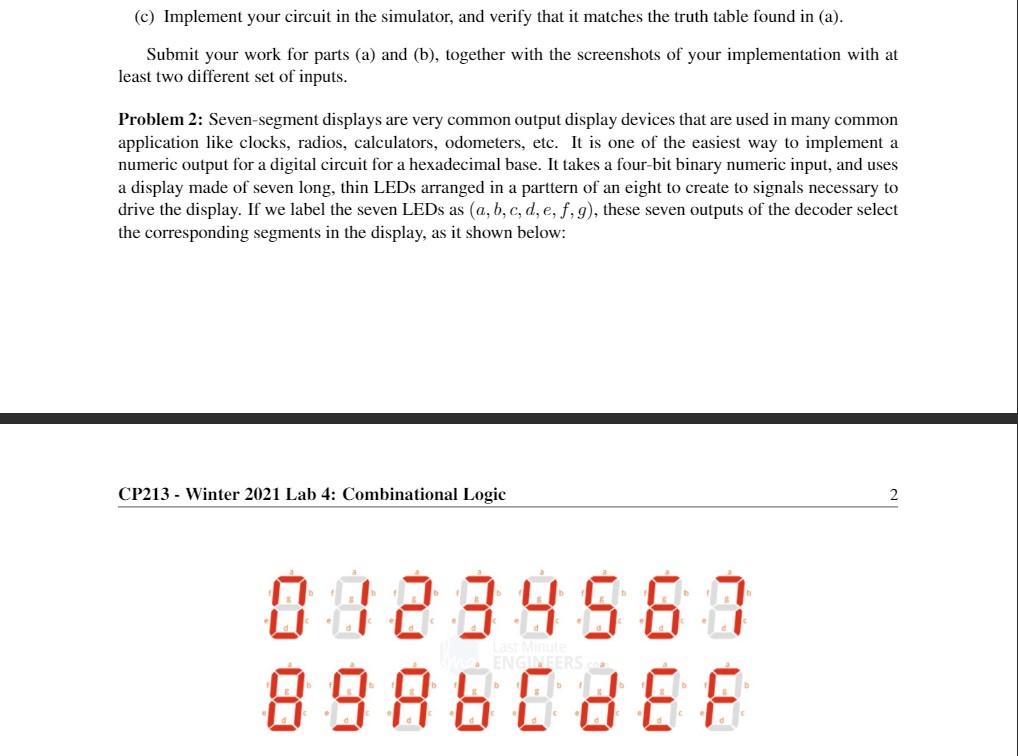
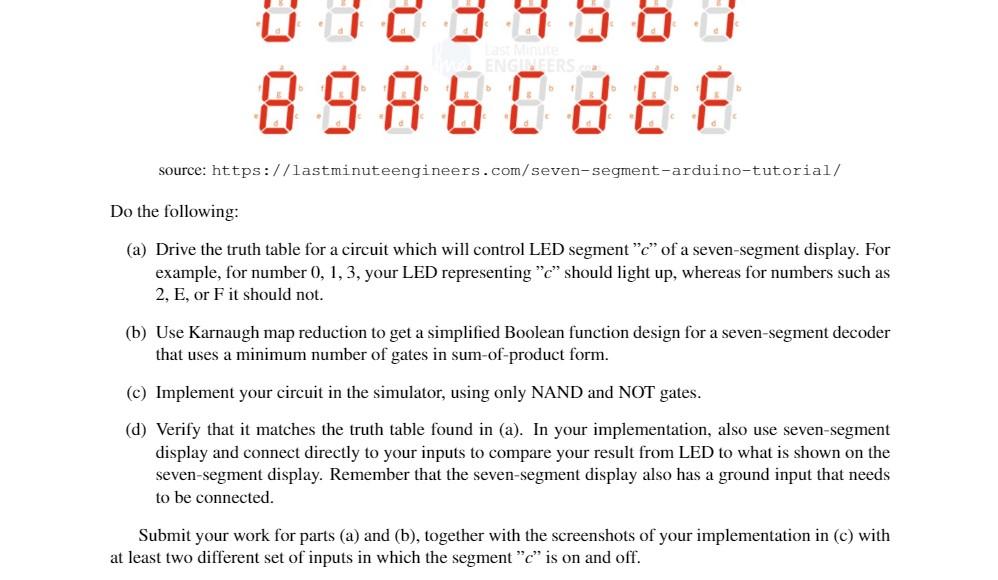
Combinational Logic 1 Overview In the previous labs, we focused on how information can be stored and manipulated using binary numbers, and an aximoatic formal approach to Boolean algebra. We also looked at gate-level implementation of a logic design and its minimization using K-maps. In this lab, we will attempt to apply what is learnt to design of stand-alone circuits or integrated into the circuitry of actual processers. In this lab, we will focus only on circuit designs that use logic gates no feedback paths or memory elements - a combinational circuit. The steps for design and verification of your circuits are: 1. Understand the problem description. 2. Identify the inputs and outputs. 3. Define the truth table accordingly. 4. Get the expression for each output and simplify. 5. Draw the diagram/circuit (if needed) Verify the result manually, or using the simulation. In particular, you will implment combinational circuits for a 3-input majority circuit, and a Hex-to- seven-segment decoder. Reading and related topics: Chapter 4 of the textbook and the lecture notes. 2 Lab Tasks Problem 1: A majority circuit is a combinational circuit whose output is equal to 1 if the input variables have more I's than 0's. The output is 0 otherwise. The goal is to design a 3-input majority circuit. That is, the output of the circuit should be 1, if two or more of the inputs are l's. Do the following: (a) Drive the truth table that represent the desired functionality. (b) Use Karnaugh map reduction to get a simplified Boolean function in sum-of-product form. (c) Implement your circuit in the simulator, and verify that it matches the truth table found in (a). (c) Implement your circuit in the simulator, and verify that it matches the truth table found in (a). Submit your work for parts (a) and (b), together with the screenshots of your implementation with at least two different set of inputs. Problem 2: Seven-segment displays are very common output display devices that are used in many common application like clocks, radios, calculators, odometers, etc. It is one of the easiest way to implement a numeric output for a digital circuit for a hexadecimal base. It takes a four-bit binary numeric input, and uses a display made of seven long, thin LEDs arranged in a parttern of an eight to create to signals necessary to drive the display. If we label the seven LEDs as (a, b, c, d, e, f, g), these seven outputs of the decoder select the corresponding segments in the display, as it shown below: CP213 - Winter 2021 Lab 4: Combinational Logic 2 0 1 2 3 4 5 6 7 89 85 DEF 89 85 DEE source: https://lastminuteengineers.com/seven-segment-arduino-tutorial/ Do the following: (a) Drive the truth table for a circuit which will control LED segment "c" of a seven-segment display. For example, for number 0, 1, 3, your LED representing "c" should light up, whereas for numbers such as 2, E, or F it should not. (b) Use Karnaugh map reduction to get a simplified Boolean function design for a seven-segment decoder that uses a minimum number of gates in sum-of-product form. (c) Implement your circuit in the simulator, using only NAND and NOT gates. (d) Verify that it matches the truth table found in (a). In your implementation, also use seven-segment display and connect directly to your inputs to compare your result from LED to what is shown on the seven-segment display. Remember that the seven-segment display also has a ground input that needs to be connected. Submit your work for parts (a) and (b), together with the screenshots of your implementation in (c) with at least two different set of inputs in which the segment "C" is on and off
Step by Step Solution
There are 3 Steps involved in it

Get step-by-step solutions from verified subject matter experts
 Study Help