



Question: Come with answer, can you show me the step? For b and c. 7.27 Recall the discrete-time Ehrenfest dog-flea model of Example 3.7. In the
Come with answer, can you show me the step?
For b and c.
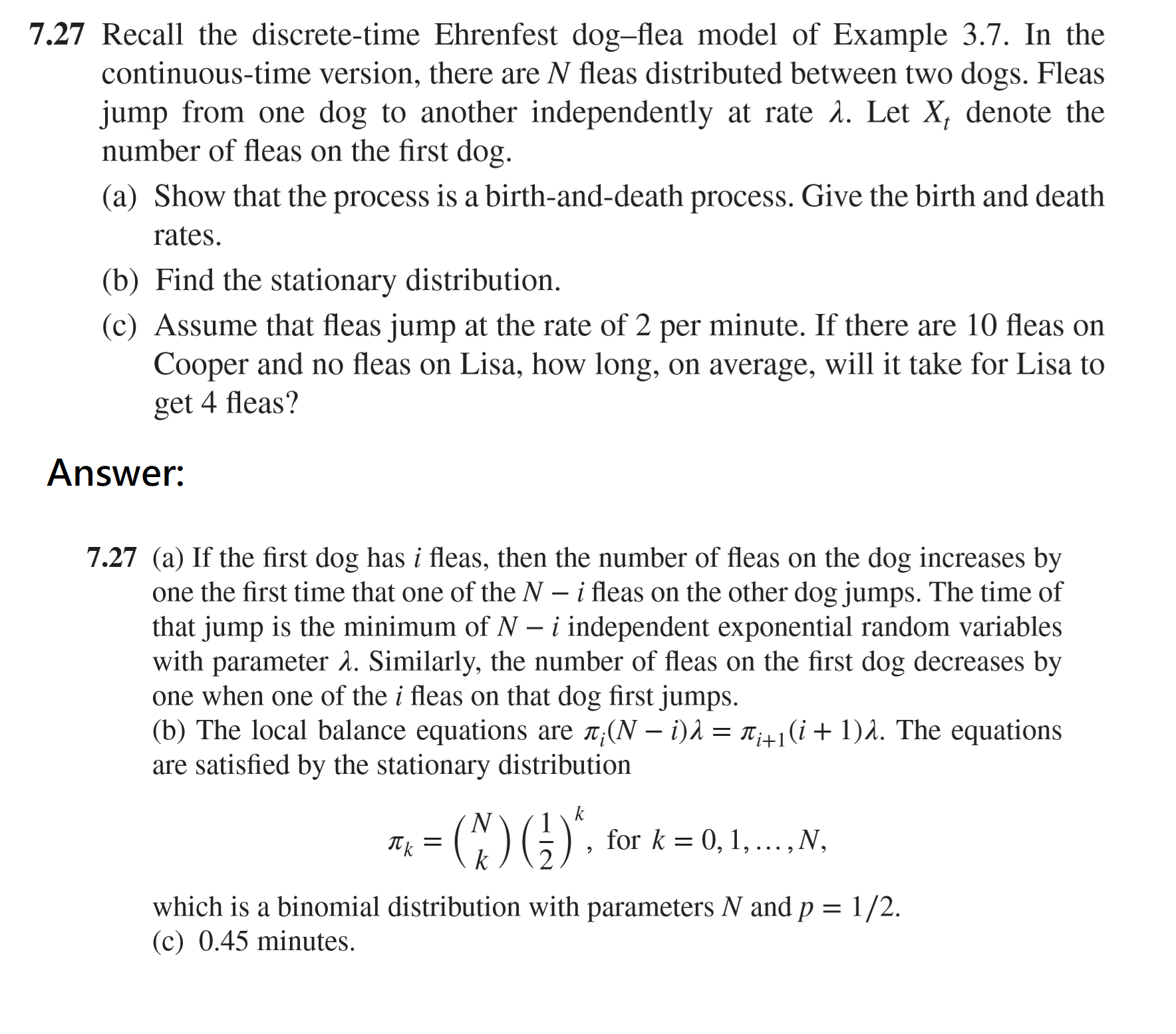
7.27 Recall the discrete-time Ehrenfest dog-flea model of Example 3.7. In the continuous-time version, there are N fleas distributed between two dogs. Fleas jump from one dog to another independently at rate 1. Let X, denote the number of fleas on the first dog. (a) Show that the process is a birth-and-death process. Give the birth and death rates. (b) Find the stationary distribution. (c) Assume that fleas jump at the rate of 2 per minute. If there are 10 fleas on Cooper and no fleas on Lisa, how long, on average, will it take for Lisa to get 4 fleas? Answer: 7.27 (a) If the first dog has i fleas, then the number of fleas on the dog increases by one the first time that one of the N - i fleas on the other dog jumps. The time of that jump is the minimum of N - i independent exponential random variables with parameter 1. Similarly, the number of fleas on the first dog decreases by one when one of the i fleas on that dog first jumps. (b) The local balance equations are n;(N - i)) = nit(i + 1)1. The equations are satisfied by the stationary distribution TK = ( NG) , for k = 0, 1, ..., N, which is a binomial distribution with parameters N and p = 1/2. (c) 0.45 minutes
Step by Step Solution
There are 3 Steps involved in it

Get step-by-step solutions from verified subject matter experts